Grúz Petr, Shimizu Masatomi, Sugiyama Kei-Ichi, Yamada Masami, Honma Masamitsu
1Division of Genetics and Mutagenesis, National Institute of Health Sciences, 3-25-26 Tonomachi, Kawasaki-ku, Kawasaki-shi, Kanagawa 210-9501 Japan.
Division of Medical Nutrition, Faculty of Healthcare, Tokyo Healthcare University, Tokyo, 154-8568 Japan.
Genes Environ. 2020 Mar 24;42:14. doi: 10.1186/s41021-020-00154-2. eCollection 2020.
The standard Ames test strains owe their high sensitivity to chemical and physical mutagens to the episomal Y-family DNA polymerase RI encoded by the operon. The test strains carry also another related operon on a 60-kDa cryptic plasmid. In contrast to the chromosomally encoded Y-family DNA polymerases V and IV, these plasmid born polymerase genes have no direct counterpart in mammalian cells. By replicating damaged templates, DNA polymerases play a central role in mutagenesis and genome stability. It is therefore imperative to investigate their specificity to understand differences in mutagenesis between the prokaryotic versus eukaryotic (mammalian) systems. To this end we have isolated and separately expressed the DNA polymerase subunits encoded by the and operons. After demonstrating how these enzymes control chemical and UV mutagenesis at the standard and Ames test targets, we are now adding the third Ames test target to the trilogy.
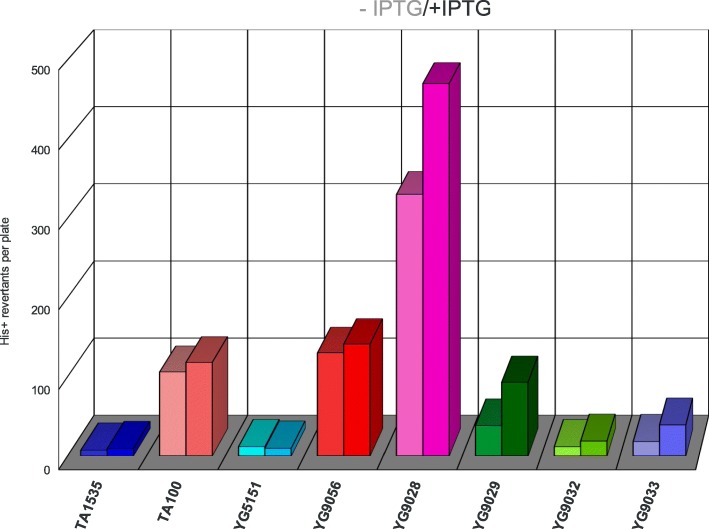
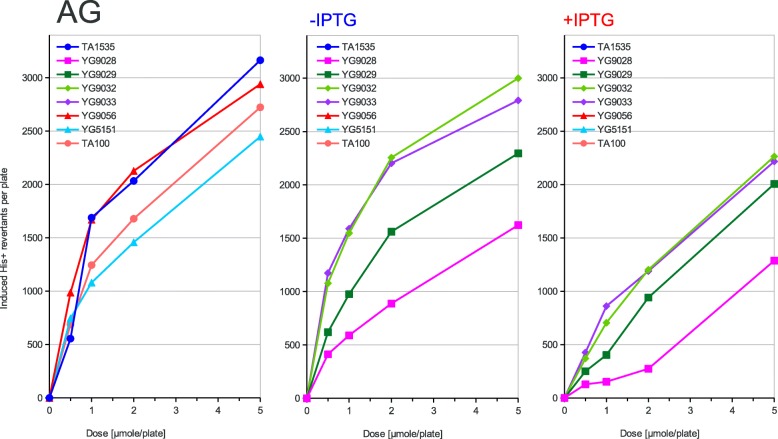
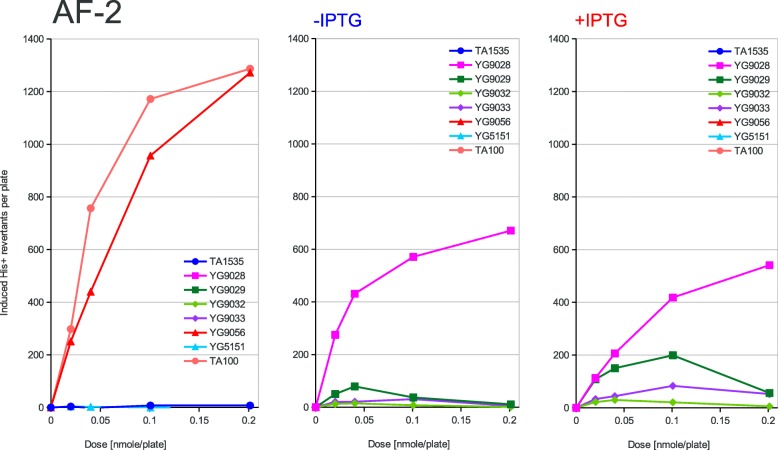
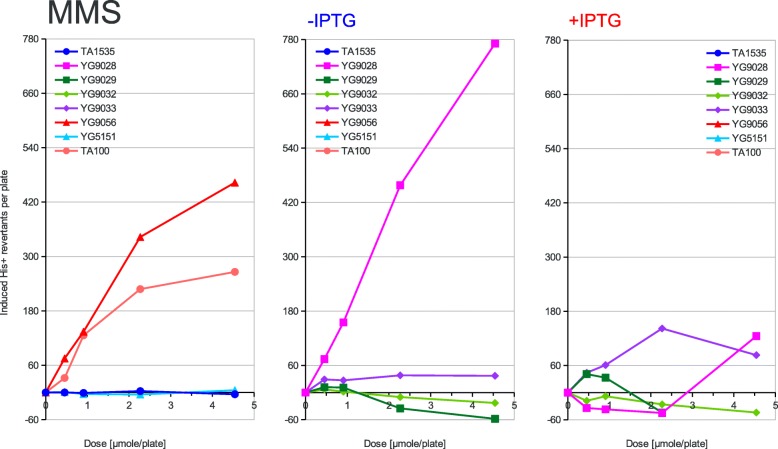
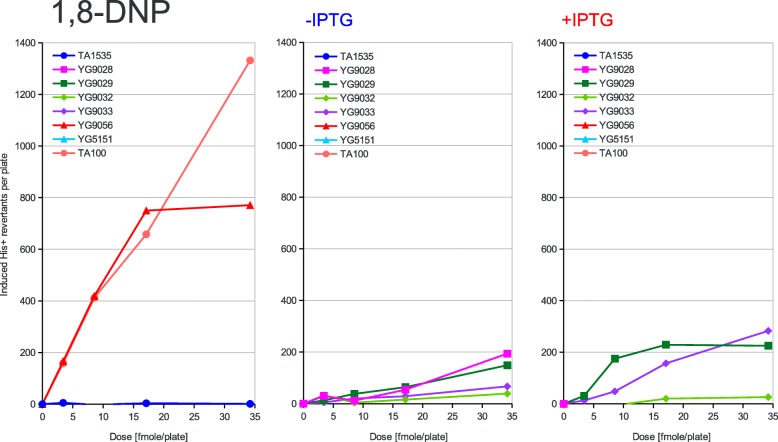
Four new Ames tester strains based on the target have been constructed expressing the activated DNA polymerase MucA' and SamA' accessory subunits combined with the MucB and SamB catalytical subunits under the control of promoter. These polymerase assemblies were substituted for the endogenous PolRI, PolV and SamAB polymerases present in the standard TA100 strain and tested for their abilities to promote chemically induced mutagenesis. SamA' + SamB has been able to promote mutagenesis induced by AF-2 and 1,8-DNP to higher extent than SamA' + MucB. The MucA' + MucB (PolRI*) more efficiently promoted MMS as well as spontaneous mutagenesis than its wild type counterpart but was less efficient for other mutagens including AFB1. Strikingly azide mutagenesis was inhibited by PolRI and also SamA'B.
A new system for SOS-independent overexpression of the activated DNA polymerases RI and SamA'B and their chimeras in the Ames test background has been established and validated with several representative mutagens. Overall, the TA100 strain showed the highest sensitivity towards most tested mutagens. The observed inhibition of azide mutagenesis by PolRI* suggests that this type of Y-family DNA polymerases can perform also "corrective" replication on a damaged DNA.
标准的艾姆斯试验菌株对化学和物理诱变剂具有高敏感性,这归因于由该操纵子编码的附加体Y家族DNA聚合酶RI。这些试验菌株在一个60 kDa的隐蔽质粒上还携带另一个相关的操纵子。与染色体编码的Y家族DNA聚合酶V和IV不同,这些质粒携带的聚合酶基因在哺乳动物细胞中没有直接对应的基因。通过复制受损模板,DNA聚合酶在诱变和基因组稳定性中发挥核心作用。因此,研究它们的特异性对于理解原核生物与真核生物(哺乳动物)系统之间诱变的差异至关重要。为此,我们分离并分别表达了由该操纵子和另一个操纵子编码的DNA聚合酶亚基。在证明了这些酶如何在标准的和艾姆斯试验靶点处控制化学和紫外线诱变之后,我们现在将第三个艾姆斯试验靶点添加到这个三部曲中。
基于该靶点构建了四种新的艾姆斯试验菌株,它们在启动子的控制下表达活化的DNA聚合酶MucA'和SamA'辅助亚基以及MucB和SamB催化亚基。这些聚合酶组合替代了标准TA100菌株中存在的内源性PolRI、PolV和SamAB聚合酶,并测试了它们促进化学诱导诱变的能力。SamA'+SamB比SamA'+MucB更能促进由AF-2和1,8-二硝基苯酚诱导的诱变。MucA'+MucB(PolRI*)比其野生型对应物更有效地促进了甲基磺酸甲酯以及自发诱变,但对包括黄曲霉毒素B1在内的其他诱变剂效率较低。引人注目的是,叠氮化物诱变受到PolRI以及SamA'B的抑制。
在艾姆斯试验背景下,已经建立并验证了一种用于独立于SOS过表达活化的DNA聚合酶RI和SamA'B及其嵌合体的新系统,并使用了几种代表性诱变剂进行验证。总体而言,TA100菌株对大多数测试诱变剂表现出最高的敏感性。PolRI*对叠氮化物诱变的抑制作用表明,这种类型的Y家族DNA聚合酶也可以在受损DNA上进行“校正”复制。