Warwick Hunter, O'Donnell Jonathan, Mather Richard C, Jiranek William
Department of Orthopaedic Surgery, Duke University Medical Center, Durham, NC, USA.
Arthroplast Today. 2020 Jan 8;6(1):81-87. doi: 10.1016/j.artd.2019.11.008. eCollection 2020 Mar.
Recent evidence describes which interventions are driving insurance payments in the management of osteoarthritis (OA) before total knee arthroplasty (TKA); however, relatively little is known about how these costs are distributed among patients.
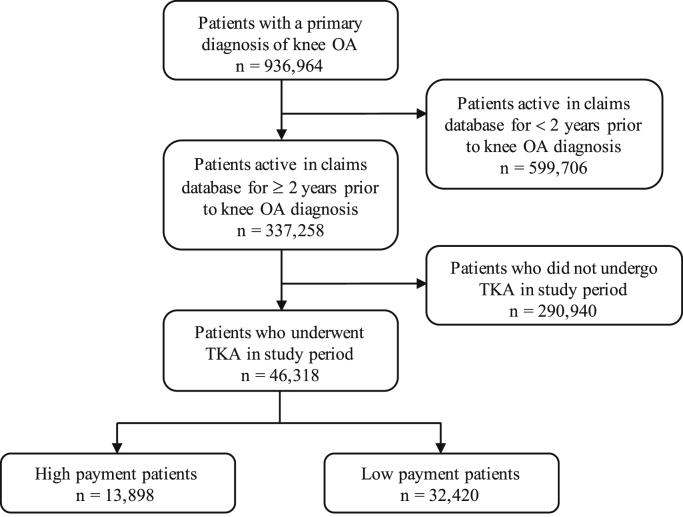
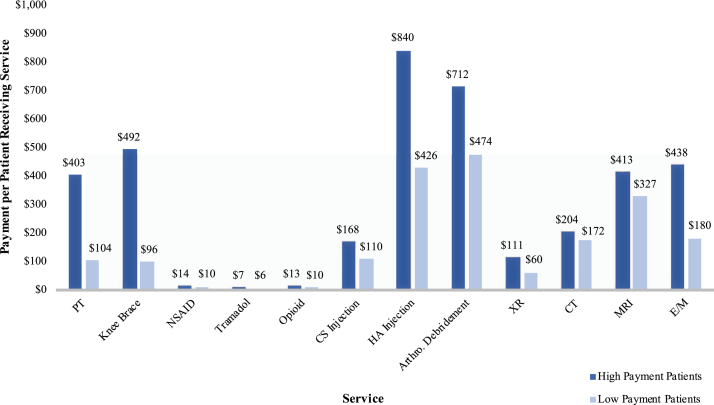
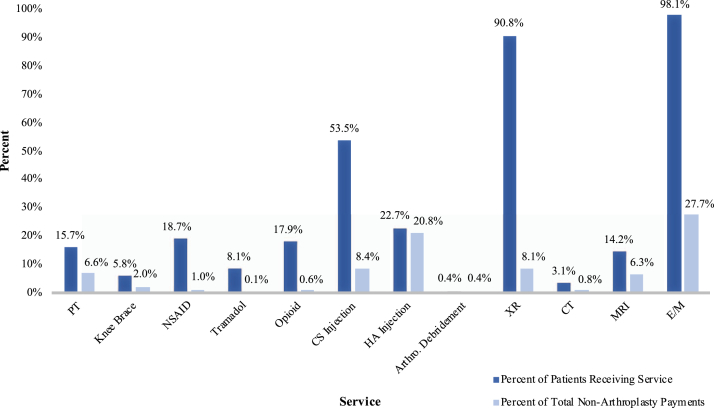
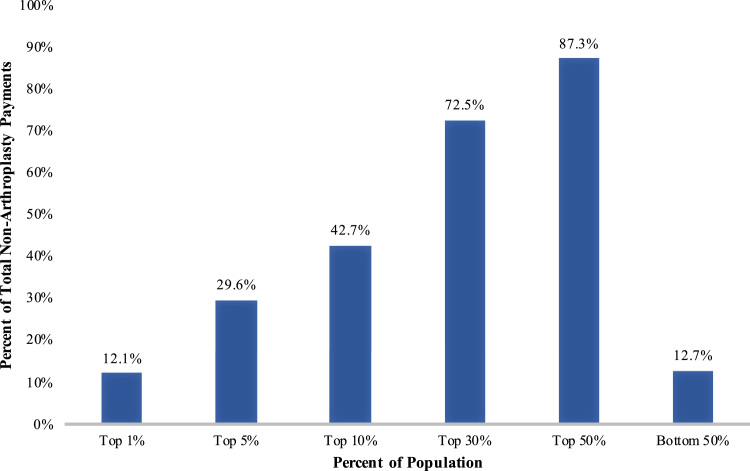
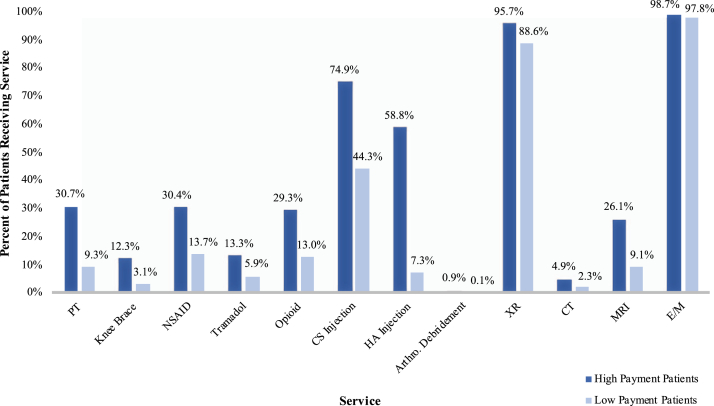
We reviewed the Humana claims database for patients who underwent primary TKA from 2009 to 2016. Insurance payments for treatment, imaging, and evaluation and management were calculated from OA diagnosis to TKA, the distribution of payments was determined, and a high-payment group was identified by determining the point at which patients began to account for a disproportionate percentage of payments. This group of high-payment patients was compared with remaining patients (low-payment patients) based on demographic factors and nonarthroplasty payments and utilization.
The top 30% of patients accounted for more than 70% of nonarthroplasty payments. High-payment patients were more likely to be younger, female, and more comorbid. Median time from diagnosis to TKA for high-payment patients was 3 times longer than that for low-payment patients (654 days [320-1191] vs 204 days [68-582], < .001), and median payment per patient was more than 5 times higher ($1891 [1405-2782] vs $362 [198-613], < .001).
Identification of high-payment patients in the management of knee OA may allow for targeted care pathways and cost-reduction strategies in the nonarthroplasty period, although additional studies are necessary to further characterize this population and efficiently recognize appropriate TKA candidates and timing.
近期证据表明了在全膝关节置换术(TKA)前骨关节炎(OA)管理中哪些干预措施推动了保险支付;然而,对于这些费用在患者之间如何分配却知之甚少。
我们回顾了2009年至2016年接受初次TKA患者的Humana索赔数据库。计算从OA诊断到TKA期间的治疗、影像检查以及评估和管理的保险支付,确定支付分布,并通过确定患者开始占支付比例过高的点来识别高支付组。根据人口统计学因素、非关节置换术支付和使用情况,将这组高支付患者与其余患者(低支付患者)进行比较。
前30%的患者占非关节置换术支付的70%以上。高支付患者更可能年轻、为女性且合并症更多。高支付患者从诊断到TKA的中位时间比低支付患者长3倍(654天[320 - 1191]对204天[68 - 582],< 0.001),每位患者的中位支付高出5倍多(1891美元[1405 - 2782]对362美元[198 - 613],< 0.001)。
识别膝关节OA管理中的高支付患者可能有助于在非关节置换术期间制定有针对性的护理路径和成本降低策略,尽管需要进一步研究以进一步描述该人群,并有效识别合适的TKA候选者和时机。