Department of Gastroenterology and Hepatology, Erasmus MC University Medical Centre, Rotterdam, The Netherlands.
United European Gastroenterol J. 2020 Apr;8(3):293-302. doi: 10.1177/2050640619890732. Epub 2019 Dec 19.
Many countries use faecal immunochemical testing (FIT) to screen for colorectal cancer. There is increasing evidence that faecal microbiota play a crucial role in colorectal cancer carcinogenesis. We assessed the possibility of measuring faecal microbial features in FIT as potential future biomarkers in colorectal cancer screening.
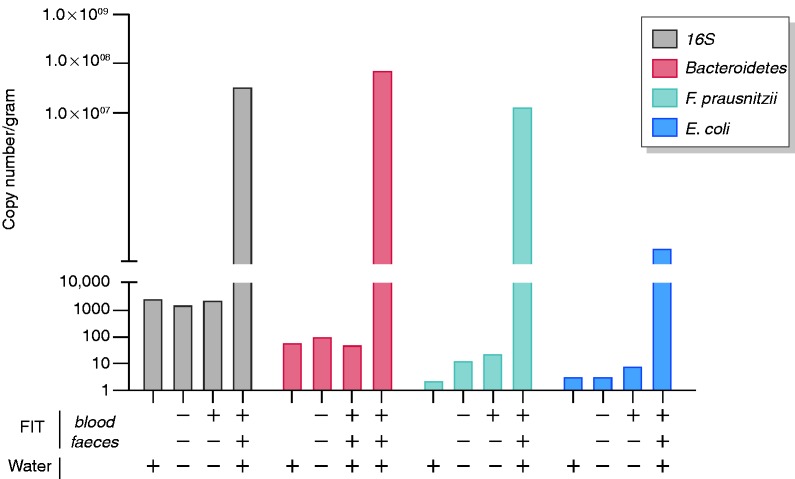
Bacterial stability over time and the possibility of bacterial contamination were evaluated using quantitative polymerase chain reaction analysis. Positive FIT samples ( = 200) of an average-risk screening cohort were subsequently analysed for universal 16S, and bacteria (), (), and () by qPCR. The results were compared with colonoscopy findings.
Faecal microbiota in FIT were stably measured up to six days for ( = 0.53), ( = 0.30), (p = 0.05) and ( = 0.62). Overall presence of bacterial contamination in FIT controls was low. Total bacterial load (i.e. 16S) was significantly higher in patients with colorectal cancer and high-grade dysplasia ( = 0.006). For the individual bacteria tested, no association was found with colonic lesions.
These results show that the faecal microbial content can be measured in FIT samples and remains stable for six days. Total bacterial load was higher in colorectal cancer and high-grade dysplasia. These results pave the way for further research to determine the potential role of microbiota assessment in FIT screening.
许多国家使用粪便免疫化学检测(FIT)筛查结直肠癌。越来越多的证据表明,粪便微生物群在结直肠癌的发生中起着至关重要的作用。我们评估了在 FIT 中测量粪便微生物特征作为结直肠癌筛查潜在未来生物标志物的可能性。
使用定量聚合酶链反应分析评估粪便中细菌随时间的稳定性和细菌污染的可能性。随后对平均风险筛查队列中的阳性 FIT 样本( = 200)进行了通用 16S 分析,并通过 qPCR 分析了细菌()、()、()和 ()。将结果与结肠镜检查结果进行比较。
FIT 中的粪便微生物在六天内稳定测量,( = 0.53)、 ( = 0.30)、 (p = 0.05)和 ( = 0.62)。FIT 对照中总体细菌污染的存在率较低。结直肠癌和高级别异型增生患者的总细菌负荷(即 16S)明显更高( = 0.006)。对于测试的单个细菌,与结肠病变没有关联。
这些结果表明,粪便微生物含量可在 FIT 样本中测量,并且在六天内保持稳定。结直肠癌和高级别异型增生患者的总细菌负荷更高。这些结果为进一步研究确定微生物评估在 FIT 筛查中的潜在作用铺平了道路。