Karaküçük-İyidoğan A, Aydınöz B, Taşkın-Tok T, Oruç-Emre E E, Balzarini J
1Department of Chemistry, Gaziantep University, 27310 Gaziantep, Turkey.
2Laboratory of Virology and Chemotherapy, Rega Institute for Medical Research, KU Leuven, 3000 Leuven, Belgium.
Pharm Chem J. 2019;53(2):139-149. doi: 10.1007/s11094-019-01968-3. Epub 2019 May 15.
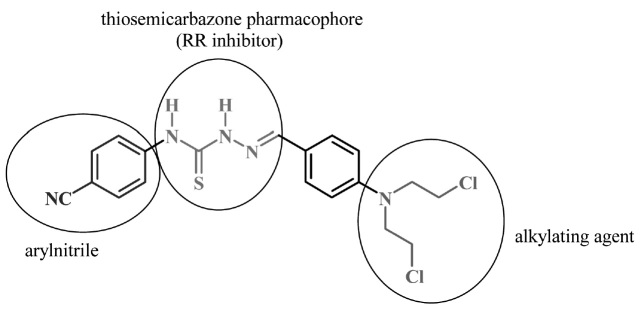
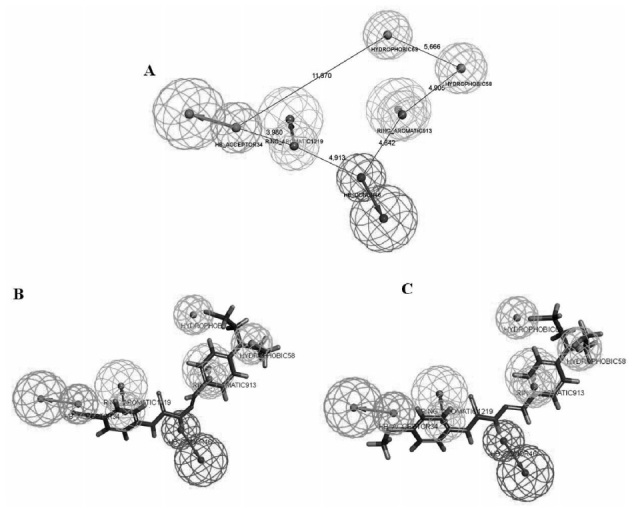
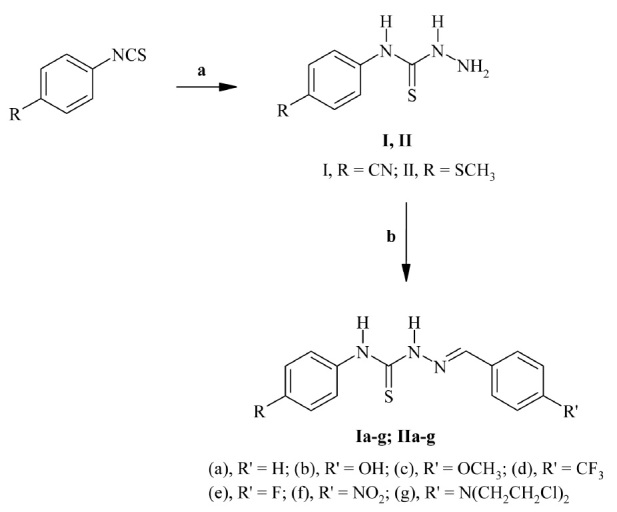
Two series of new aromatic thiosemicarbazone derivatives were synthesized by condensation of -(4-cyanophenyl)hydrazine carbothioamide () and -(4-methylsulfanylphenyl)hydrazine carbothioamide () with appropriate aromatic aldehydes in order to investigate their antiviral and cytostatic potency. The chemical structures of all compounds were fully characterized by elemental analysis and spectroscopic techniques. The results of the bioassays indicated that compounds , , and proved inhibitory against influenza virus A (EC = 13 - 27 μg/mL for strain H1N1 and 9.3 - 18 μg/mL for strain H3N2). Compounds and were the most cytostatic compounds with inhibition of HeLa cell proliferation at an IC = 0.3 μg/mL for and 1.9 μg/mL for . Especially, compound showed the highest cytostatic activity with IC of 0.30, 0.70 and 2.50 μg/mL against HeLa, CEM and L1210 cell lines, respectively. This inhibition range was within the same order of magnitude as that for cisplatin. Furthermore, molecular modeling was carried out to examine the cytostatic activity and determine the best pharmacophore model as a guide for the design and development of potential prodrugs in future studies.
通过将-(4-氰基苯基)肼基硫代甲酰胺()和-(4-甲硫基苯基)肼基硫代甲酰胺()与合适的芳香醛缩合,合成了两个系列的新型芳香硫代半卡巴腙衍生物,以研究它们的抗病毒和细胞抑制活性。所有化合物的化学结构均通过元素分析和光谱技术进行了全面表征。生物测定结果表明,化合物、、和对甲型流感病毒具有抑制作用(H1N1毒株的EC = 13 - 27 μg/mL,H3N2毒株的EC = 9.3 - 18 μg/mL)。化合物和是最具细胞抑制作用的化合物,对HeLa细胞增殖的抑制作用在IC = 0.3 μg/mL()和1.9 μg/mL()时表现出来。特别是,化合物对HeLa、CEM和L1210细胞系的细胞抑制活性最高,IC分别为0.30、0.70和2.50 μg/mL。该抑制范围与顺铂的抑制范围在同一数量级内。此外,进行了分子建模以研究细胞抑制活性,并确定最佳药效团模型,为未来潜在前药的设计和开发提供指导。