Fazilat-Panah Danial, Vakili Ahrari Roudi Somaye, Keramati Alireza, Fanipakdel Azar, Sadeghian Mohammad Hadi, Homaei Shandiz Fatemeh, Shahidsales Soodabeh, Javadinia Seyed Alireza
Cancer Research Center, Babol University of Medical Sciences, Babol, Iran.
Department of Pathology, Student Research Committee, Mashhad University of Medical Sciences, Mashhad, Iran.
Iran J Pathol. 2020 Spring;15(2):117-126. doi: 10.30699/ijp.2020.116238.2261. Epub 2020 Feb 19.
BACKGROUND & OBJECTIVE: Prediction of response to neoadjuvant treatment is an important part of treatment of patients with breast cancer. This study aimed to assess changes in serum levels of Cytokeratin 18 during neoadjuvant chemotherapy in patients with locally advanced breast cancer and its association with neoadjuvant treatments.
This research was performed on newly diagnosed breast cancer patients referred to Omid Radiotherapy Center and radiotherapy and oncology departments of Emam Reza and Ghaem hospitals, in Mashhad, Iran. Serum levels of M30 and M65 fragments of Cytokeratin 18 were measured before and 24 hours after the first course of neoadjuvant chemotherapy. Changes in serum levels of Cytokeratin 18 and its fragments and their correlation with pathologic response were analyzed.
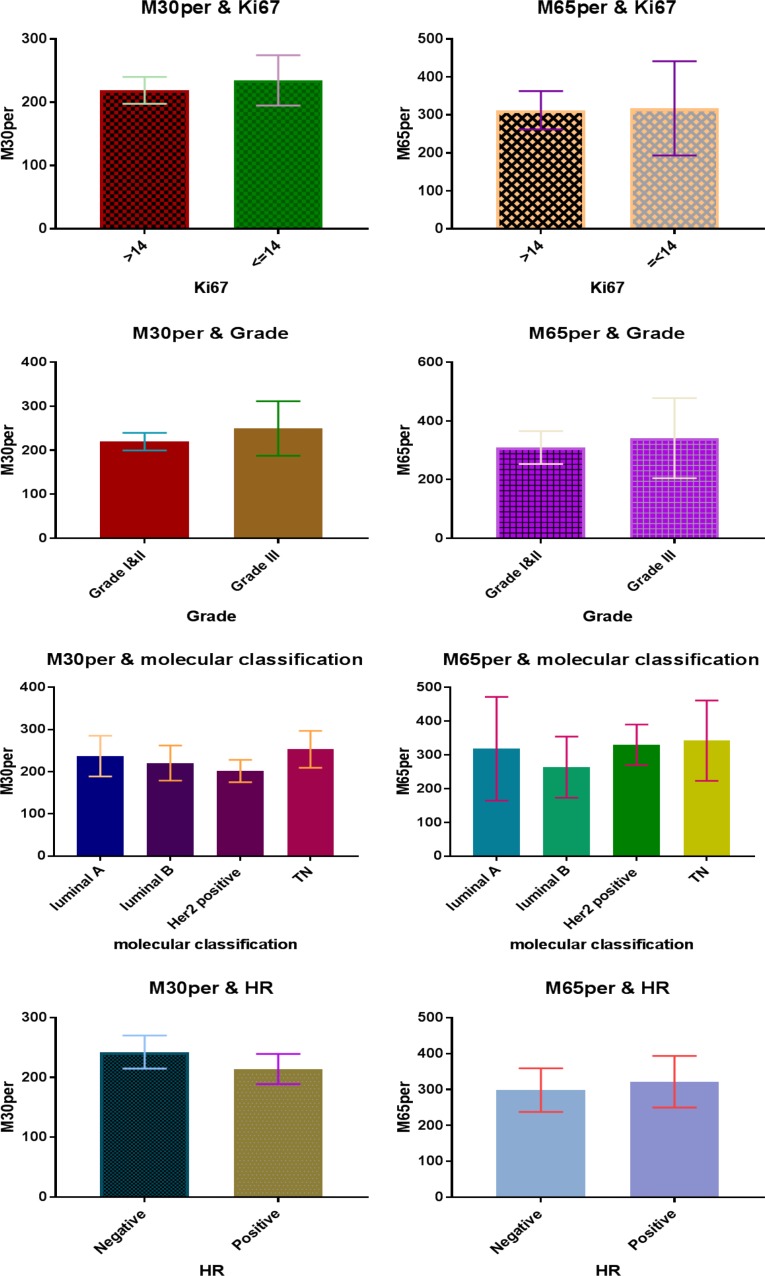
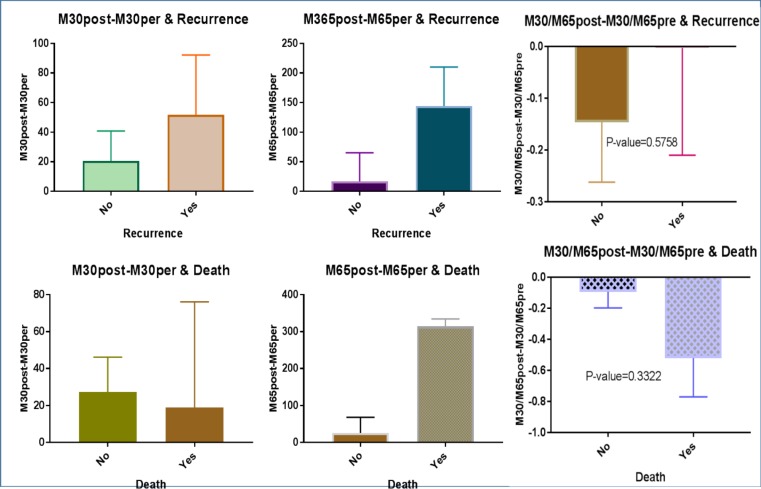
Pre- and post-chemotherapy levels of M30 were respectively 223.9±18.94 and 250.7±23.92 U/L (=0.24). For M65, these levels were respectively 301.5±313.9 and 330.2±352.2 U/L (=0.1). Changes in M30 level during chemotherapy in patients with and without pathologic complete response were -20±92.69 and 43.1±106.5, respectively (=0.1). For M65, these changes were respectively -247±55 and 76±240 (=0.1). Baseline levels of M30 and M65 had no relation with menopausal status, tumor grade, hormone receptor status, Ki67 expression, molecular subtype, and stage.
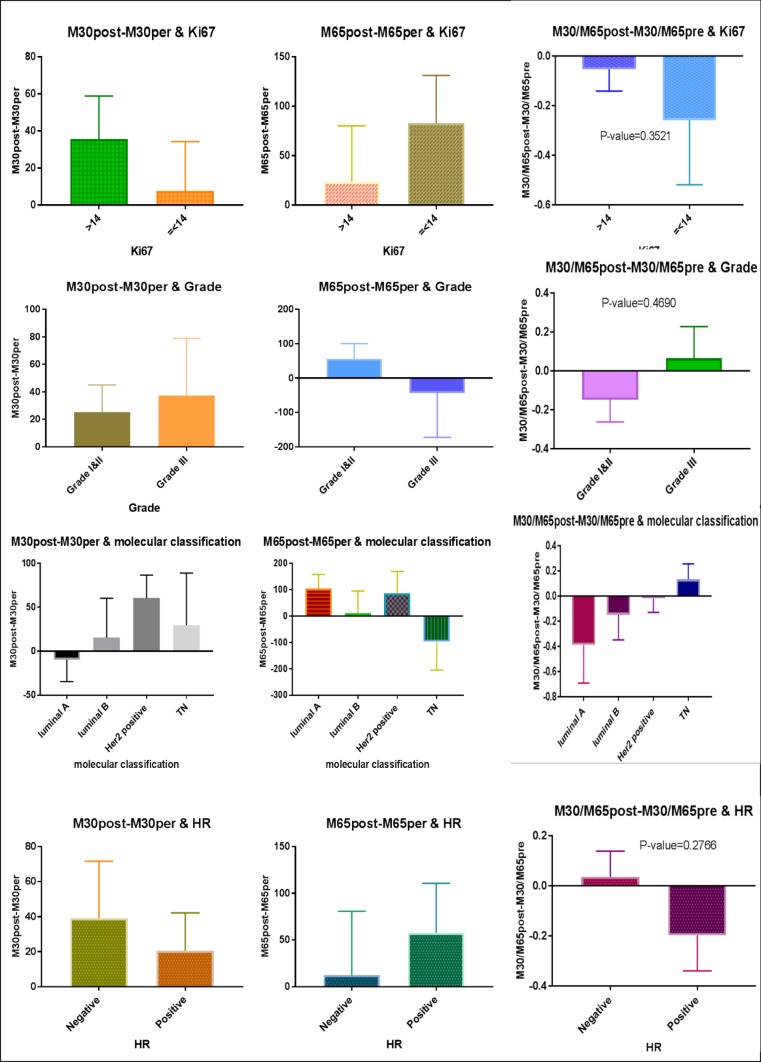
Our findings showed statistically insignificant changes in the level of Caspase-cleaved- (M30) and uncleaved- (M65) cytokeratin 18 fragments (apoptotic and necrotic indicators, respectively) during neoadjuvant chemotherapy in patients with breast cancer. There was no notable relationship between tumor-related factors and either baseline levels or serum changes of CK18 fragments. Also, there was no correlation between M30/M65 level and pathologic response to neoadjuvant chemotherapy.
预测新辅助治疗的反应是乳腺癌患者治疗的重要组成部分。本研究旨在评估局部晚期乳腺癌患者新辅助化疗期间细胞角蛋白18血清水平的变化及其与新辅助治疗的相关性。
本研究对转诊至伊朗马什哈德奥米德放疗中心以及伊玛目礼萨医院和加姆医院放疗与肿瘤科的新诊断乳腺癌患者进行。在新辅助化疗第一疗程前及疗程后24小时测量细胞角蛋白18的M30和M65片段的血清水平。分析细胞角蛋白18及其片段血清水平的变化及其与病理反应的相关性。
化疗前和化疗后M30水平分别为223.9±18.94和250.7±23.92 U/L(P=0.24)。对于M65,这些水平分别为301.5±313.9和330.2±352.2 U/L(P=0.1)。有和没有病理完全缓解的患者化疗期间M30水平变化分别为-20±92.69和43.1±106.5(P=0.1)。对于M65,这些变化分别为-247±55和76±240(P=0.1)。M30和M65的基线水平与绝经状态、肿瘤分级、激素受体状态、Ki67表达、分子亚型和分期无关。
我们的研究结果显示,乳腺癌患者新辅助化疗期间,半胱天冬酶切割的(M30)和未切割的(M65)细胞角蛋白18片段(分别为凋亡和坏死指标)水平变化在统计学上无显著意义。肿瘤相关因素与CK18片段的基线水平或血清变化之间没有显著关系。此外,M30/M65水平与新辅助化疗的病理反应之间没有相关性。