Wang Dong-Xiao, Huang Zheng, Li Qing-Jie, Zhong Guo-Qiang, He Yan, Huang Wei-Qiang, Cao Xiao-Li, Tu Rong-Hui, Meng Jian-Jun
MD, Department of Cardiology, First Affiliated Hospital, Guang Xi Medical University, China. Manuscript preparation and writing.
PhD, Department of Cardiology, First Affiliated Hospital, Guang Xi Medical University, China. Acquisition of data, manuscript preparation and writing.
Acta Cir Bras. 2020 Mar 20;35(1):e202000105. doi: 10.1590/s0102-865020200010000005. eCollection 2020.
To investigate whether heat shock protein 90 (HSP90) is involved in complement regulation in ischemic postconditioning (IPC).
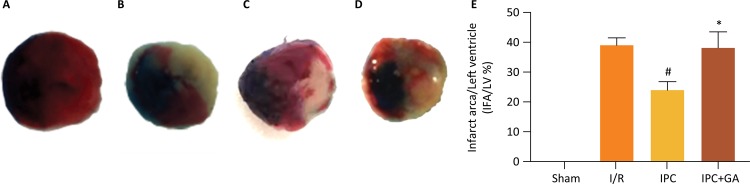
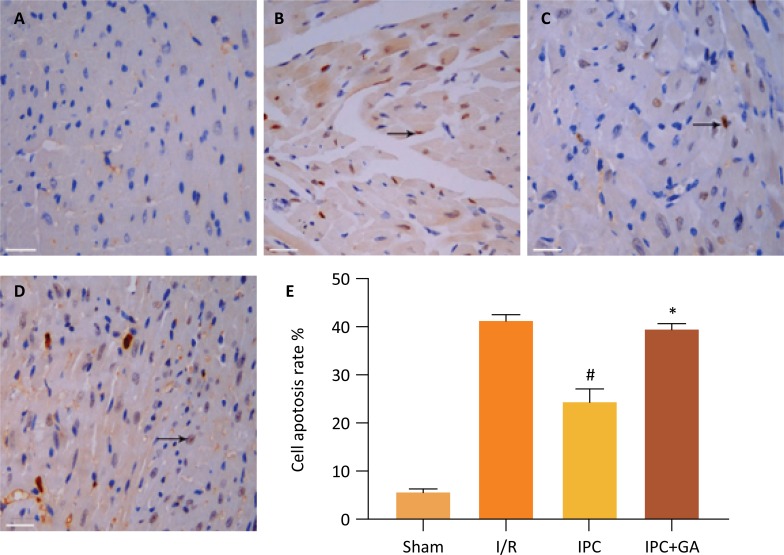
The left coronary artery of rats underwent 30 min of occlusion, followed by 120 min of reperfusion and treatment with IPC via 3 cycles of 30s reperfusion and 30s occlusion. The rats were injected intraperitoneally with 1 mg/kg HSP90 inhibitor geldanamycin (GA) after anesthesia. Eighty rats were randomly divided into four groups: sham, ischemia-reperfusion (I/R), IPC and IPC + GA. Myocardial infarct size, apoptosis index and the expression of HSP90, C3, C5a, tumor necrosis factor (TNF)-alpha, interleukin (IL)-1β and c-Jun N-terminal kinase (JNK) were assessed.
Compared with the I/R injury, the IPC treatment significantly reduced infarct size, release of troponin T, creatine kinase-MB, and lactate dehydrogenase, and cardiomyocyte apoptosis. These beneficial effects were accompanied by a decrease in TNF-α, IL-1β, C3, C5a and JNK expression levels. However, all these effects were abrogated by administration of the HSP90 inhibitor GA.
HSP90 exerts a profound effect on IPC cardioprotection, and may be linked to the inhibition of the complement system and JNK, ultimately attenuating I/R-induced myocardial injury and apoptosis.
研究热休克蛋白90(HSP90)是否参与缺血后适应(IPC)中的补体调节。
大鼠左冠状动脉闭塞30分钟,随后再灌注120分钟,并通过3个周期的30秒再灌注和30秒闭塞进行IPC处理。麻醉后,大鼠腹腔注射1mg/kg的HSP90抑制剂格尔德霉素(GA)。80只大鼠随机分为四组:假手术组、缺血再灌注(I/R)组、IPC组和IPC + GA组。评估心肌梗死面积、凋亡指数以及HSP90、C3、C5a、肿瘤坏死因子(TNF)-α、白细胞介素(IL)-1β和c-Jun氨基末端激酶(JNK)的表达。
与I/R损伤相比,IPC处理显著减小梗死面积,降低肌钙蛋白T、肌酸激酶-MB和乳酸脱氢酶的释放以及心肌细胞凋亡。这些有益作用伴随着TNF-α、IL-1β、C3、C5a和JNK表达水平的降低。然而,给予HSP90抑制剂GA消除了所有这些作用。
HSP90对IPC心脏保护发挥着深远作用,可能与补体系统和JNK的抑制有关,最终减轻I/R诱导的心肌损伤和凋亡。