Jazz Pharmaceuticals, Palo Alto, California, USA.
Division of Pediatric Pulmonology and Sleep Medicine, Rainbow Babies & Children's Hospital, Cleveland, Ohio, USA.
Clin Transl Sci. 2020 Sep;13(5):932-940. doi: 10.1111/cts.12780. Epub 2020 Apr 18.
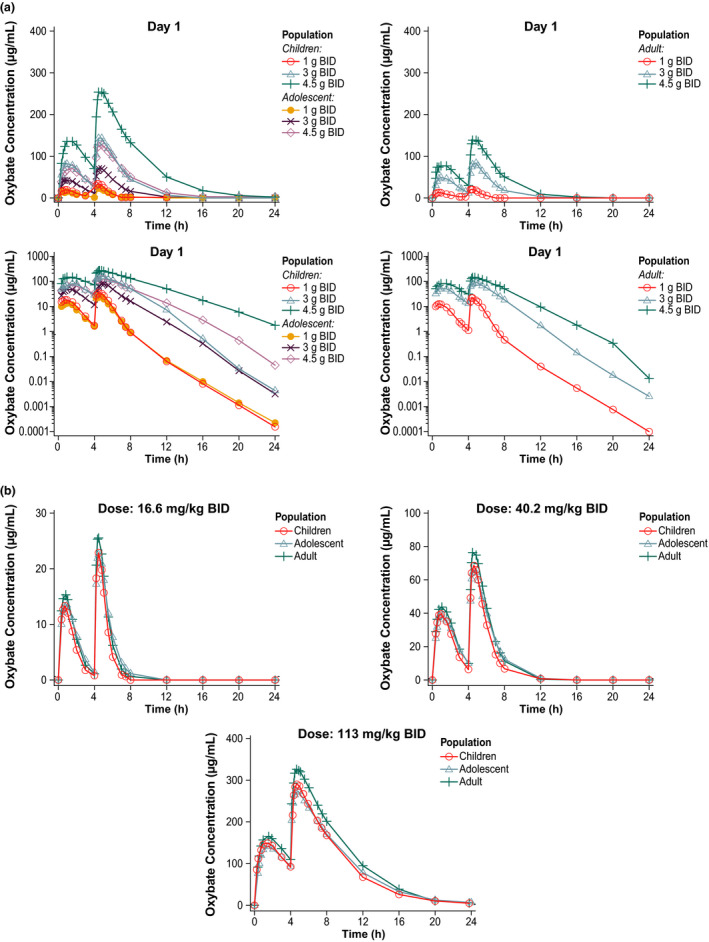
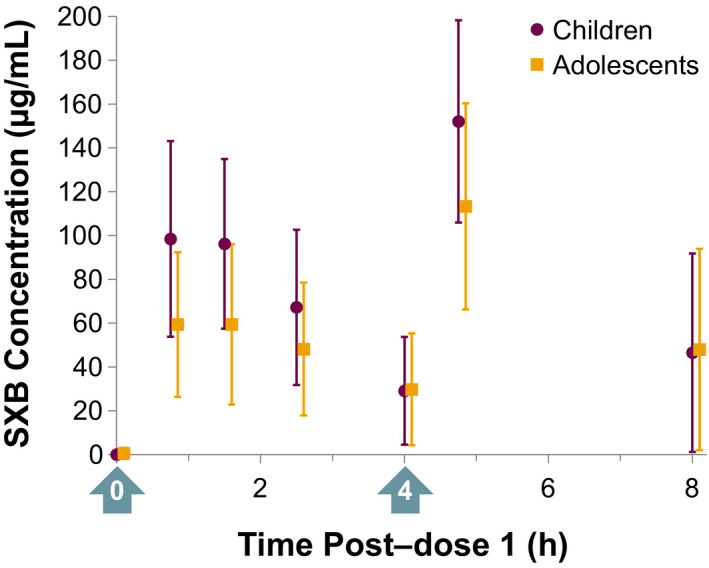
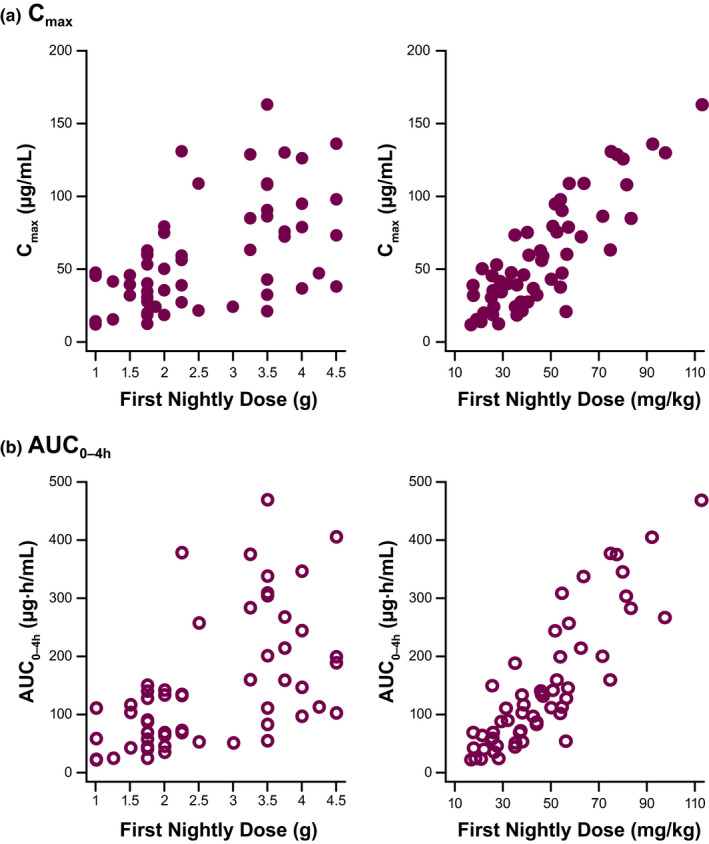
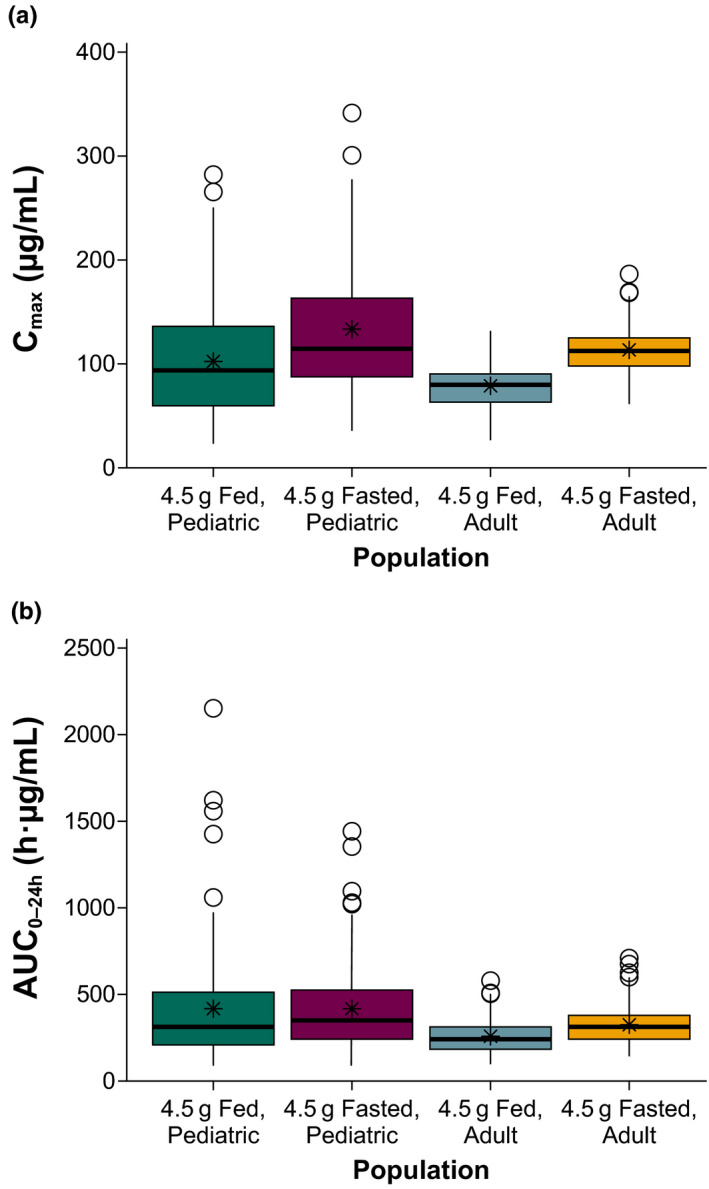
The pharmacokinetics (PKs) of sodium oxybate (SXB) was evaluated in a subset of participants from a study of SXB treatment in children (aged 7-11 years; n = 11) and adolescents (aged 12-17 years; n = 18) with narcolepsy with cataplexy. PK evaluation was conducted over 2 nights during the period when participants received a stable nightly SXB dose. The SXB dose on night 1 was half of night 2 and was administered in two equally divided doses: dose 1 was administered > 2 hours after the evening meal, and dose 2 was administered ≥ 4 hours after dose 1. Noncompartmental PK analysis demonstrated higher plasma concentrations post-dose 2 vs. post-dose 1, higher than dose-proportional increases in area under the concentration-time curve from 0 to 4 hours (AUC ) after dose 1, indicating nonlinear clearance, and better correlation between exposure and mg/kg than exposure and gram dose. To confirm the noncompartmental findings, identify factors affecting SXB PK, and compare with prior results in adults, a population PK (PopPK) model was established combining PK data from the current study with prior data from adults (132 healthy volunteers and 13 with narcolepsy). A two-compartment PopPK model with first-order absorption and nonlinear clearance from the central compartment described the data well. PopPK identified weight as the main intrinsic factor and food as the main extrinsic factor affecting SXB PK, and predicts similar PK profiles on a mg/kg basis across ages. These results, along with previously reported efficacy and safety outcomes, support weight-based SXB dose initiation in pediatric patients.
奥沙西泮(SXB)的药代动力学(PKs)在一项奥沙西泮治疗儿童(7-11 岁;n=11)和青少年(12-17 岁;n=18)发作性睡病伴猝倒症研究的参与者亚组中进行了评估。PK 评估在参与者接受稳定的每晚 SXB 剂量的期间进行了 2 个晚上。第 1 晚的 SXB 剂量是第 2 晚的一半,并分为两等份剂量给药:第 1 剂在晚餐后>2 小时给予,第 2 剂在第 1 剂后≥4 小时给予。非房室 PK 分析表明,第 2 次给药后血浆浓度高于第 1 次给药后,第 1 次给药后 AUC (0 至 4 小时)的剂量比例增加幅度高于剂量比例增加,表明清除非线性,并且暴露与 mg/kg 之间的相关性优于暴露与克剂量之间的相关性。为了证实非房室 PK 结果,确定影响 SXB PK 的因素,并与成人的先前结果进行比较,建立了一个群体 PK(PopPK)模型,该模型结合了当前研究的 PK 数据和成人的先前数据(132 名健康志愿者和 13 名发作性睡病患者)。具有一级吸收和从中央隔室非线性清除的两室 PopPK 模型很好地描述了数据。PopPK 确定体重为影响 SXB PK 的主要内在因素,食物为主要外在因素,并预测在 mg/kg 基础上年龄相关的相似 PK 特征。这些结果与先前报道的疗效和安全性结果一起,支持基于体重的 SXB 剂量在儿科患者中的起始。