Wen Qingxian, Han Tao, Wang Zijian, Jiang Shulong
Clinical Medical Laboratory Center, Jining No. 1 People's Hospital, Jining Medical University, Jining, Shandong 272000, P.R. China.
Department of Molecular Oncology, H. Lee Moffitt Cancer Center and Research Institute, Tampa, FL 33612, USA.
Oncol Lett. 2020 Apr;19(4):2595-2601. doi: 10.3892/ol.2020.11369. Epub 2020 Feb 5.
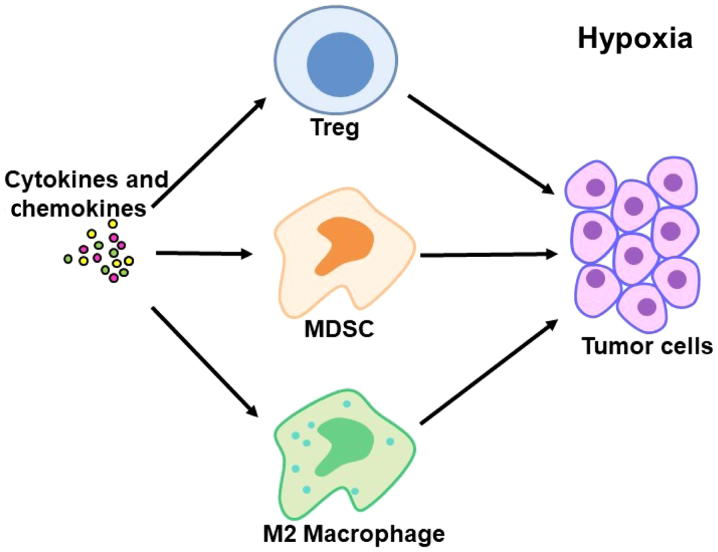
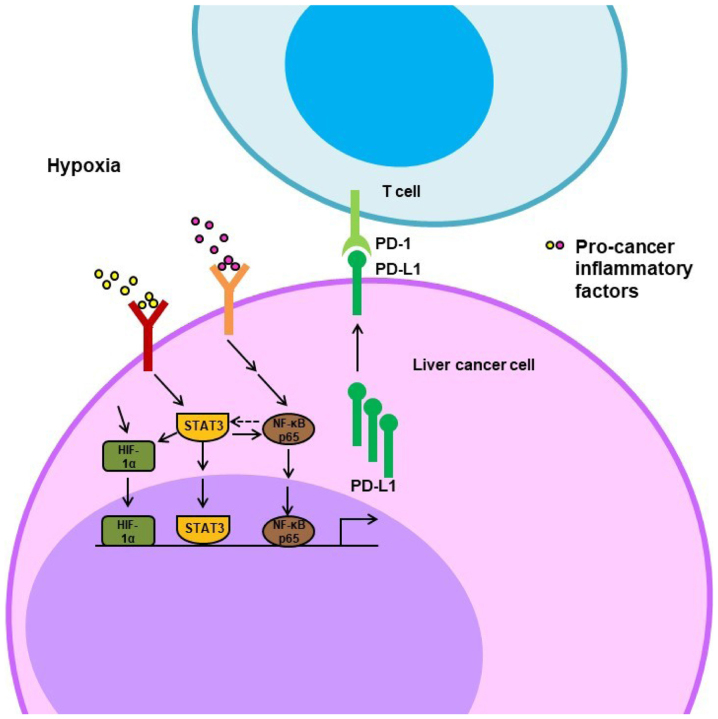
Immune escape plays a vital role in the development of liver cancer. The interaction between programmed death-ligand 1 (PD-L1) and programmed cell death-1 is a key mediator of cancer immune escape, which leads to the suppression of anticancer immunity and promotion of tumor progression. Hypoxia is a common phenomenon in the tumor microenvironment. Under hypoxic conditions, suppressive immune cells, such as regulatory T cells, myeloid-derived suppressor cells and M2 macrophages, are frequently recruited to tumor tissues to form the immunosuppressive microenvironment in liver cancer. These cells secrete cancer-promoting inflammatory cytokines, which activate the STAT3 and NF-κB signaling pathways. Recent studies have shown that STAT3 is associated with NF-κB and that these transcription factors are often co-activated to regulate tumor proliferation, survival, angiogenesis and invasion. The activation of STAT3 and NF-κB signaling pathways can directly and indirectly induce PD-L1 expression. Therefore, further understanding of the association between hypoxia and PD-L1 may help in the future treatment of liver cancer. The present review summarizes the recent progresses on PD-L1-mediated regulation and facilitation of liver cancer cell immune escape in response to hypoxia.
免疫逃逸在肝癌发展过程中起着至关重要的作用。程序性死亡配体1(PD-L1)与程序性细胞死亡蛋白1之间的相互作用是癌症免疫逃逸的关键介质,它导致抗癌免疫受到抑制并促进肿瘤进展。缺氧是肿瘤微环境中的常见现象。在缺氧条件下,抑制性免疫细胞,如调节性T细胞、髓源性抑制细胞和M2巨噬细胞,经常被招募到肿瘤组织中,形成肝癌的免疫抑制微环境。这些细胞分泌促进癌症的炎性细胞因子,激活信号转导和转录激活因子3(STAT3)和核因子κB(NF-κB)信号通路。最近的研究表明,STAT3与NF-κB相关,并且这些转录因子经常被共同激活以调节肿瘤增殖、存活、血管生成和侵袭。STAT3和NF-κB信号通路的激活可直接和间接诱导PD-L1表达。因此,进一步了解缺氧与PD-L1之间的关联可能有助于未来肝癌的治疗。本综述总结了近期关于PD-L1介导的调节以及促进肝癌细胞在缺氧状态下免疫逃逸的研究进展。