Environmental Research Center, Duke Kunshan University, Kunshan, Jiangsu, China; Nicholas School of the Environment, Duke University, Durham, NC, USA.
Environmental Research Center, Duke Kunshan University, Kunshan, Jiangsu, China.
Lancet Planet Health. 2020 Mar;4(3):e107-e115. doi: 10.1016/S2542-5196(20)30027-9.
Both air pollution and green space have been shown to affect health. We aimed to assess whether greenness protects against air pollution-related mortality.
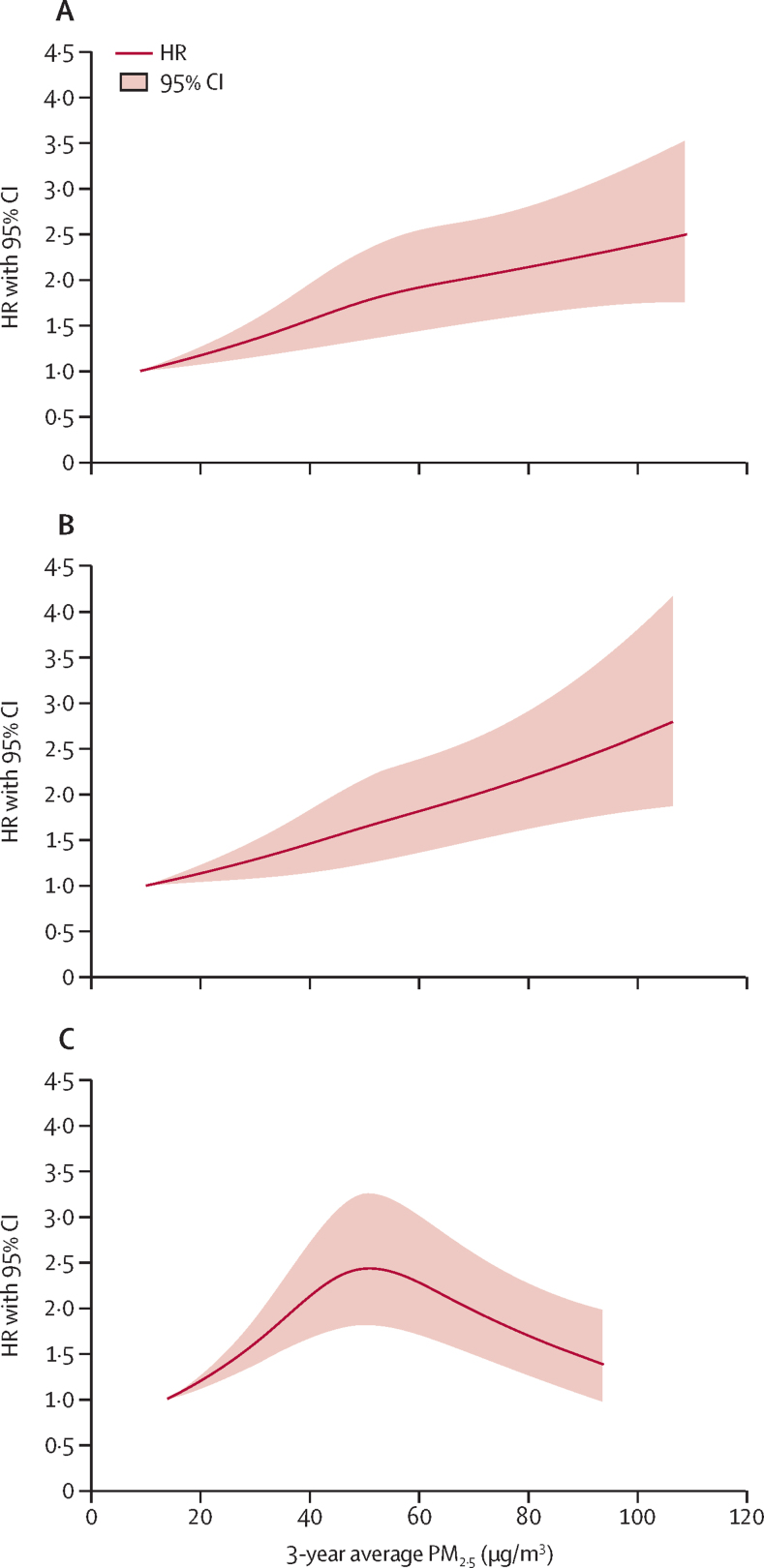
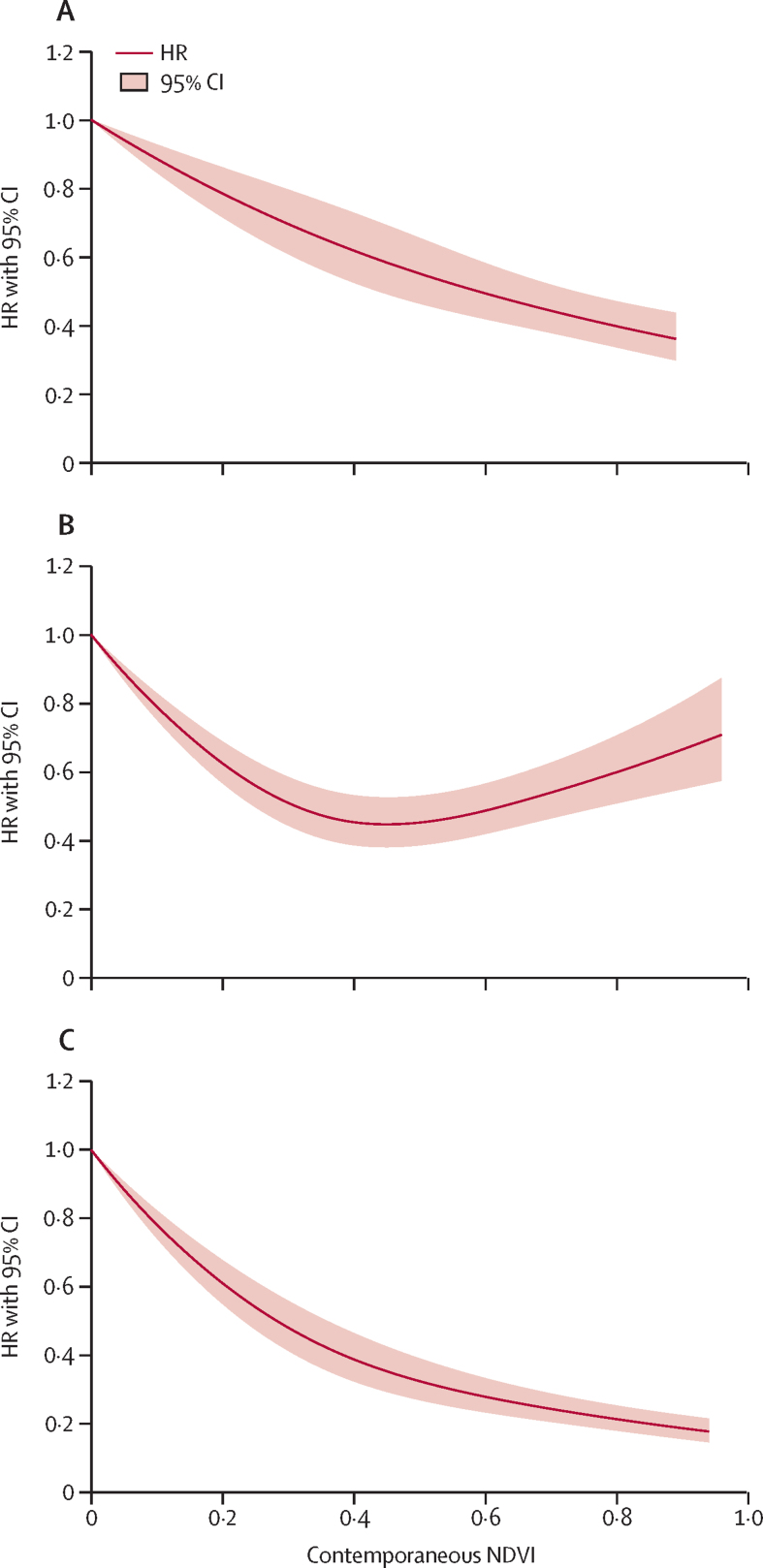
We used data from the 2008 wave of the Chinese Longitudinal Healthy Longevity Survey. We calculated contemporaneous normalised difference vegetation index (NDVI) in the 500 m radius around each participant's residence. Fine particulate matter (PM) concentration was calculated using 3-year average concentrations in 1 km × 1 km grid resolution. We used Cox proportional hazards models to estimate the effects of NDVI, PM, and their interaction on all-cause mortality, adjusted for a range of covariates.
The cohort contained 12 873 participants, totalling 47 884 person-years. There were 7426 deaths between 2008 and 2014. The mean contemporaneous NDVI was 0·42 (SD 0·21), and the mean 3-year average PM was 49·63 μg/m (13·72). In the fully adjusted model, the mortality hazard ratio for each 0·1-unit decrease in contemporaneous NDVI was 1·08 (95% CI 1·03-1·13), each 10 μg/m increase in PM was 1·13 (1·09-1·18), and the interaction term was 1·01 (1·00-1·02) with a p value of 0·027. We observed non-linear associations in our stratified analyses: people living in urban areas were more likely to benefit from greenness, and people living in rural areas were more likely to be harmed by air pollution.
Our study showed some indication of a synergistic effect of greenness and air pollution, suggesting that green space planning and air pollution control can jointly improve public health.
Bill & Melinda Gates Foundation, National Institutes of Health, National Key R&D Program of China, National Natural Science Foundation of China.
空气污染和绿色空间都已被证明会影响健康。我们旨在评估绿色空间是否能预防与空气污染相关的死亡率。
我们使用了 2008 年中国纵向健康长寿调查的资料。我们计算了每个参与者居住半径 500 米范围内的同期归一化差异植被指数(NDVI)。使用 3 年平均浓度,在 1 公里×1 公里网格分辨率下计算细颗粒物(PM)浓度。我们使用 Cox 比例风险模型,在调整了一系列协变量后,评估了 NDVI、PM 及其相互作用对全因死亡率的影响。
该队列包含 12873 名参与者,共 47884 人年。在 2008 年至 2014 年期间有 7426 人死亡。同期 NDVI 的平均值为 0.42(标准差 0.21),3 年平均 PM 为 49.63μg/m(13.72μg/m)。在完全调整的模型中,同期 NDVI 每降低 0.1 单位,死亡率风险比为 1.08(95%置信区间 1.03-1.13),PM 每增加 10μg/m,死亡率风险比为 1.13(1.09-1.18),交互项为 1.01(1.00-1.02),p 值为 0.027。我们在分层分析中观察到了非线性关联:居住在城市的人更有可能受益于绿色空间,而居住在农村的人更有可能受到空气污染的伤害。
我们的研究表明,绿色空间和空气污染之间存在协同作用的一些迹象,这表明绿色空间规划和空气污染控制可以共同改善公众健康。
比尔及梅琳达·盖茨基金会、美国国立卫生研究院、中国国家重点研发计划、中国国家自然科学基金。