Environmental Microbiology and Biotechnology, University of Duisburg-Essen, Essen, Germany.
Department of Physics, Faculty of Science and Technology, The University of The West Indies, St. Augustine, Trinidad and Tobago.
Appl Environ Microbiol. 2020 May 19;86(11). doi: 10.1128/AEM.00164-20.
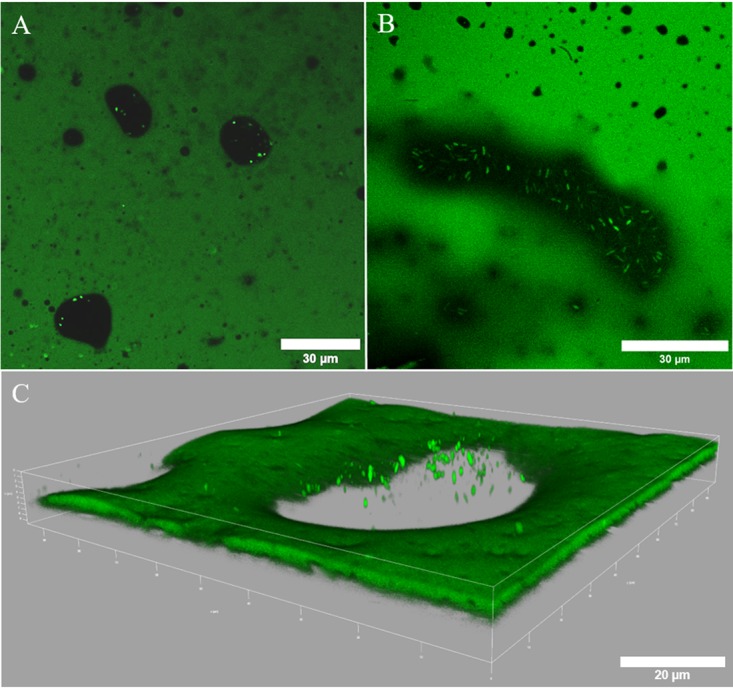
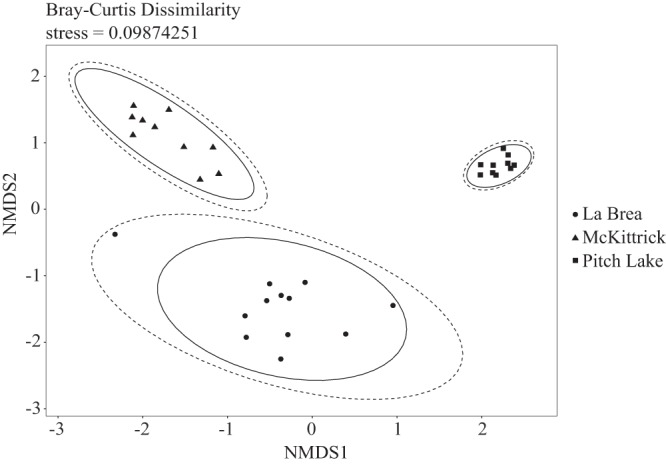
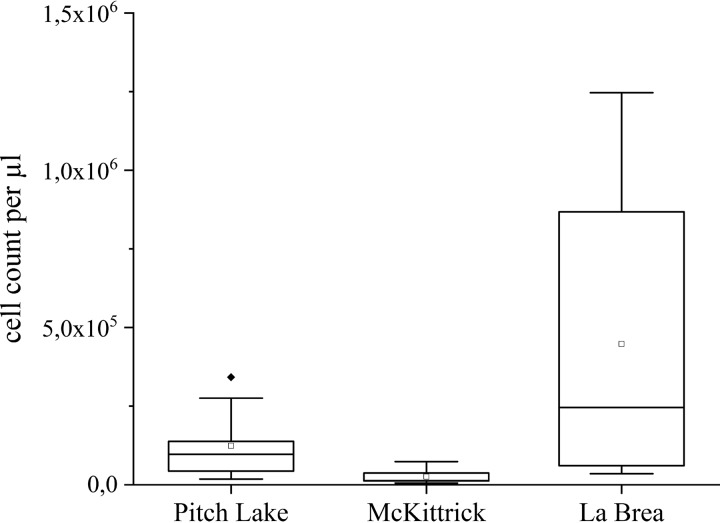
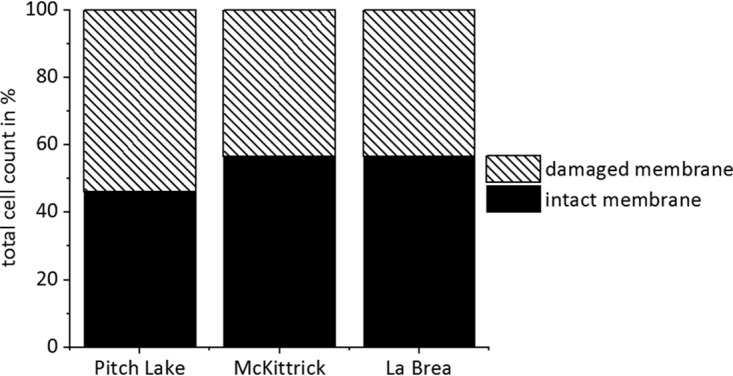
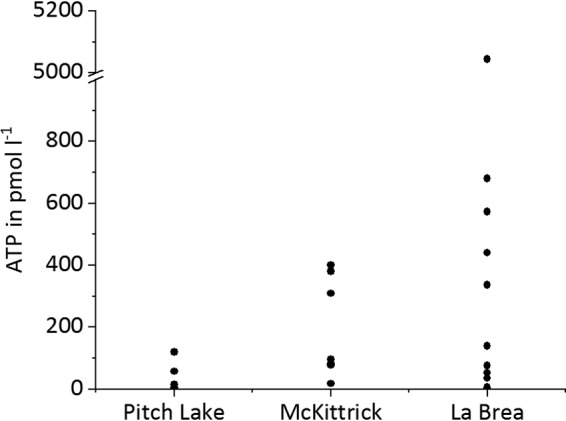
Most of the microbial degradation in oil reservoirs is believed to take place at the oil-water transition zone (OWTZ). However, a recent study indicates that there is microbial life enclosed in microliter-sized water droplets dispersed in heavy oil of Pitch Lake in Trinidad and Tobago. This life in oil suggests that microbial degradation of oil also takes place in water pockets in the oil-bearing rock of an oil leg independent of the OWTZ. However, it is unknown whether microbial life in water droplets dispersed in oil is a generic property of oil reservoirs rather than an exotic exception. Hence, we took samples from three heavy-oil seeps, Pitch Lake (Trinidad and Tobago), the La Brea Tar Pits (California, USA), and an oil seep on the McKittrick oil field (California, USA). All three tested oil seeps contained dispersed water droplets. Larger droplets between 1 and 10 μl revealed high cell densities of up to 10 cells ml Testing for ATP content and LIVE/DEAD staining showed that these populations consist of active and viable microbial cells with an average of 60% membrane-intact cells and ATP concentrations comparable to those of other subsurface ecosystems. Microbial community analyses based on 16S rRNA gene amplicon sequencing revealed the presence of known anaerobic oil-degrading microorganisms. Surprisingly, the community analyses showed similarities between all three oil seeps, revealing common OTUs, although the sampling sites were thousands of kilometers apart. Our results indicate that small water inclusions are densely populated microhabitats in heavy oil and possibly a generic trait of degraded-oil reservoirs. Our results confirmed that small water droplets in oil are densely populated microhabitats containing active microbial communities. Since these microhabitats occurred in three tested oil seeps which are located thousands of kilometers away from each other, such populated water droplets might be a generic trait of biodegraded oil reservoirs and might be involved in the overall oil degradation process. Microbial degradation might thus also take place in water pockets in the oil-bearing oil legs of the reservoir rock rather than only at the oil-water transition zone.
大多数油藏中的微生物降解被认为发生在油水过渡带(OWTZ)。然而,最近的一项研究表明,在特立尼达和多巴哥的 Pitch Lake 的重油中,有微生物生命存在于分散在其中的微升大小的水滴中。油中的这种生命表明,油的微生物降解也发生在含油储层岩石中的油带中的水囊中,而与 OWTZ 无关。然而,目前尚不清楚分散在油中的水滴中的微生物生命是油藏的普遍特性还是奇特的例外。因此,我们从三个重油渗出物(特立尼达和多巴哥的 Pitch Lake、美国加利福尼亚州的 La Brea Tar Pits 和加利福尼亚州的 McKittrick 油田的油渗出物)中采集了样本。所有三个测试的油渗出物都含有分散的水滴。直径在 1 至 10 微升之间的较大水滴显示出高达 10 个细胞 ml 的高细胞密度。测试 ATP 含量和 LIVE/DEAD 染色显示,这些种群由活跃且存活的微生物细胞组成,平均有 60%的膜完整细胞,并且 ATP 浓度与其他地下生态系统相当。基于 16S rRNA 基因扩增子测序的微生物群落分析表明,存在已知的厌氧石油降解微生物。令人惊讶的是,群落分析显示所有三个油渗出物之间存在相似性,显示出共同的 OTU,尽管采样地点相距数千公里。我们的结果表明,小的水包裹是重油中密集的小生境,并且可能是降解油储层的一般特征。我们的结果证实,油中的小水滴是密集的小生境,其中含有活跃的微生物群落。由于这些小生境存在于相距数千公里的三个测试油渗出物中,因此如此密集的水滴可能是生物降解油藏的一般特征,并可能参与整体油降解过程。微生物降解因此也可能发生在储层岩石含油油腿中的水囊中,而不仅仅是在油水过渡带。