Unit of Structural Dynamics of Macromolecules, Institut Pasteur and CNRS UMR 3528, Paris, France.
CNRS, Ifremer, Université de Brest, Laboratoire de Microbiologie des Environnements Extrêmes, Plouzané, France.
Nat Commun. 2020 Mar 27;11(1):1591. doi: 10.1038/s41467-020-15392-9.
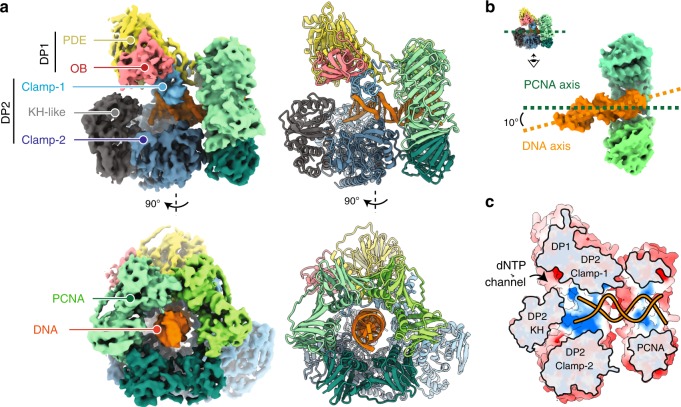
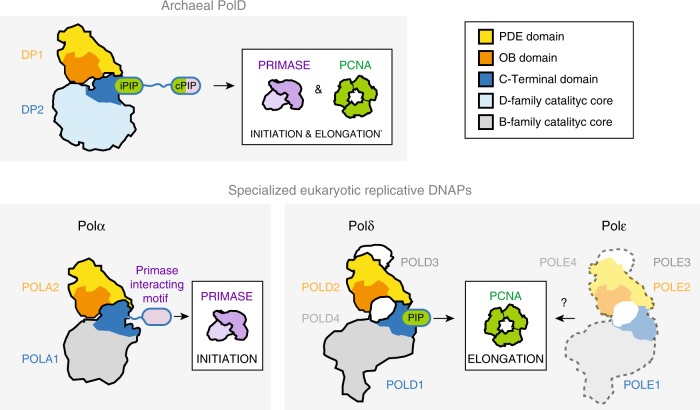
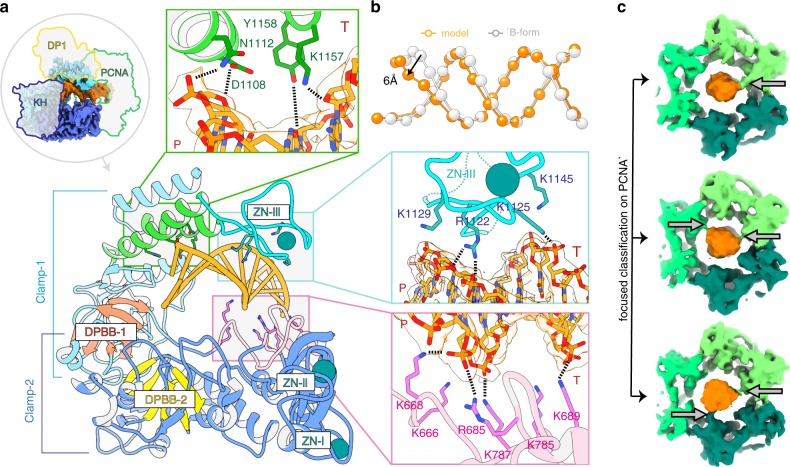
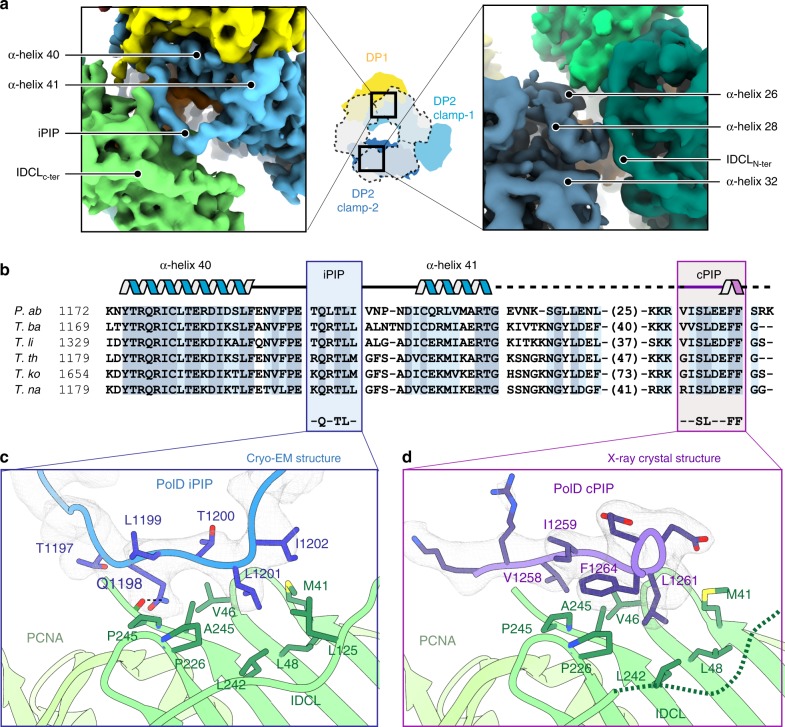
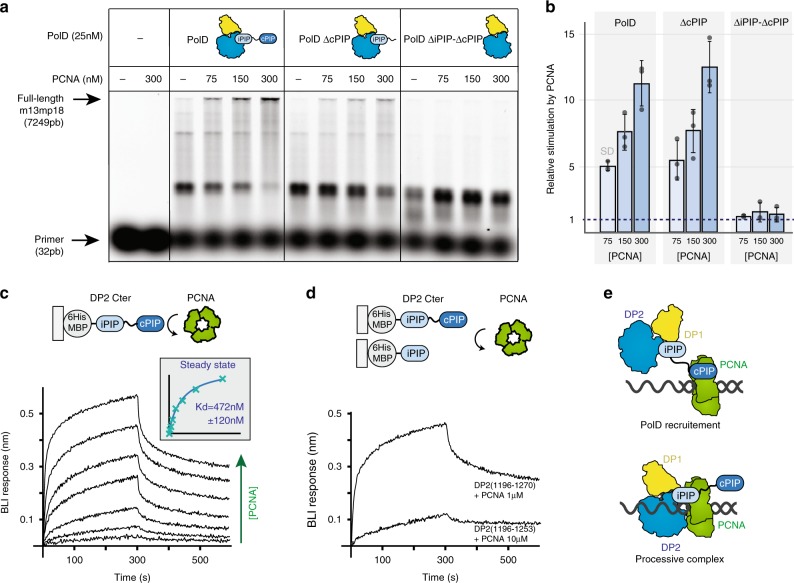
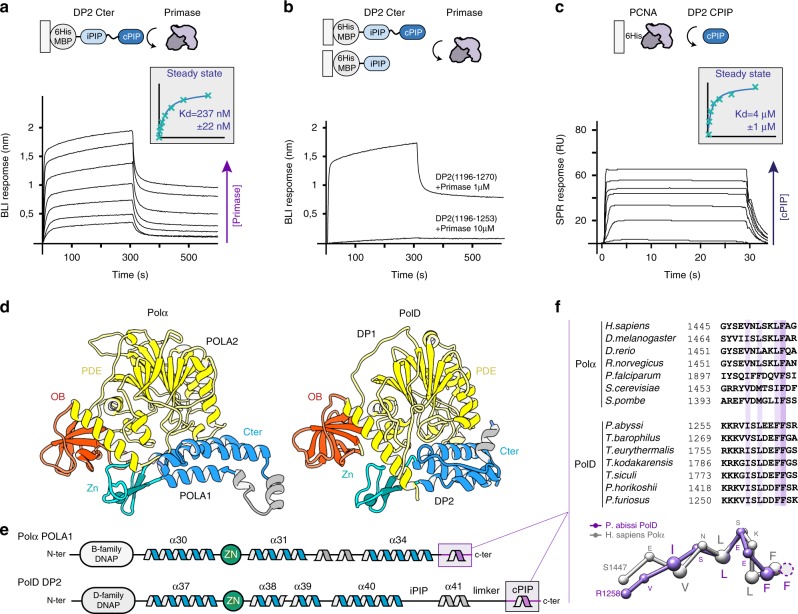
Replicative DNA polymerases (DNAPs) have evolved the ability to copy the genome with high processivity and fidelity. In Eukarya and Archaea, the processivity of replicative DNAPs is greatly enhanced by its binding to the proliferative cell nuclear antigen (PCNA) that encircles the DNA. We determined the cryo-EM structure of the DNA-bound PolD-PCNA complex from Pyrococcus abyssi at 3.77 Å. Using an integrative structural biology approach - combining cryo-EM, X-ray crystallography, protein-protein interaction measurements, and activity assays - we describe the molecular basis for the interaction and cooperativity between a replicative DNAP and PCNA. PolD recruits PCNA via a complex mechanism, which requires two different PIP-boxes. We infer that the second PIP-box, which is shared with the eukaryotic Polα replicative DNAP, plays a dual role in binding either PCNA or primase, and could be a master switch between an initiation and a processive phase during replication.
复制 DNA 聚合酶(DNAP)已经进化出了以高持续性和保真度复制基因组的能力。在真核生物和古菌中,复制性 DNA 聚合酶的持续性通过其与增殖细胞核抗原(PCNA)的结合得到极大增强,PCNA 环绕 DNA。我们在 3.77 Å 的分辨率下确定了来自 Pyrococcus abyssi 的 DNA 结合态 PolD-PCNA 复合物的冷冻电镜结构。我们采用整合结构生物学方法——结合冷冻电镜、X 射线晶体学、蛋白质-蛋白质相互作用测量和活性测定——描述了复制性 DNA 聚合酶与 PCNA 之间相互作用和协同的分子基础。PolD 通过一种复杂的机制招募 PCNA,该机制需要两个不同的 PIP 盒。我们推断第二个 PIP 盒与真核 Polα 复制性 DNA 聚合酶共享,在与 PCNA 或引物酶结合中发挥双重作用,并且可能是复制过程中起始和持续性阶段之间的主开关。