Institute of Physiology, Christian-Albrechts-University, Hermann-Rodewald-Str. 5, 24118, Kiel, Germany.
Exp Brain Res. 2020 May;238(5):1107-1117. doi: 10.1007/s00221-020-05794-y. Epub 2020 Mar 27.
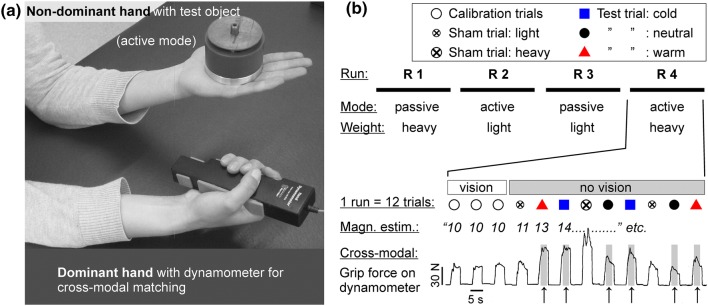
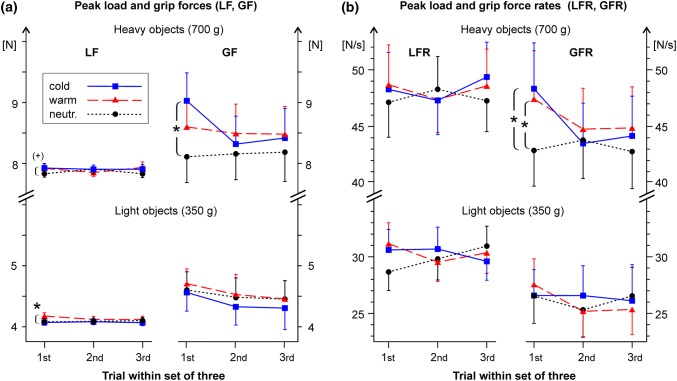
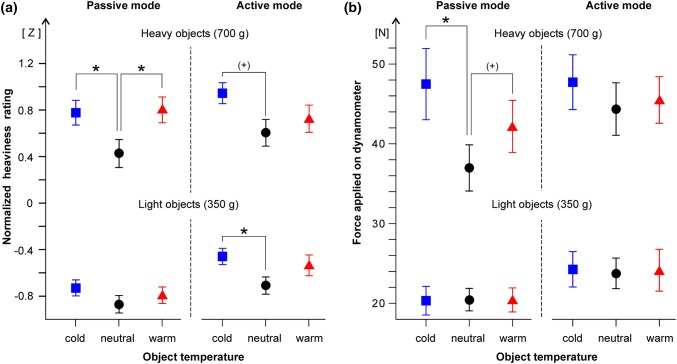
The apparent heaviness of weights placed on the skin depends on their temperature. We studied the effects of such a temperature-weight illusion (TWI) on perception and action in 21 healthy volunteers. Cold (18 °C), thermal-neutral (32 °C, skin temperature) and warm (41 °C) test objects were placed onto the palm of the non-dominant hand. Their veridical mass was 350 g (light) or 700 g (heavy). Perception of heaviness was assessed with two psychophysical experiments (magnitude estimation, cross modal matching). Cold heavy objects felt about 20% heavier than thermal-neutral objects of the same mass, shape and material. In a subsequent grip-lift experiment, the test objects were grasped with a precision grip of the dominant hand and lifted off the palm of the non-dominant hand. The grip and lift forces exerted by the fingertips were recorded. The temperature of the objects had significant effects (ANOVA, p < 0.05) on the peak grip and lift forces and on the peak grip force rate (i.e., the initial force incline). The peak grip force was about 10% higher when cold heavy objects were grasped and lifted, compared to lifts of otherwise identical thermal-neutral objects. The TWI was less pronounced when light objects or warm objects were handled. In conclusion, cooling of an object increases its apparent heaviness (perception) and influences scaling of the fingertip forces during grasping and lifting (action).
放在皮肤上的重物的表观重量取决于它们的温度。我们研究了这种温度-重量错觉(TWI)对 21 名健康志愿者的感知和动作的影响。冷(18°C)、热中性(32°C,皮肤温度)和热(41°C)测试物体被放置在非优势手的手掌上。它们的真实质量为 350 克(轻)或 700 克(重)。通过两个心理物理实验(数量估计、跨模态匹配)评估了沉重感。冷重物体感觉比相同质量、形状和材料的热中性物体重约 20%。在随后的抓握-提起实验中,用优势手的精确抓握抓住测试物体,并从非优势手的手掌提起。记录指尖施加的抓握力和提起力。物体的温度对峰值抓握力和提起力以及峰值抓握力速率(即初始力倾斜)有显著影响(ANOVA,p<0.05)。与提起相同的热中性物体相比,提起冷重物体时,峰值抓握力约高 10%。当处理轻物体或热物体时,TWI 不太明显。总之,物体的冷却会增加其表观重量(感知),并影响抓握和提起过程中指尖力的缩放(动作)。