Kang Jialing, Wang Mengjia, Lu Chenbao, Ke Changchun, Liu Pan, Zhu Jinhui, Qiu Feng, Zhuang Xiaodong
School of Chemical and Environmental Engineering, Shanghai Institute of Technology, Shanghai 201418, China.
The Meso-Entropy Matter Lab, State Key Laboratory of Metal Matrix Composites, Shanghai Key Laboratory of Electrical Insulation and Thermal Ageing, School of Chemistry and Chemical Engineering, Shanghai Jiao Tong University, Shanghai 200240, China.
Materials (Basel). 2020 Mar 26;13(7):1513. doi: 10.3390/ma13071513.
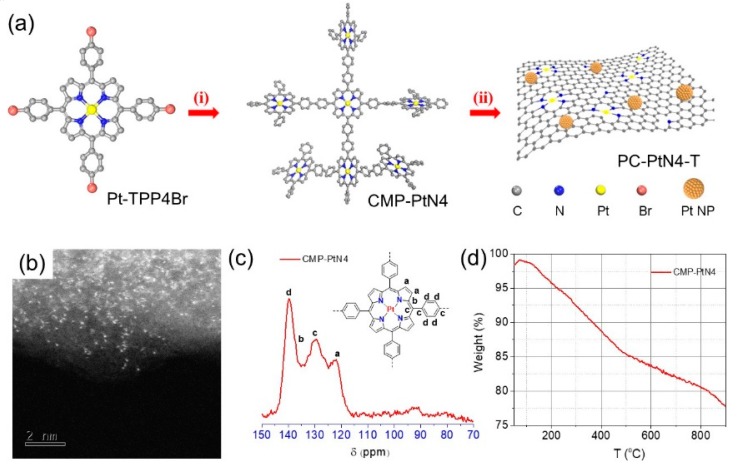
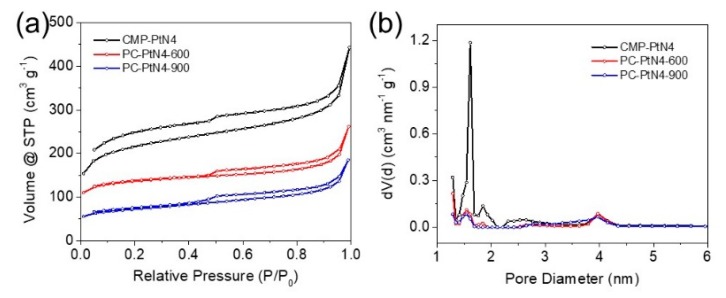
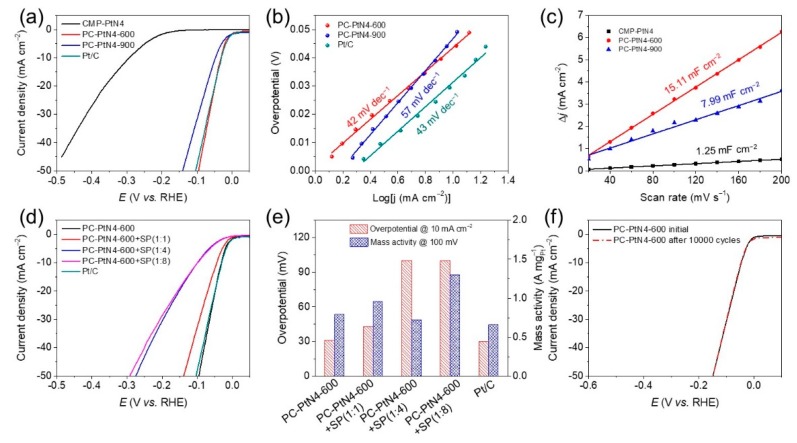
Due to the growing demand for energy and imminent environmental issues, hydrogen energy has attracted widespread attention as an alternative to traditional fossil energy. Platinum (Pt) catalytic hydrogen evolution reaction (HER) is a promising technology to produce hydrogen because the consumed electricity can be generated from renewable energy. To overcome the high cost of Pt, one effective strategy is decreasing the Pt nanoparticle (NP) size from submicron to nano-scale or even down to single atom level for efficient interacting water molecules. Herein, atomically dispersed Pt and ultra-fine Pt NPs embedded porous carbons were prepared through the pyrolysis of Pt porphyrin-based conjugated microporous polymer. As-prepared electrocatalyst exhibit high HER activity with overpotential of down to 31 mV at 10 mA cm, and mass activity of up to 1.3 A mg at overpotential of 100 mV, which is double of commercial Pt/C (0.66 A mg). Such promising performance can be ascribed to the synergistic effect of the atomically dispersed Pt and ultra-fine Pt NPs. This work provides a new strategy to prepare porous carbons with both atomically dispersed metal active sites and corresponding metal NPs for various electrocatalysis, such as oxygen reduction reaction, carbon dioxide reduction, etc.
由于对能源的需求不断增长以及紧迫的环境问题,氢能作为传统化石能源的替代品已引起广泛关注。铂(Pt)催化析氢反应(HER)是一种很有前景的制氢技术,因为消耗的电能可以由可再生能源产生。为了克服Pt的高成本,一种有效的策略是将Pt纳米颗粒(NP)的尺寸从亚微米减小到纳米级甚至降至单原子水平,以便与水分子有效相互作用。在此,通过基于卟啉的Pt共轭微孔聚合物的热解制备了原子分散的Pt和嵌入多孔碳中的超细Pt NPs。所制备的电催化剂表现出高HER活性,在10 mA cm时过电位低至31 mV,在100 mV过电位下质量活性高达1.3 A mg,是商业Pt/C(0.66 A mg)的两倍。这种优异的性能可归因于原子分散的Pt和超细Pt NPs的协同效应。这项工作为制备具有原子分散的金属活性位点和相应金属NP的多孔碳提供了一种新策略,用于各种电催化,如氧还原反应、二氧化碳还原等。