Chair of Hydrobiology and Fishery, Institute of Agricultural and Environmental Sciences, Estonian University of Life Sciences, 51006 Tartu, Estonia.
Department F.-A. Forel for Environmental and Aquatic Sciences, University of Geneva, 1205 Geneva, Switzerland.
Toxins (Basel). 2020 Mar 26;12(4):211. doi: 10.3390/toxins12040211.
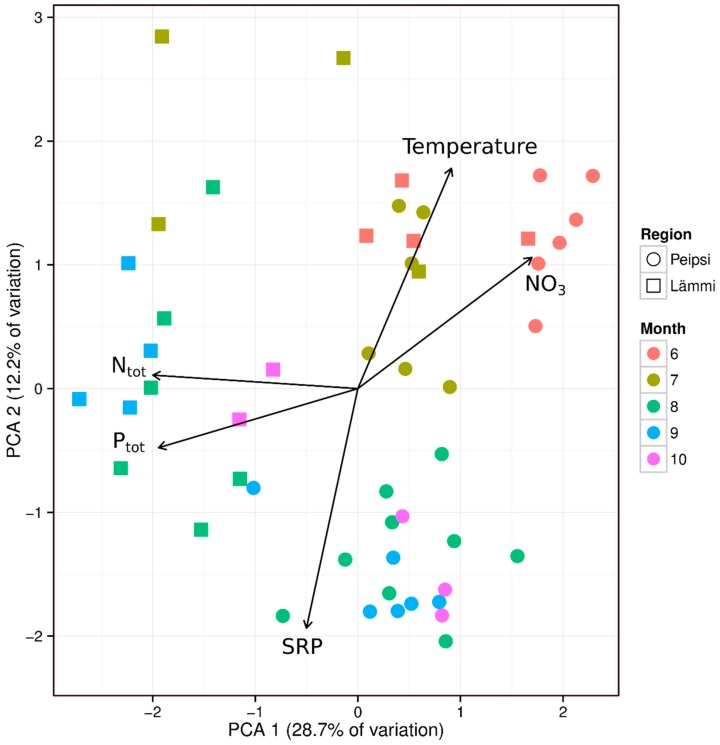
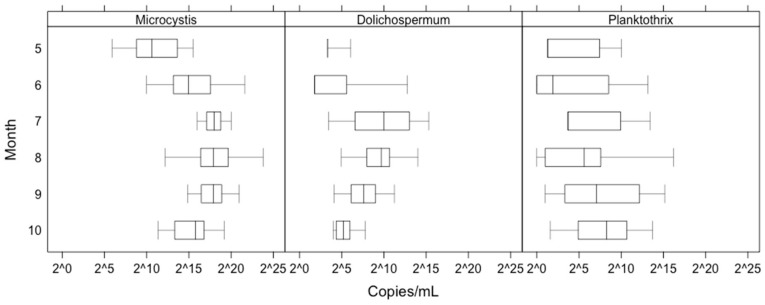
Global warming, paired with eutrophication processes, is shifting phytoplankton communities towards the dominance of bloom-forming and potentially toxic cyanobacteria. The ecosystems of shallow lakes are especially vulnerable to these changes. Traditional monitoring via microscopy is not able to quantify the dynamics of toxin-producing cyanobacteria on a proper spatio-temporal scale. Molecular tools are highly sensitive and can be useful as an early warning tool for lake managers. We quantified the potential microcystin (MC) producers in Lake Peipsi using microscopy and quantitative polymerase chain reaction (qPCR) and analysed the relationship between the abundance of the genes, MC concentration, MC variants and toxin quota per gene. We also linked environmental factors to the cyanobacteria community composition. In Lake Peipsi, we found rather moderate MC concentrations, but microcystins and microcystin-producing cyanobacteria were widespread across the lake. Nitrate (NO) was a main driver behind the cyanobacterial community at the beginning of the growing season, while in late summer it was primarily associated with the soluble reactive phosphorus (SRP) concentration. A positive relationship was found between the MC quota per gene and water temperature. The most abundant variant-MC-RR-was associated with MC quota per gene, while other MC variants did not show any significant impact.
全球变暖与富营养化过程相结合,正促使浮游植物群落向形成水华和潜在有毒蓝藻的优势种转变。浅水湖泊的生态系统尤其容易受到这些变化的影响。传统的显微镜检测无法在适当的时空尺度上量化产毒蓝藻的动态。分子工具具有高度的敏感性,可以作为湖泊管理者的预警工具。我们使用显微镜和定量聚合酶链反应 (qPCR) 来量化派伊兹湖 (Peipsi Lake) 中潜在的微囊藻毒素 (MC) 产生菌,并分析基因丰度、MC 浓度、MC 变体和每个基因的毒素配额之间的关系。我们还将环境因素与蓝藻群落组成联系起来。在派伊兹湖中,我们发现了相当温和的 MC 浓度,但微囊藻和产微囊藻的蓝藻在整个湖中广泛存在。硝酸盐 (NO) 是生长季节初期蓝藻群落的主要驱动因素,而到了夏末,它主要与可溶性反应磷 (SRP) 浓度有关。我们发现每个基因的 MC 配额与水温之间呈正相关关系。最丰富的变体-MC-RR-与每个基因的 MC 配额有关,而其他 MC 变体则没有显示出任何显著的影响。