Suvila Karri, McCabe Elizabeth L, Lima Joao A C, Aittokallio Jenni, Yano Yuichiro, Cheng Susan, Niiranen Teemu J
Division of Medicine, Turku University Hospital and University of Turku, Turku, Finland.
Division of Cardiovascular Medicine, Department of Medicine, Brigham and Women's Hospital, Boston, Massachusetts, USA.
Am J Hypertens. 2020 Jul 18;33(7):644-651. doi: 10.1093/ajh/hpaa055.
Objectively defined early onset hypertension, based on repeated blood pressure measurements, is a strong risk factor for cardiovascular disease (CVD). We aimed to assess if also self-reported hypertension onset age is associated with hypertension-mediated organ damage (HMOD). Additionally, we evaluated the agreement between self-reported and objectively defined hypertension onset age.
We studied 2,649 participants (50 ± 4 years at the time of outcome assessment, 57% women) of the Coronary Artery Risk Development in Young Adults (CARDIA) study who underwent measurements for echocardiographic left ventricular hypertrophy (LVH), left ventricular diastolic dysfunction (LVDD), coronary calcification, and albuminuria. We divided the participants into groups according to self-reported hypertension onset age (<35 years, 35-44 years, ≥45 years, and no hypertension). We used multivariable-adjusted logistic regression models to assess the relation between self-reported hypertension onset age with the presence of HMOD, with those who did not report hypertension as the referent group.
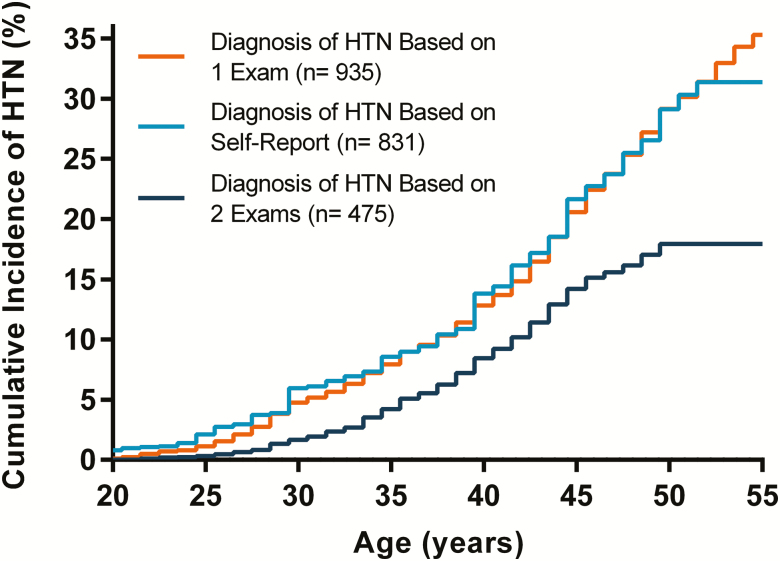
Compared with individuals without self-reported hypertension, self-reported hypertension onset at <35 years was associated with LVH (odds ratio (OR), 2.38; 95% confidence interval (CI), 1.51-3.76), LVDD (OR, 2.32; 95% CI, 1.28-4.18, coronary calcification (OR, 2.87; 95% CI, 1.50-5.47), and albuminuria (OR, 1.62; 95% CI, 0.81-3.26). Self-reported hypertension onset at ≥45 years was only associated with LVDD (OR, 1.81; 95% CI, 1.06-3.08). The agreement between self-reported and objectively defined hypertension onset age groups was 78-79%.
Our findings suggest that self-reported hypertension onset age, a pragmatically feasible assessment in clinical practice, is a reasonable method for assessing risk of HMOD and CVD.
基于多次血压测量客观定义的早发性高血压是心血管疾病(CVD)的一个强风险因素。我们旨在评估自我报告的高血压发病年龄是否也与高血压介导的器官损害(HMOD)相关。此外,我们评估了自我报告的和客观定义的高血压发病年龄之间的一致性。
我们研究了青年动脉粥样硬化风险发展研究(CARDIA研究)中的2649名参与者(在结局评估时年龄为50±4岁,57%为女性),这些参与者接受了超声心动图左心室肥厚(LVH)、左心室舒张功能障碍(LVDD)、冠状动脉钙化和蛋白尿的测量。我们根据自我报告的高血压发病年龄将参与者分为几组(<35岁、35 - 44岁、≥45岁和无高血压)。我们使用多变量调整的逻辑回归模型来评估自我报告的高血压发病年龄与HMOD存在之间的关系,以未报告高血压的人群作为参照组。
与未自我报告高血压的个体相比,自我报告高血压发病年龄<35岁与LVH(优势比(OR),2.38;95%置信区间(CI),1.51 - 3.76)、LVDD(OR,2.32;95%CI,1.28 - 4.18)、冠状动脉钙化(OR,2.87;95%CI,1.50 - 5.47)和蛋白尿(OR,1.62;95%CI,0.81 - 3.26)相关。自我报告高血压发病年龄≥45岁仅与LVDD相关(OR,1.81;95%CI,1.06 - 3.08)。自我报告的和客观定义的高血压发病年龄组之间的一致性为78 - 79%。
我们的研究结果表明,自我报告的高血压发病年龄在临床实践中是一种切实可行的评估方法,是评估HMOD和CVD风险的合理方法。