Foord Aimee M, Cushing-Haugen Kara L, Boeckh Michael J, Carpenter Paul A, Flowers Mary E D, Lee Stephanie J, Leisenring Wendy M, Mueller Beth A, Hill Joshua A, Chow Eric J
Department of Pediatrics, University of Washington, Seattle Children's Hospital, Seattle, WA.
Public Health Sciences Division, Fred Hutchinson Cancer Research Center, Seattle, WA.
Blood Adv. 2020 Apr 14;4(7):1232-1241. doi: 10.1182/bloodadvances.2020001470.
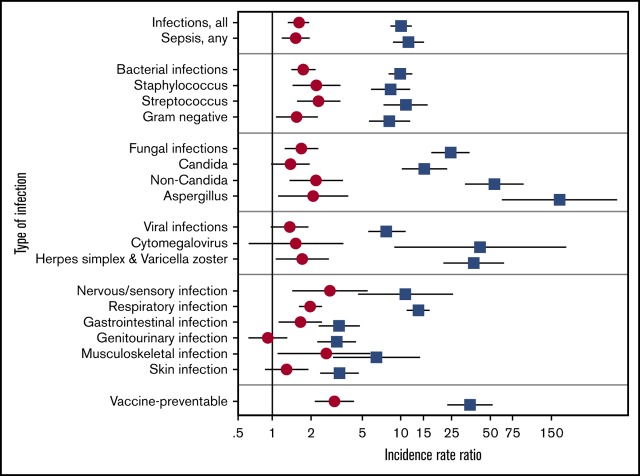
Few studies have compared the incidence of infections occurring ≥2 years after hematopoietic cell transplant (HCT) with other cancer patients and the general population. In this study, ≥2-year HCT survivors who were Washington residents treated from 1992 through 2009 (n = 1792; median age, 46 years; 52% allogeneic; 90% hematologic malignancies) were matched to individuals from the state cancer registry (n = 5455, non-HCT) and driver's license files (n = 16 340; Department of Licensing [DOL]). Based on hospital and death registry codes, incidence rate ratios (IRRs; 95% confidence interval [CI]) of infections by organism type and organ system were estimated using Poisson regression. With 7-year median follow-up, the incidence rate (per 1000 person-years) of all infections was 65.4 for HCT survivors vs 39.6 for the non-HCT group (IRR, 1.6; 95% CI, 1.3-1.9) and 7.2 for DOL (IRR, 10.0; 95% CI, 8.3-12.1). Bacterial and fungal infections were each 70% more common in HCT vs non-HCT cancer survivors (IRR, 1.7; P < .01), whereas the risk for viral infection was lower (IRR, 1.4; P = .07). Among potentially vaccine-preventable organisms, the IRR was 3.0 (95% CI, 2.1-4.3) vs the non-HCT group. Although the incidences of all infections decreased with time, the relative risk in almost all categories remained significantly increased in ≥5-year HCT survivors vs other groups. Risk factors for late infection included history of relapse and for some infections, history of chronic graft-versus-host disease. Providers caring for HCT survivors should maintain vigilance for infections and ensure adherence to antimicrobial prophylaxis and vaccination guidelines.
很少有研究将造血细胞移植(HCT)后≥2年发生感染的发生率与其他癌症患者及普通人群进行比较。在本研究中,1992年至2009年期间接受治疗的华盛顿州居民中≥2年的HCT幸存者(n = 1792;中位年龄46岁;52%为异基因移植;90%为血液系统恶性肿瘤)与州癌症登记处的个体(n = 5455,非HCT)和驾照档案(n = 16340;驾照部门[DOL])进行匹配。基于医院和死亡登记编码,使用泊松回归估计按病原体类型和器官系统划分的感染发病率比(IRR;95%置信区间[CI])。中位随访7年时,HCT幸存者所有感染的发病率(每1000人年)为65.4,非HCT组为39.6(IRR,1.6;95%CI,1.3 - 1.9),DOL组为7.2(IRR,10.0;95%CI,8.3 - 12.1)。与非HCT癌症幸存者相比,HCT幸存者中细菌和真菌感染的发生率均高出70%(IRR,1.7;P <.01),而病毒感染风险较低(IRR,1.4;P =.07)。在潜在可通过疫苗预防的病原体中,与非HCT组相比,IRR为3.0(95%CI,2.1 - 4.3)。尽管所有感染的发生率随时间下降,但≥5年的HCT幸存者与其他组相比,几乎所有类别中的相对风险仍显著增加。晚期感染的风险因素包括复发史以及某些感染的慢性移植物抗宿主病病史。照料HCT幸存者的医护人员应保持对感染的警惕,并确保遵守抗菌预防和疫苗接种指南。