Centre for Biodiversity Dynamics, Department of Biology, Norwegian University of Science and Technology, Realfagbygget, NO-7491 Trondheim, Norway.
Department of Biological and Environmental Science, University of Jyväskylä, Jyväskylä, Finland.
Proc Biol Sci. 2020 Apr 8;287(1924):20200189. doi: 10.1098/rspb.2020.0189. Epub 2020 Apr 1.
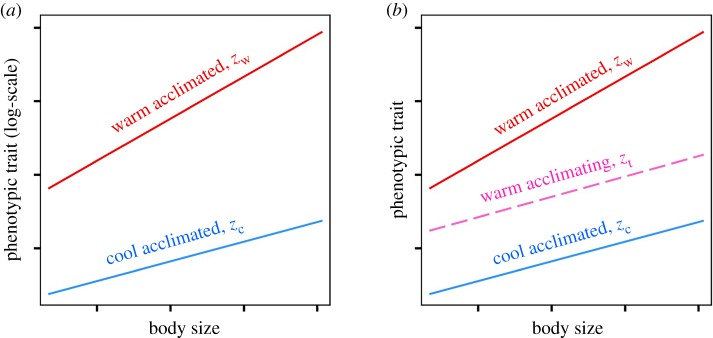
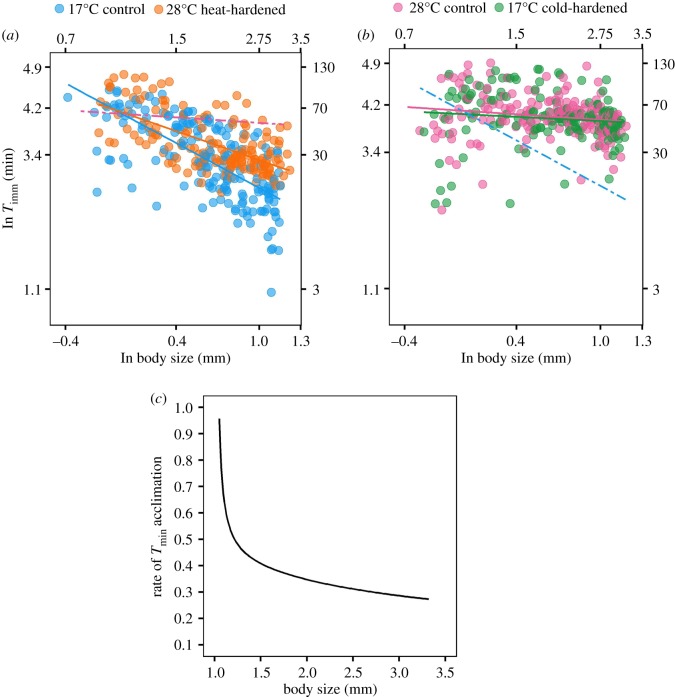
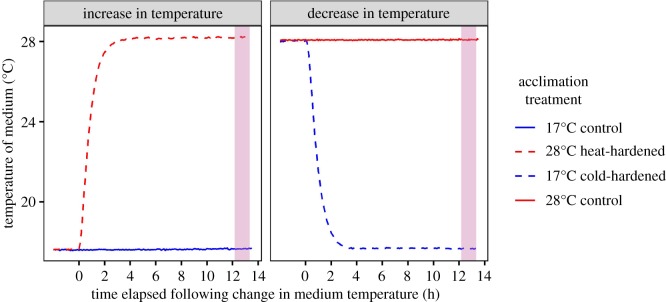
When a change in the environment occurs, organisms can maintain an optimal phenotypic state via plastic, reversible changes to their phenotypes. These adjustments, when occurring within a generation, are described as the process of acclimation. While acclimation has been studied for more than half a century, global environmental change has stimulated renewed interest in quantifying variation in the rate and capacity with which this process occurs, particularly among ectothermic organisms. Yet, despite the likely ecological importance of acclimation capacity and rate, how these traits change throughout life among members of the same species is largely unstudied. Here we investigate these relationships by measuring the acute heat tolerance of the clonally reproducing zooplankter of different size/age and acclimation status. The heat tolerance of individuals completely acclimated to relatively warm (28°C) or cool (17°C) temperatures diverged during development, indicating that older, larger individuals had a greater capacity to increase heat tolerance. However, when cool acclimated individuals were briefly exposed to the warm temperature (i.e. were 'heat-hardened'), it was younger, smaller animals with less capacity to acclimate that were able to do so more rapidly because they obtained or came closer to obtaining complete acclimation of heat tolerance. Our results illustrate that within a species, individuals can differ substantially in how rapidly and by how much they can respond to environmental change. We urge greater investigation of the intraspecific relationship between acclimation and development along with further consideration of the factors that might contribute to these enigmatic patterns of phenotypic variation.
当环境发生变化时,生物体可以通过对其表型进行可塑性、可逆的改变来维持最佳表型状态。这些在一个世代内发生的调整被描述为适应过程。虽然适应已经被研究了半个多世纪,但全球环境变化激发了人们对量化这一过程发生的速度和能力的变化的重新兴趣,尤其是在变温动物中。然而,尽管适应能力和速度可能具有重要的生态意义,但在同一物种的成员中,这些特征在整个生命过程中是如何变化的,在很大程度上还没有得到研究。在这里,我们通过测量不同大小/年龄和适应状态的克隆浮游动物个体的急性耐热性来研究这些关系。完全适应相对温暖(28°C)或凉爽(17°C)温度的个体的耐热性在发育过程中存在差异,这表明年龄较大、体型较大的个体具有更大的提高耐热性的能力。然而,当凉爽适应的个体短暂暴露于温暖温度(即“热硬化”)时,能够更快地适应的是体型较小、年龄较小、适应能力较弱的动物,因为它们获得或更接近获得耐热性的完全适应。我们的研究结果表明,在一个物种中,个体在对环境变化的响应速度和幅度上可能存在很大差异。我们强烈呼吁更多地研究适应与发育之间的种内关系,并进一步考虑可能导致这些神秘的表型变异模式的因素。