National Research Council (CNR) - Institute of Translational Pharmacology (IFT), Via Carducci, 32, 67100, L'Aquila, Italy.
Regional Center for Organ Transplantation (CRT), S. Salvatore Hospital, L'Aquila, Italy.
BMC Nephrol. 2020 Mar 30;21(1):109. doi: 10.1186/s12882-020-01752-6.
Human leukocyte antigen (HLA)-G is a non-classical HLA molecule with immunomodulant and immunosuppressive functions, involved in transplantation tolerance. HLA-G14bp ins/del polymorphism in exon 8 has been associated with allograft rejection and kidney transplant outcome, with controversial results. We investigated associations of HLA-G14bp ins/del polymorphism on onset of some of the main post-transplant risk factors, like excess body weight, lipid abnormalities, increased fasting plasma glucose. Polymorphisms of cytokines with both immunosuppressive and metabolic effects were also assessed for comparisons and associated analysis.
The present study involved kidney transplant recipients (n = 173) in which body mass index, cholesterol, triglycerides, fasting plasma glucose were registered in the first years after transplantation and analyzed in association with genotypes. Presence of hypertension and smoking habits, demographic, transplant-related and therapeutic data of patients were also recorded. Polymerase chain reaction, sequence-specific primer amplification and Taqman allelic discrimination techniques were used for genotyping of HLA-G14bp ins/del, interleukin (IL)-10(-1082G > A,-819 T > C,-592A > C), transforming growth factor-β(+ 869 T > C,+915C > G), IL-6(-174G > C), tumor necrosis factor-α(-308G > A) and IL-18(-137G > C,-607C > A). Effects of genotypes on clinical markers at each time point (pre-transplant and 1 to 5 years after transplant) were analyzed using a repeated-measures general linear model analysis; adjustment for potential confounders was performed.
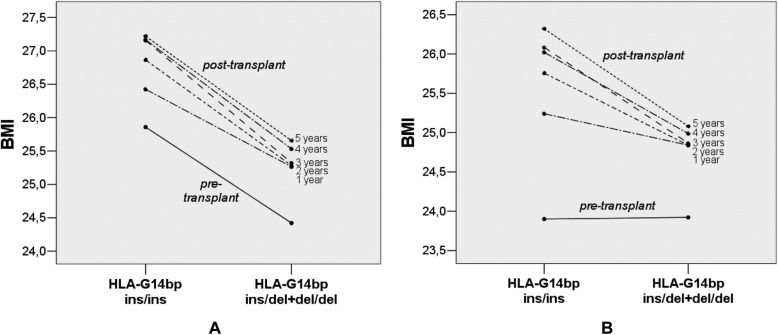
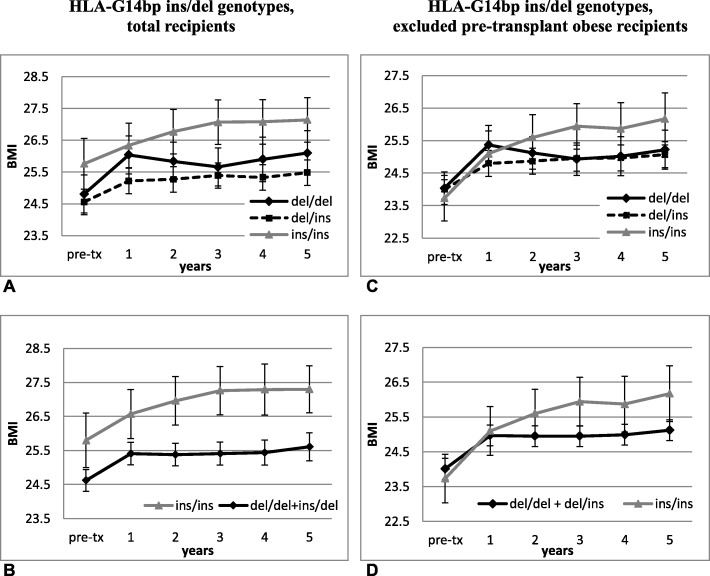
Results showed that HLA-G14bp ins/ins was significantly associated with obesity, in particular after transplantation (3 years, p = 0.002, OR = 4.48, 95% CI:1.76-11.41). Post-transplant body mass index was significantly increased in HLA-G14bp ins/ins carriers (3 and 4 years, p = 0.033 and p = 0.044); effects of HLA-G14bp genotypes on post-transplant BMI were confirmed by using repeated-measures analysis and after controlling for confounding variables. Cytokine genotypes did not associate with the examined factors.
The study of transplanted patients allowed to evidence a potential relationship between post-transplant weight gain and HLA-G14bp ins/del polymorphism, previously involved in rejection for its immunosuppressive/tolerogenic activity. This novel association could widen the knowledge of the role and functions of HLA-G molecules in diseases and transplantation.
人类白细胞抗原(HLA)-G 是一种具有免疫调节和免疫抑制功能的非经典 HLA 分子,参与移植耐受。HLA-G14bp 外显子 8 中的插入/缺失多态性与同种异体排斥和肾移植结果有关,但结果存在争议。我们研究了 HLA-G14bp 插入/缺失多态性与一些主要移植后风险因素(如超重、脂质异常、空腹血糖升高)的发病之间的关联。还评估了具有免疫抑制和代谢作用的细胞因子的多态性,以便进行比较和相关分析。
本研究涉及 173 名肾移植受者,在移植后最初几年记录了体重指数、胆固醇、甘油三酯和空腹血糖,并分析了与基因型的关联。还记录了患者的高血压和吸烟习惯、人口统计学、移植相关和治疗数据。使用聚合酶链反应、序列特异性引物扩增和 Taqman 等位基因鉴别技术对 HLA-G14bp 插入/缺失、白细胞介素(IL)-10(-1082G>A、-819T>C、-592A>C)、转化生长因子-β(+869T>C、+915C>G)、IL-6(-174G>C)、肿瘤坏死因子-α(-308G>A)和 IL-18(-137G>C、-607C>A)进行基因分型。使用重复测量一般线性模型分析,分析每个时间点(移植前和移植后 1 至 5 年)基因型对临床标志物的影响;进行了潜在混杂因素的调整。
结果表明,HLA-G14bp ins/ins 与肥胖显著相关,尤其是在移植后(3 年,p=0.002,OR=4.48,95%CI:1.76-11.41)。HLA-G14bp ins/ins 携带者的移植后体重指数显著增加(3 年和 4 年,p=0.033 和 p=0.044);使用重复测量分析和控制混杂变量后,证实了 HLA-G14bp 基因型对移植后 BMI 的影响。细胞因子基因型与所检查的因素无关。
对移植患者的研究表明,HLA-G14bp ins/del 多态性与移植后体重增加之间可能存在潜在联系,HLA-G14bp ins/del 多态性因其免疫抑制/耐受活性而先前与排斥有关。这种新的关联可以扩大 HLA-G 分子在疾病和移植中的作用和功能的知识。