Department of Biomedical Engineering, School of Medicine, Oregon Health and Science University, Portland, OR, USA.
MD/PhD Program, School of Medicine, Oregon Health and Science University, Portland, OR, USA.
BMC Public Health. 2020 Mar 30;20(1):421. doi: 10.1186/s12889-020-08538-3.
Little is known about patient characteristics that contribute to initiating antiretroviral therapy (ART) and achieving viral suppression among HIV people with opioid use disorder in Vietnam. The primary objective of this analysis was to evaluate associations between participant characteristics and the critical steps in the HIV care continuum of ART initiation and HIV viral suppression among people with opioid use disorder and HIV in Vietnam.
We assessed baseline participant characteristics, ART status, and HIV viral suppression (HIV RNA PCR < 200 copies/mL) enrolled in a clinical trial of HIV clinic-based buprenorphine versus referral for methadone among people with opioid use disorder in Vietnam. We developed logistic regression models to identify characteristics associated with ART status and HIV viral suppression.
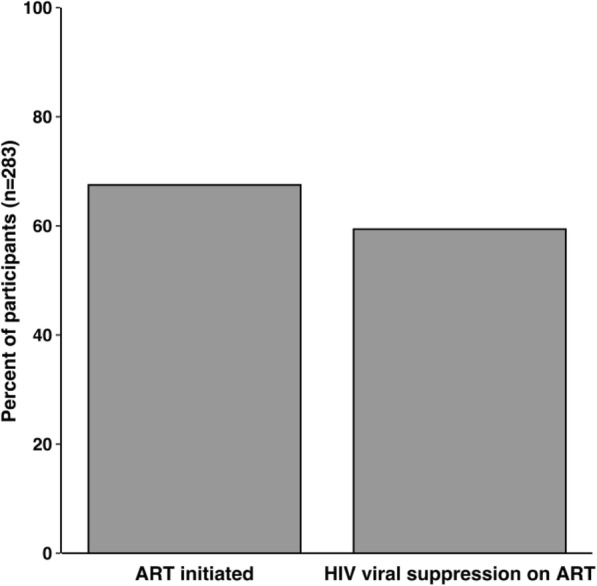
Among 283 study participants, 191 (67.5%) were prescribed ART at baseline, and 168 of those on ART (90%) were virally suppressed. Years since HIV diagnosis (aOR = 1.12, 95% CI 1.06, 1.19) and being married (aOR = 2.83, 95% CI 1.51, 5.34) were associated with an increased likelihood of current prescription for ART at baseline. Greater depression symptoms were negatively associated with receipt of ART (aOR = 0.97, 95% CI = (0.94, 0.9963)). In the HIV suppression model, once adjusting for all included covariates, only receipt of ART was associated with viral suppression (aOR = 25.9, 95% CI = (12.5, 53.8). In bivariate analyses, methamphetamine was negatively correlated with ART prescription (p = 0.07) and viral suppression (p = 0.08).
While fewer than 90% of participants had received ART, 90% of those on ART had achieved HIV viral suppression at baseline, suggesting that interventions to improve uptake of ART in Vietnam are essential for achieving UNAIDS 90-90-90 goals in people who use heroin in Vietnam. Social determinants of health associated with ART and HIV viral suppression suggest that social support may be a key to facilitating both of these steps in the HIV care continuum.
在越南,患有阿片类药物使用障碍的 HIV 感染者中,人们对启动抗逆转录病毒治疗(ART)和实现病毒抑制的患者特征知之甚少。本分析的主要目的是评估参与者特征与 HIV 感染者和越南阿片类药物使用障碍者 HIV 护理连续体中 ART 启动和 HIV 病毒抑制的关键步骤之间的关联。
我们评估了参与一项在越南进行的基于诊所的丁丙诺啡与美沙酮转介治疗阿片类药物使用障碍者的临床试验的基线参与者特征、ART 状况和 HIV 病毒抑制(HIV RNA PCR<200 拷贝/毫升)。我们开发了逻辑回归模型,以确定与 ART 状况和 HIV 病毒抑制相关的特征。
在 283 名研究参与者中,191 名(67.5%)在基线时被开处 ART,其中 168 名接受 ART 的患者(90%)病毒得到抑制。HIV 诊断后的年数(OR=1.12,95%CI 1.06,1.19)和已婚状况(OR=2.83,95%CI 1.51,5.34)与基线时当前处方 ART 的可能性增加相关。抑郁症状越严重,接受 ART 的可能性越低(OR=0.97,95%CI=(0.94,0.9963))。在 HIV 抑制模型中,在调整所有纳入的协变量后,只有接受 ART 与病毒抑制相关(OR=25.9,95%CI=(12.5,53.8))。在单变量分析中,冰毒与 ART 处方呈负相关(p=0.07)和病毒抑制呈负相关(p=0.08)。
尽管不到 90%的参与者接受了 ART,但基线时接受 ART 的参与者中有 90%达到了 HIV 病毒抑制,这表明在越南,为实现 UNAIDS 90-90-90 目标,必须采取干预措施,以改善越南海洛因使用者对 ART 的接受程度。与 ART 和 HIV 病毒抑制相关的健康社会决定因素表明,社会支持可能是促进 HIV 护理连续体中这两个步骤的关键。