Sieuwerts Anieta M, Inda Márcia A, Smid Marcel, van Ooijen Henk, van de Stolpe Anja, Martens John W M, Verhaegh Wim F J
Department of Medical Oncology and Cancer Genomics Netherlands, Erasmus MC Cancer Institute, Erasmus MC, Doctor Molewaterplein 40, 3015 GD Rotterdam, The Netherlands.
Philips Research, Precision Diagnostics Department, High Tech Campus 11, 5656 AE Eindhoven, The Netherlands.
Cancers (Basel). 2020 Mar 27;12(4):802. doi: 10.3390/cancers12040802.
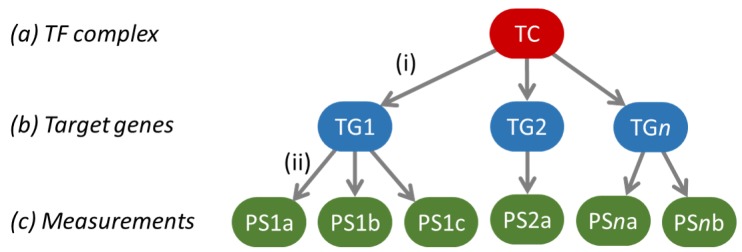
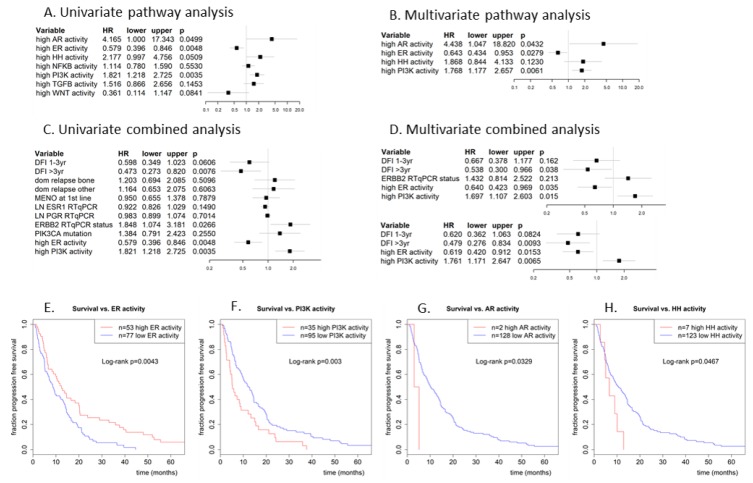
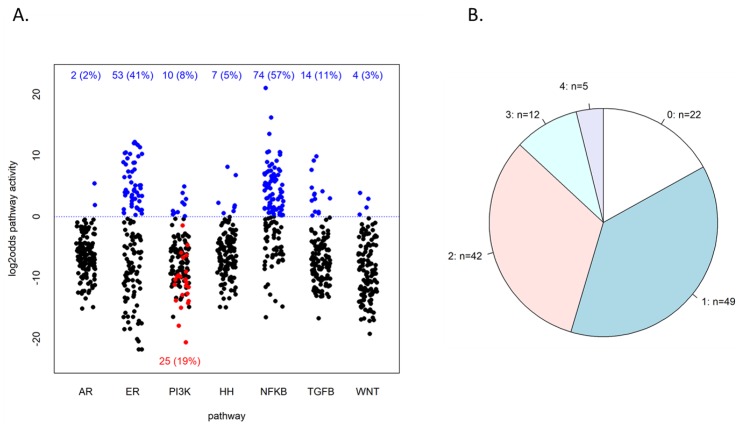
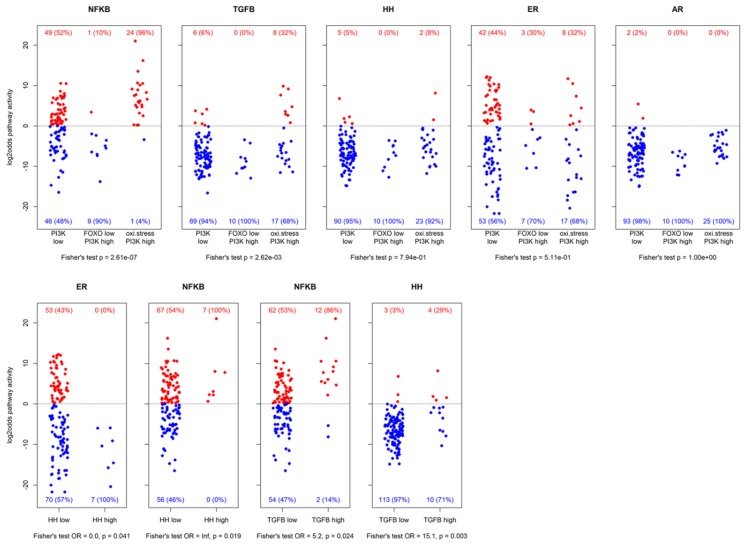
Estrogen receptor positive (ER+) breast cancer patients are eligible for hormonal treatment, but only around half respond. A test with higher specificity for prediction of endocrine therapy response is needed to avoid hormonal overtreatment and to enable selection of alternative treatments. A novel testing method was reported before that enables measurement of functional signal transduction pathway activity in individual cancer tissue samples, using mRNA levels of target genes of the respective pathway-specific transcription factor. Using this method, 130 primary breast cancer samples were analyzed from non-metastatic ER+ patients, treated with surgery without adjuvant hormonal therapy, who subsequently developed metastatic disease that was treated with first-line tamoxifen. Quantitative activity levels were measured of androgen and estrogen receptor (AR and ER), PI3K-FOXO, Hedgehog (HH), NFκB, TGFβ, and Wnt pathways. Based on samples with known pathway activity, thresholds were set to distinguish low from high activity. Subsequently, pathway activity levels were correlated with the tamoxifen treatment response and progression-free survival. High ER pathway activity was measured in 41% of the primary tumors and was associated with longer time to progression (PFS) of metastases during first-line tamoxifen treatment. In contrast, high PI3K, HH, and androgen receptor pathway activity was associated with shorter PFS, and high PI3K and TGFβ pathway activity with worse treatment response. Potential clinical utility of assessment of ER pathway activity lies in predicting response to hormonal therapy, while activity of PI3K, HH, TGFβ, and AR pathways may indicate failure to respond, but also opens new avenues for alternative or complementary targeted treatments.
雌激素受体阳性(ER+)乳腺癌患者适合接受激素治疗,但只有约一半的患者有反应。需要一种对内分泌治疗反应预测具有更高特异性的检测方法,以避免激素过度治疗,并能够选择替代治疗方法。此前报道了一种新型检测方法,该方法能够利用各通路特异性转录因子的靶基因的mRNA水平,测量个体癌组织样本中的功能性信号转导通路活性。使用这种方法,对130例非转移性ER+患者的原发性乳腺癌样本进行了分析,这些患者接受了手术治疗但未接受辅助激素治疗,随后发生了转移性疾病并接受了一线他莫昔芬治疗。测量了雄激素和雌激素受体(AR和ER)、PI3K-FOXO、刺猬信号(HH)、NFκB、TGFβ和Wnt通路的定量活性水平。基于具有已知通路活性的样本,设定阈值以区分低活性和高活性。随后,将通路活性水平与他莫昔芬治疗反应和无进展生存期相关联。在41%的原发性肿瘤中检测到高ER通路活性,并且与一线他莫昔芬治疗期间转移灶的较长无进展时间(PFS)相关。相比之下,高PI3K、HH和雄激素受体通路活性与较短的PFS相关,高PI3K和TGFβ通路活性与较差的治疗反应相关。评估ER通路活性的潜在临床效用在于预测对激素治疗的反应,而PI3K、HH、TGFβ和AR通路的活性可能表明无反应,但也为替代或补充性靶向治疗开辟了新途径。