Crans René A J, Wouters Elise, Valle-León Marta, Taura Jaume, Massari Caio M, Fernández-Dueñas Víctor, Stove Christophe P, Ciruela Francisco
Laboratory of Toxicology, Department of Bioanalysis, Ghent University, Ghent, Belgium.
Unitat de Farmacologia, Departament Patologia i Terapèutica Experimental, Facultat de Medicina, IDIBELL-Universitat de Barcelona, L'Hospitalet de Llobregat, Barcelona, Spain.
Front Pharmacol. 2020 Mar 13;11:194. doi: 10.3389/fphar.2020.00194. eCollection 2020.
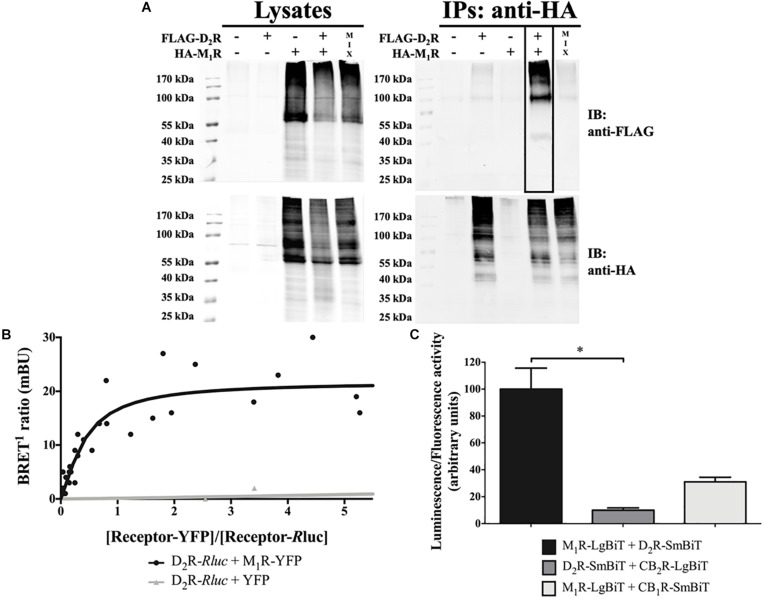
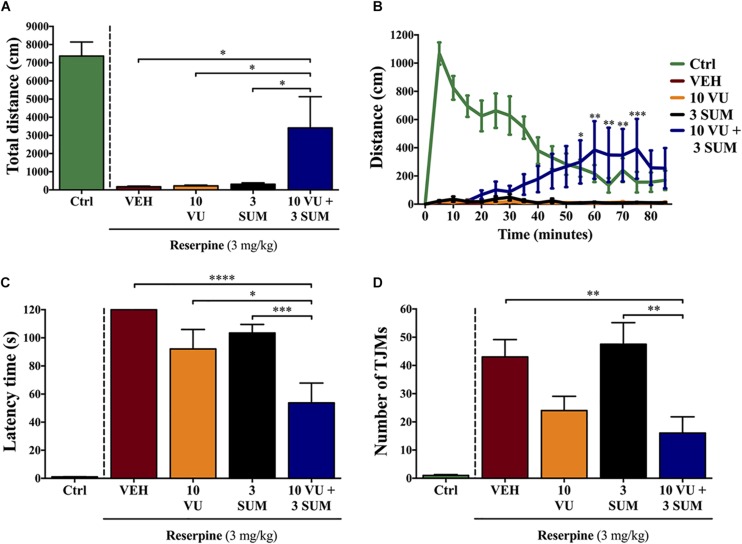
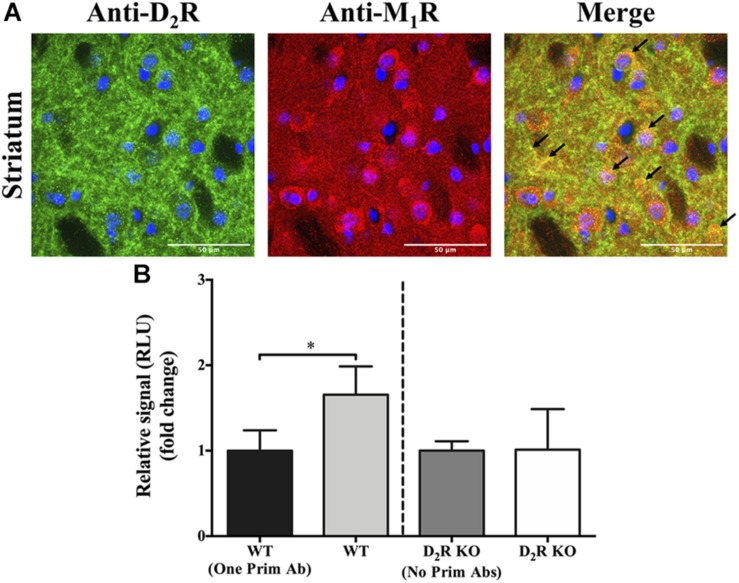
Parkinson's disease (PD) is a neurodegenerative disorder characterized by motor control deficits, which is associated with the loss of striatal dopaminergic neurons from the substantia nigra. In parallel to dopaminergic denervation, there is an increase of acetylcholine within the striatum, resulting in a striatal dopaminergic-cholinergic neurotransmission imbalance. Currently, available PD pharmacotherapy (e.g., prodopaminergic drugs) does not reinstate the altered dopaminergic-cholinergic balance. In addition, it can eventually elicit cholinergic-related adverse effects. Here, we investigated the interplay between dopaminergic and cholinergic systems by assessing the physical and functional interaction of dopamine D and muscarinic acetylcholine M receptors (DR and MR, respectively), both expressed at striatopallidal medium spiny neurons. First, we provided evidence for the existence of DR-MR complexes via biochemical (i.e., co-immunoprecipitation) and biophysical (i.e., BRET and NanoBiT) assays, performed in transiently transfected HEK293T cells. Subsequently, a DR-MR co-distribution in the mouse striatum was observed through double-immunofluorescence staining and AlphaLISA immunoassay. Finally, we evaluated the functional interplay between both receptors via behavioral studies, by implementing the classical acute reserpine pharmacological animal model of experimental parkinsonism. Reserpinized mice were administered with a DR-selective agonist (sumanirole) and/or an MR-selective antagonist (VU0255035), and alterations in PD-related behavioral tasks (i.e., locomotor activity) were evaluated. Importantly, VU0255035 (10 mg/kg) potentiated the antiparkinsonian-like effects (i.e., increased locomotor activity and decreased catalepsy) of an ineffective sumanirole dose (3 mg/kg). Altogether, our data suggest the existence of putative striatal DR/MR heteromers, which might be a relevant target to manage PD motor impairments with fewer adverse effects.
帕金森病(PD)是一种以运动控制缺陷为特征的神经退行性疾病,与黑质纹状体多巴胺能神经元的丧失有关。与多巴胺能去神经支配同时发生的是,纹状体内乙酰胆碱增加,导致纹状体多巴胺能-胆碱能神经传递失衡。目前,现有的帕金森病药物治疗(如前多巴胺能药物)并不能恢复改变的多巴胺能-胆碱能平衡。此外,它最终可能引发胆碱能相关的不良反应。在这里,我们通过评估分别在纹状体苍白球中型多棘神经元表达的多巴胺D受体和毒蕈碱型乙酰胆碱M受体(分别为DR和MR)的物理和功能相互作用,研究了多巴胺能和胆碱能系统之间的相互作用。首先,我们通过在瞬时转染的HEK293T细胞中进行的生化(即免疫共沉淀)和生物物理(即BRET和NanoBiT)分析,为DR-MR复合物的存在提供了证据。随后,通过双重免疫荧光染色和AlphaLISA免疫分析观察到小鼠纹状体中DR-MR的共分布。最后,我们通过行为学研究,采用经典的急性利血平药理学实验性帕金森病动物模型,评估了两种受体之间的功能相互作用。给利血平化的小鼠施用DR选择性激动剂(舒马普坦)和/或MR选择性拮抗剂(VU0255035),并评估帕金森病相关行为任务(即运动活动)的改变。重要的是,VU0255035(10mg/kg)增强了无效剂量舒马普坦(3mg/kg)的抗帕金森样作用(即增加运动活动和减少僵住)。总之,我们的数据表明存在假定的纹状体DR/MR异聚体,这可能是一个相关靶点,用于管理帕金森病运动障碍且副作用较少。