Abramovs Nikita, Brass Andrew, Tassabehji May
School of Computer Science, University of Manchester, Manchester, United Kingdom.
Faculty of Biology, Medicine and Health, School of Biological Sciences, University of Manchester, Manchester, United Kingdom.
Front Genet. 2020 Mar 13;11:210. doi: 10.3389/fgene.2020.00210. eCollection 2020.
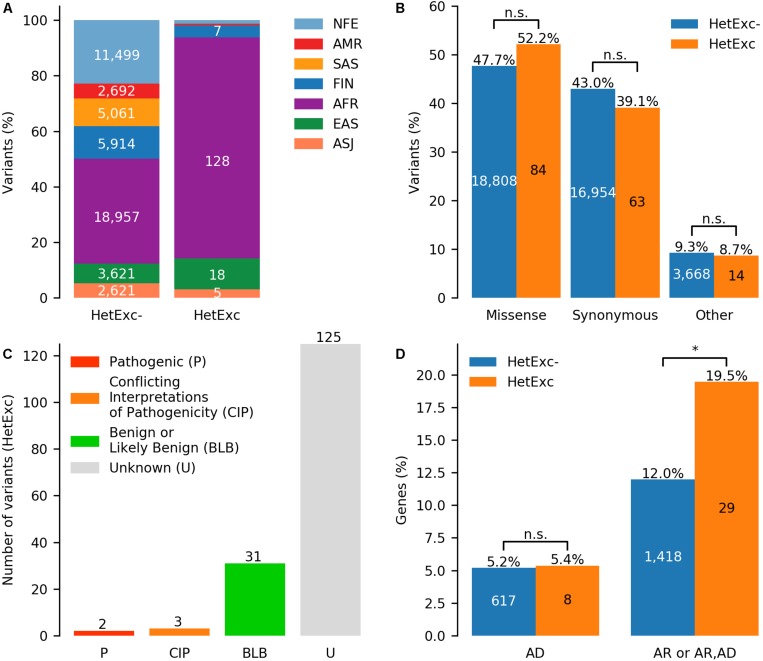
Hardy-Weinberg Equilibrium (HWE) is used to estimate the number of homozygous and heterozygous variant carriers based on its allele frequency in populations that are not evolving. Deviations from HWE in large population databases have been used to detect genotyping errors, which can result in extreme heterozygote excess (HetExc). However, HetExc might also be a sign of natural selection since recessive disease causing variants should occur less frequently in a homozygous state in the population, but may reach high allele frequency in a heterozygous state, especially if they are advantageous. We developed a filtering strategy to detect these variants and applied it on genome data from 137,842 individuals. The main limitations of this approach were quality of genotype calls and insufficient population sizes, whereas population structure and inbreeding can reduce sensitivity, but not precision, in certain populations. Nevertheless, we identified 161 HetExc variants in 149 genes, most of which were specific to African/African American populations (∼79.5%). Although the majority of them were not associated with known diseases, or were classified as clinically "benign," they were enriched in genes associated with autosomal recessive diseases. The resulting dataset also contained two known recessive disease causing variants with evidence of heterozygote advantage in the sickle-cell anemia and cystic fibrosis . Finally, we provide supporting evidence of a novel heterozygote advantageous variant in the chromodomain helicase DNA binding protein 6 gene (; involved in influenza virus replication). We anticipate that our approach will aid the detection of rare recessive disease causing variants in the future.
哈迪-温伯格平衡(HWE)用于根据非进化群体中的等位基因频率来估计纯合子和杂合子变异携带者的数量。在大型群体数据库中,与HWE的偏差已被用于检测基因分型错误,这可能导致极端杂合子过剩(HetExc)。然而,HetExc也可能是自然选择的一个迹象,因为导致隐性疾病的变异在群体中以纯合状态出现的频率应该较低,但在杂合状态下可能达到较高的等位基因频率,特别是如果它们具有优势。我们开发了一种过滤策略来检测这些变异,并将其应用于来自137842个人的基因组数据。这种方法的主要局限性是基因分型调用的质量和群体规模不足,而群体结构和近亲繁殖在某些群体中会降低敏感性,但不会降低精度。尽管如此,我们在149个基因中鉴定出161个HetExc变异,其中大多数是非洲/非裔美国人特有的(约79.5%)。虽然其中大多数与已知疾病无关,或被归类为临床“良性”,但它们在与常染色体隐性疾病相关的基因中富集。所得数据集还包含两个已知的导致隐性疾病的变异,在镰状细胞贫血和囊性纤维化中有杂合子优势的证据。最后,我们提供了染色质结构域解旋酶DNA结合蛋白6基因(参与流感病毒复制)中一个新的杂合子优势变异的支持证据。我们预计我们的方法将有助于未来检测导致罕见隐性疾病的变异。