Department of Biomedical Sciences, University of Pennsylvania School of Veterinary Medicine, Philadelphia, PA, USA.
Department of Biology, University of Pennsylvania, 433 South University Avenue, Philadelphia, PA, USA.
Sci Adv. 2020 Mar 25;6(13):eaaz2129. doi: 10.1126/sciadv.aaz2129. eCollection 2020 Mar.
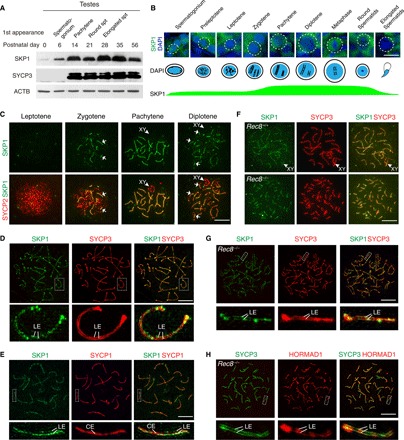
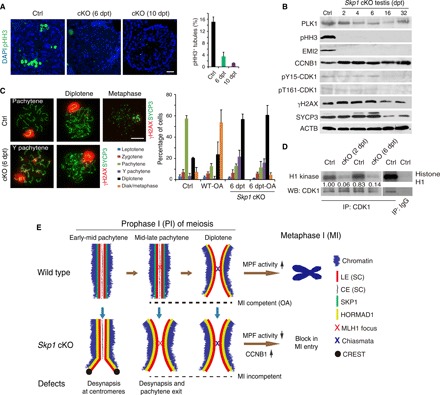
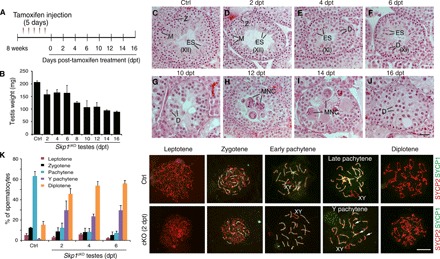
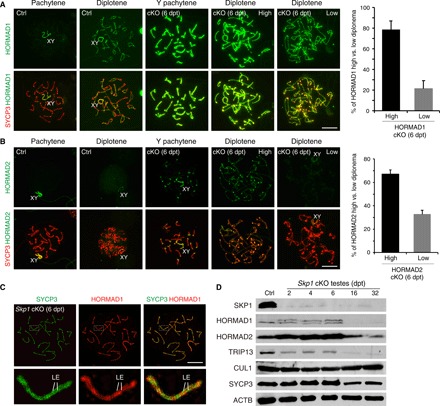
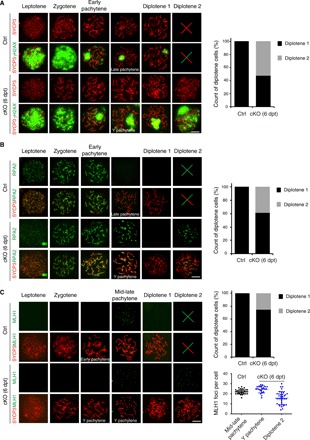
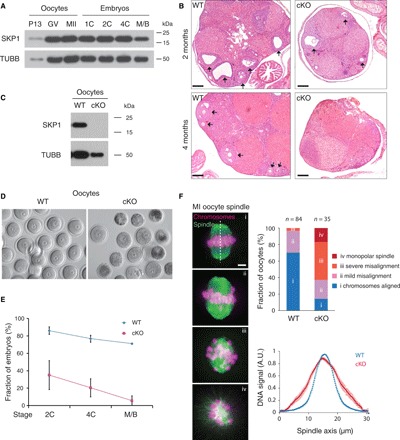
The meiotic prophase I to metaphase I (PI/MI) transition requires chromosome desynapsis and metaphase competence acquisition. However, control of these major meiotic events is poorly understood. Here, we identify an essential role for SKP1, a core subunit of the SKP1-Cullin-F-box (SCF) ubiquitin E3 ligase, in the PI/MI transition. SKP1 localizes to synapsed chromosome axes and evicts HORMAD proteins from these regions in meiotic spermatocytes. SKP1-deficient spermatocytes display premature desynapsis, precocious pachytene exit, loss of PLK1 and BUB1 at centromeres, but persistence of HORMAD, γH2AX, RPA2, and MLH1 in diplonema. Strikingly, SKP1-deficient spermatocytes show sharply reduced MPF activity and fail to enter MI despite treatment with okadaic acid. SKP1-deficient oocytes exhibit desynapsis, chromosome misalignment, and progressive postnatal loss. Therefore, SKP1 maintains synapsis in meiosis of both sexes. Furthermore, our results support a model where SKP1 functions as the long-sought intrinsic metaphase competence factor to orchestrate MI entry during male meiosis.
减数分裂前期 I 到中期 I(PI/MI)的转变需要染色体解联和获得中期能力。然而,这些主要的减数分裂事件的控制机制还知之甚少。在这里,我们发现 SKP1(SKP1-Cullin-F-box(SCF)泛素 E3 连接酶的核心亚基)在 PI/MI 转变中起着至关重要的作用。SKP1 定位于联会的染色体轴上,并将 HORMAD 蛋白从减数分裂精母细胞的这些区域中驱逐出去。SKP1 缺陷型精母细胞表现出过早的解联、早熟的粗线期退出、着丝粒处 PLK1 和 BUB1 的丢失,但在二联体中仍存在 HORMAD、γH2AX、RPA2 和 MLH1。引人注目的是,尽管用渥曼青霉素处理,SKP1 缺陷型精母细胞的 MPF 活性明显降低,无法进入 MI。SKP1 缺陷型卵母细胞表现出解联、染色体错位和出生后逐渐丢失。因此,SKP1 维持了两性减数分裂中的联会。此外,我们的结果支持了这样一种模型,即 SKP1 作为长期以来寻找的内在中期能力因子,在雄性减数分裂中协调 MI 的进入。