Gerlin Léo, Cottret Ludovic, Cesbron Sophie, Taghouti Géraldine, Jacques Marie-Agnès, Genin Stéphane, Baroukh Caroline
LIPM, Université de Toulouse, INRAE, CNRS, Castanet-Tolosan, France.
IRHS, INRAE, AGROCAMPUS-Ouest, Université d'Angers, Beaucouzé, France.
mSystems. 2020 Mar 31;5(2):e00698-19. doi: 10.1128/mSystems.00698-19.
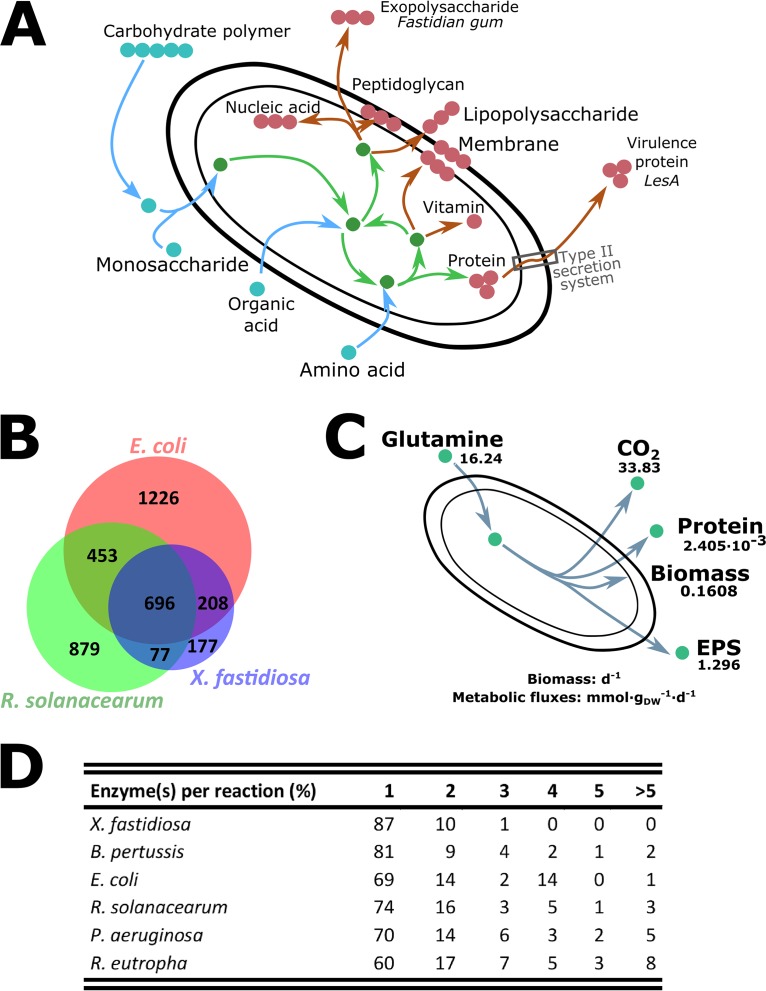
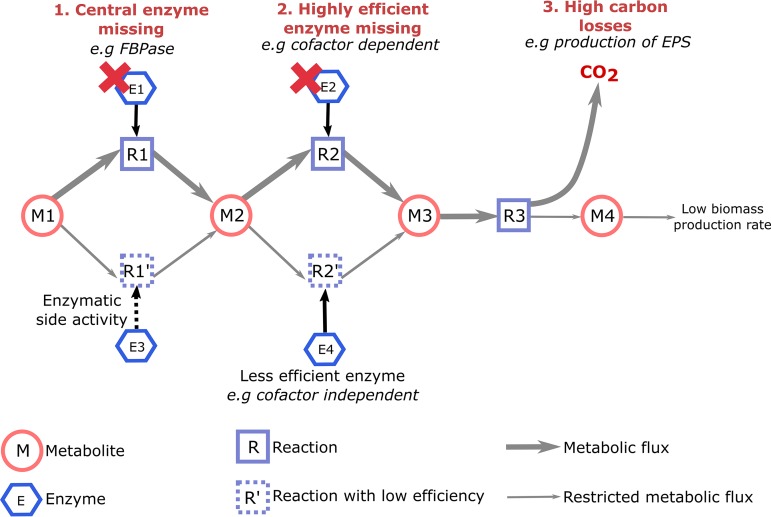
High proliferation rate and robustness are vital characteristics of bacterial pathogens that successfully colonize their hosts. The observation of drastically slow growth in some pathogens is thus paradoxical and remains unexplained. In this study, we sought to understand the slow (fastidious) growth of the plant pathogen Using genome-scale metabolic network reconstruction, modeling, and experimental validation, we explored its metabolic capabilities. Despite genome reduction and slow growth, the pathogen's metabolic network is complete but strikingly minimalist and lacking in robustness. Most alternative reactions were missing, especially those favoring fast growth, and were replaced by less efficient paths. We also found that the production of some virulence factors imposes a heavy burden on growth. Interestingly, some specific determinants of fastidious growth were also found in other slow-growing pathogens, enriching the view that these metabolic peculiarities are a pathogenicity strategy to remain at a low population level. is one of the most important threats to plant health worldwide, causing disease in the Americas on a range of agricultural crops and trees, and recently associated with a critical epidemic affecting olive trees in Europe. A main challenge for the detection of the pathogen and the development of physiological studies is its fastidious growth, as the generation time can vary from 10 to 100 h for some strains. This physiological peculiarity is shared with several human pathogens and is poorly understood. We performed an analysis of the metabolic capabilities of through a genome-scale metabolic model of the bacterium. This model was reconstructed and manually curated using experiments and bibliographical evidence. Our study revealed that fastidious growth most probably results from different metabolic specificities such as the absence of highly efficient enzymes or a global inefficiency in virulence factor production. These results support the idea that the fragility of the metabolic network may have been shaped during evolution to lead to the self-limiting behavior of .
高增殖率和稳健性是成功定殖于宿主的细菌病原体的重要特征。因此,观察到一些病原体生长极度缓慢是自相矛盾的,且仍未得到解释。在本研究中,我们试图了解植物病原体的缓慢(苛求型)生长。通过基因组规模的代谢网络重建、建模和实验验证,我们探索了其代谢能力。尽管基因组缩减且生长缓慢,但该病原体的代谢网络是完整的,但极为简约且缺乏稳健性。大多数替代反应缺失,尤其是那些有利于快速生长的反应,取而代之的是效率较低的途径。我们还发现,一些毒力因子的产生对生长造成了沉重负担。有趣的是,在其他生长缓慢的病原体中也发现了一些导致苛求型生长的特定决定因素,这强化了这样一种观点,即这些代谢特性是一种将种群水平维持在较低水平的致病策略。是全球植物健康面临的最重要威胁之一,在美洲导致一系列农作物和树木患病,最近还与影响欧洲橄榄树的一场严重疫情有关。检测该病原体和开展生理学研究的一个主要挑战是其苛求型生长,因为某些菌株的代时可在10至100小时之间变化。这种生理特性与几种人类病原体共有,且人们对此了解甚少。我们通过该细菌的基因组规模代谢模型对的代谢能力进行了分析。该模型是利用实验和文献证据重建并人工编辑的。我们的研究表明,苛求型生长很可能源于不同的代谢特异性,例如缺乏高效酶或毒力因子产生的整体低效性。这些结果支持了这样一种观点,即代谢网络的脆弱性可能在进化过程中形成,从而导致的自我限制行为。