Pulmonary, Critical Care & Sleep Medicine, Department of Medicine, the University of Oklahoma Health Sciences Center, Oklahoma City, OK 73104, USA.
Department of Microbiology and Immunology, the University of Oklahoma Health Sciences Center, Oklahoma City, OK 73104, USA.
Viruses. 2020 Mar 29;12(4):377. doi: 10.3390/v12040377.
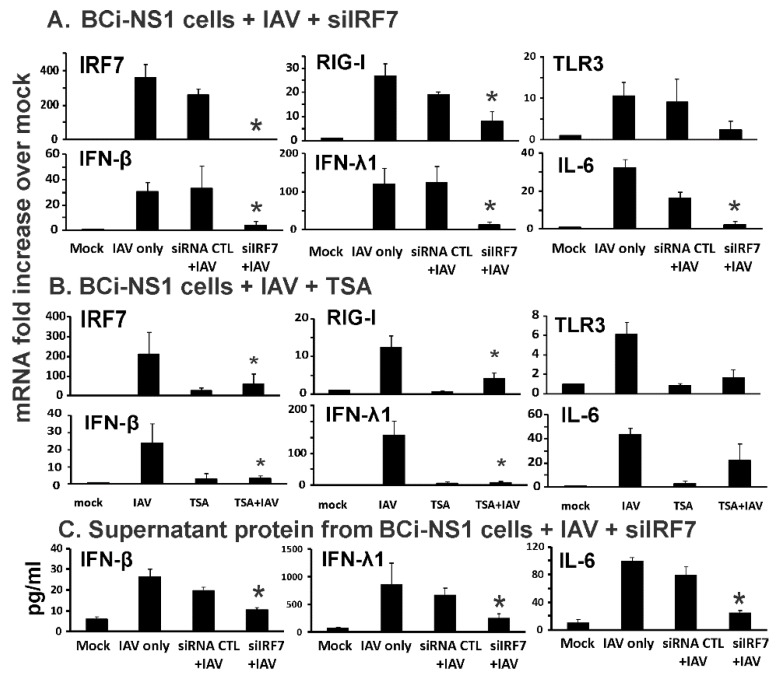
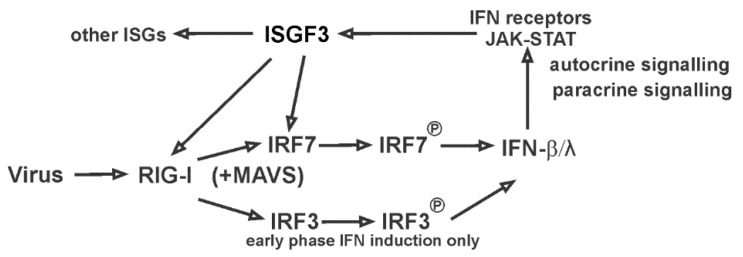
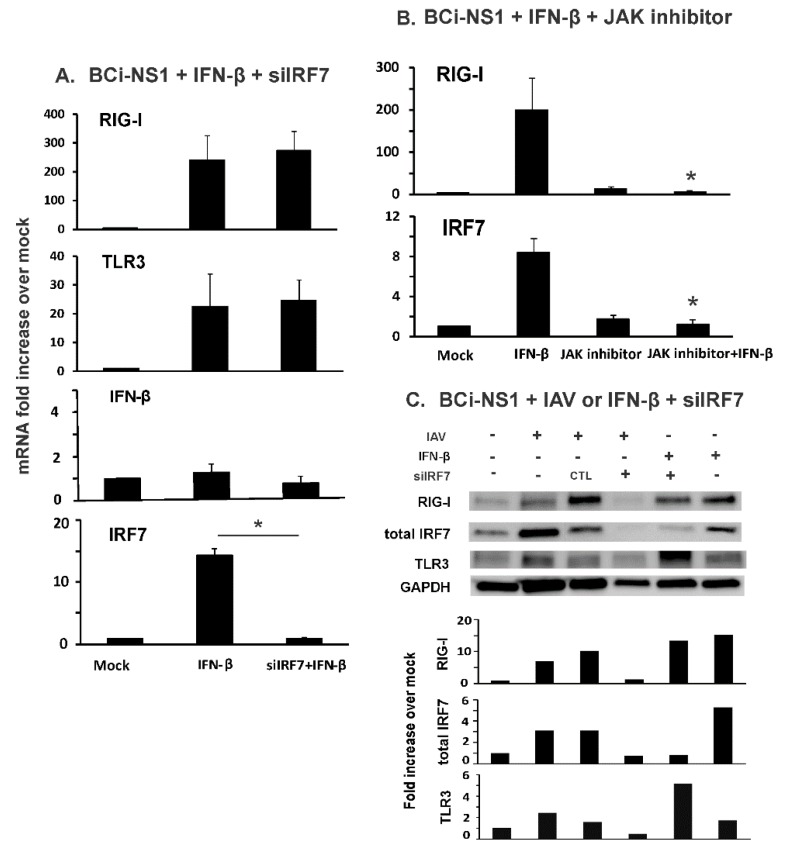
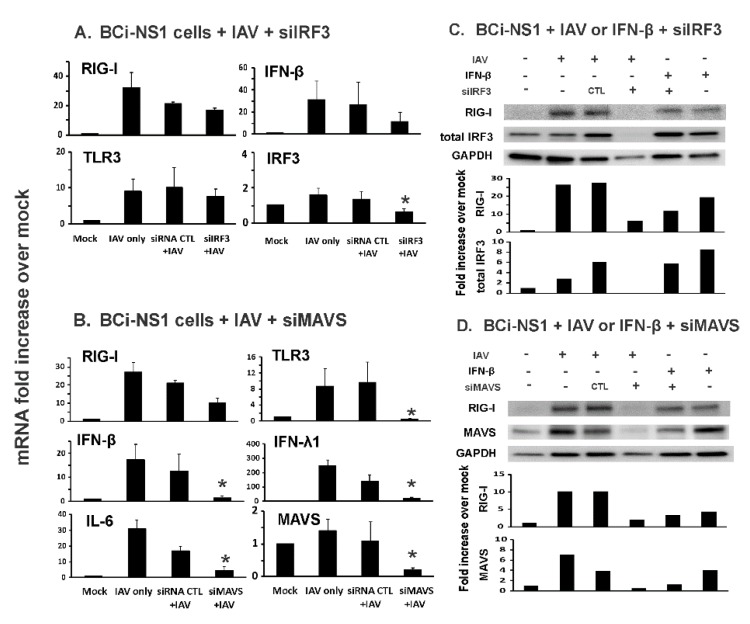
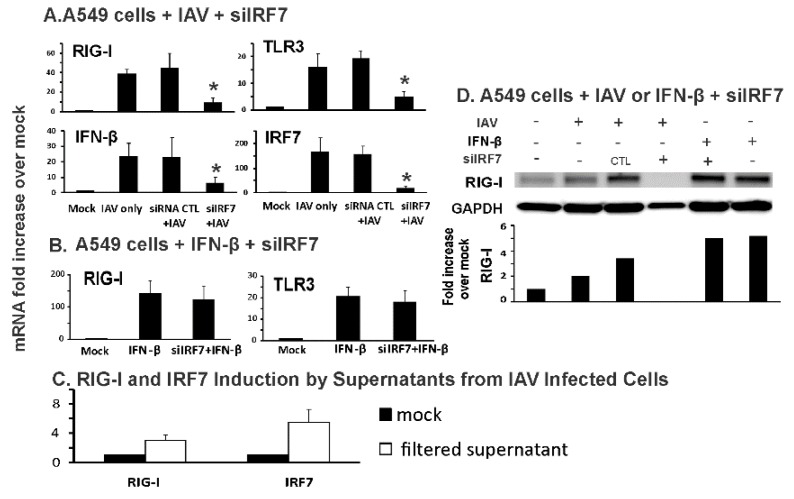
Influenza A virus (IAV) infection is a major cause of morbidity and mortality. Retinoic acid-inducible protein I (RIG-I) plays an important role in the recognition of IAV in most cell types, and leads to the activation of interferon (IFN). We investigated mechanisms of RIG-I and IFN induction by IAV in the BCi-NS1.1 immortalized human airway basal cell line and in the A549 human alveolar epithelial cell line. We found that the basal expression levels of RIG-I and regulatory transcription factor (IRF) 7 were very low in BCi-NS1.1 cells. IAV infection induced robust RIG-I and IRF7, not IRF3, expression. siRNA against IRF7 and mitochondrial antiviral-signaling protein (MAVS), but not IRF3, significantly inhibited RIG-I mRNA expression and IFN induction by IAV infection. Most importantly, even without virus infection, IFN-β alone induced RIG-I, and siRNA against IRF7 did not inhibit RIG-I induction by IFN-β. Similar results were found in the alveolar basal epithelial A549 cell line. RIG-I and IRF7 expression in humans is highly inducible and greatly amplified by IFN produced from virus infected cells. IFN induction can be separated into two phases, that initially induced by the virus with basal RIG-I (the first phase), and that induced by the subsequent virus with amplified RIG-I from the first phase IFN (the second phase). The synthesis of IRF7 is required for the second phase IFN induction during influenza virus infection in human lung bronchial and alveolar epithelial cells.
甲型流感病毒(IAV)感染是发病率和死亡率的主要原因。视黄酸诱导蛋白 I(RIG-I)在大多数细胞类型中对 IAV 的识别中起重要作用,并导致干扰素(IFN)的激活。我们研究了 RIG-I 和 IFN 诱导的机制由 IAV 在 BCi-NS1.1 永生化人气道基底细胞系和 A549 人肺泡上皮细胞系。我们发现 RIG-I 和调节转录因子(IRF)7 的基础表达水平在 BCi-NS1.1 细胞中非常低。IAV 感染诱导强烈的 RIG-I 和 IRF7,但不是 IRF3 表达。针对 IRF7 和线粒体抗病毒信号蛋白(MAVS)的 siRNA,但不是 IRF3,显着抑制 RIG-I mRNA 表达和 IAV 感染诱导的 IFN。最重要的是,即使没有病毒感染,IFN-β 本身也会诱导 RIG-I,并且针对 IRF7 的 siRNA 不会抑制 IFN-β 诱导的 RIG-I。在肺泡基底上皮 A549 细胞系中也发现了类似的结果。人类的 RIG-I 和 IRF7 表达高度可诱导,并且由病毒感染细胞产生的 IFN 大大放大。IFN 诱导可分为两个阶段,即最初由具有基础 RIG-I 的病毒诱导(第一阶段),以及由第一阶段 IFN 放大的 RIG-I 诱导的后续病毒诱导(第二阶段)。IRF7 的合成是流感病毒感染期间人肺支气管和肺泡上皮细胞中第二阶段 IFN 诱导所必需的。