Laboratory of Epidemiology and Population Sciences, NIA/NIH/IRP, Baltimore, MD 21224, USA.
Department of Research Programs, Fort Belvoir Community Hospital, Fort Belvoir, VA 22060, USA.
Nutrients. 2020 Mar 30;12(4):950. doi: 10.3390/nu12040950.
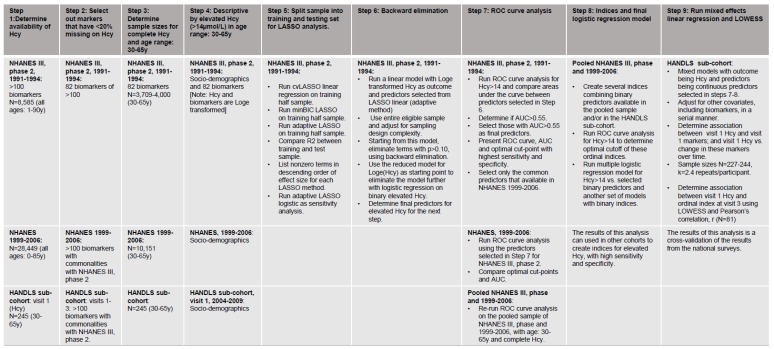
Elevated blood homocysteine (Hcy) among middle-aged adults can increase age-related disease risk, possibly through other biochemical and hematological markers. We selected markers for hyperhomocysteinemia among middle-aged adults, studied time-dependent Hcy-marker associations and computed highly predictive indices of hyperhomocysteinemia, with cross-sectional and longitudinal validations. We used data from the National Health and Nutrition Examination Survey (NHANES III, phase 2, = 4000), the NHANES 1999-2006 ( = 10,151) and pooled NHANES (cross-sectional validation). Longitudinal validation consisted of mixed-effects linear regression models (Hcy predicting markers' annual rates of change), applied to the Healthy Aging in Neighborhoods of Diversity Across the Life Span (HANDLS, = 227-244 participants, k = 2.4 repeats/participant, Age: 30-65 years) data. Machine learning detected nine independent markers for Hcy > 14 µmol/L (NHANES III, phase 2): older age; lower folate and B-12 status; higher serum levels of creatinine, uric acid, alkaline phosphatase, and cotinine; mean cell hemoglobin and red cell distribution widths (RDW); results replicated in the 1999-2006 NHANES [AUC = 0.60-0.80]. Indices combining binary markers increased elevated Hcy odds by 6.9-7.5-fold. In HANDLS, first-visit Hcy predicted annual increase in creatinine, RDW and alkaline phosphatase, with third-visit index (2013-2018) directly predicting Hcy (2004-2009). We provide evidence of the internal and external validity of indices composed of several biomarkers that are strongly associated with elevated Hcy.
中年人群血液同型半胱氨酸(Hcy)升高与年龄相关疾病风险增加有关,可能通过其他生化和血液学标志物起作用。我们选择了中年人群高同型半胱氨酸血症的标志物,研究了 Hcy 标志物随时间变化的关联,并计算了高同型半胱氨酸血症的高度预测指数,进行了横断面和纵向验证。我们使用了来自国家健康和营养调查(NHANES III,第 2 阶段,n = 4000)、NHANES 1999-2006(n = 10151)和合并的 NHANES(横断面验证)的数据。纵向验证包括混合效应线性回归模型(Hcy 预测标志物每年的变化率),应用于多样性跨生命周期邻里健康老龄化研究(HANDLS,n = 227-244 名参与者,k = 2.4 次/参与者,年龄:30-65 岁)数据。机器学习检测到 9 个与 Hcy > 14 µmol/L 相关的独立标志物(NHANES III,第 2 阶段):年龄较大;叶酸和 B12 水平较低;血清肌酐、尿酸、碱性磷酸酶和可替宁水平较高;平均细胞血红蛋白和红细胞分布宽度(RDW)较高;结果在 1999-2006 年的 NHANES 中得到复制[AUC = 0.60-0.80]。结合二分类标志物的指数将升高的 Hcy 比值增加了 6.9-7.5 倍。在 HANDLS 中,首次就诊的 Hcy 预测肌酐、RDW 和碱性磷酸酶的年度增加,而第三次就诊的指数(2013-2018 年)直接预测 Hcy(2004-2009 年)。我们提供了证据,证明由与升高的 Hcy 密切相关的几个生物标志物组成的指数具有内部和外部有效性。