Department of Gastroenterology, Hepatology and Endocrinology, Hannover Medical School, Hannover, Germany.
Department of Medicine II, Division of Hepatology, Medical Faculty Mannheim, University of Heidelberg, Mannheim, Germany.
Cell Death Dis. 2020 Mar 31;11(3):212. doi: 10.1038/s41419-020-2411-6.
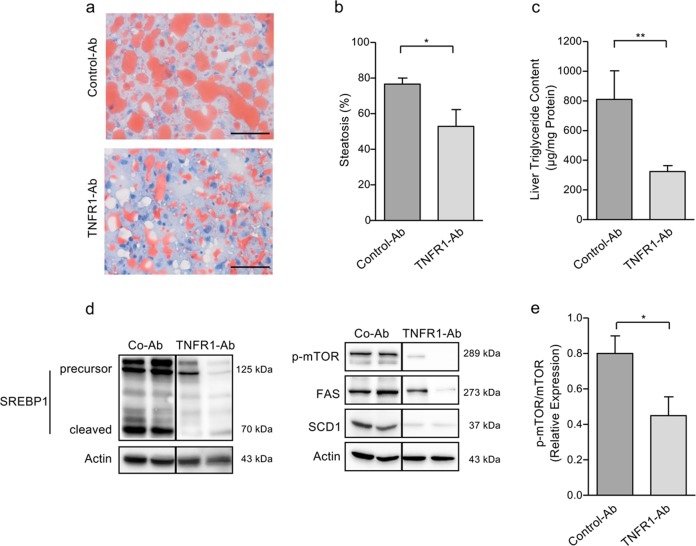
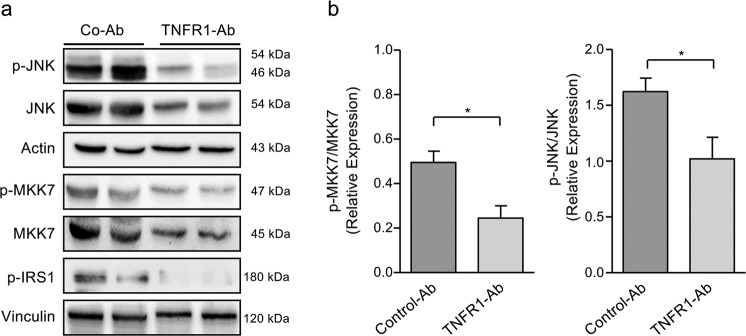
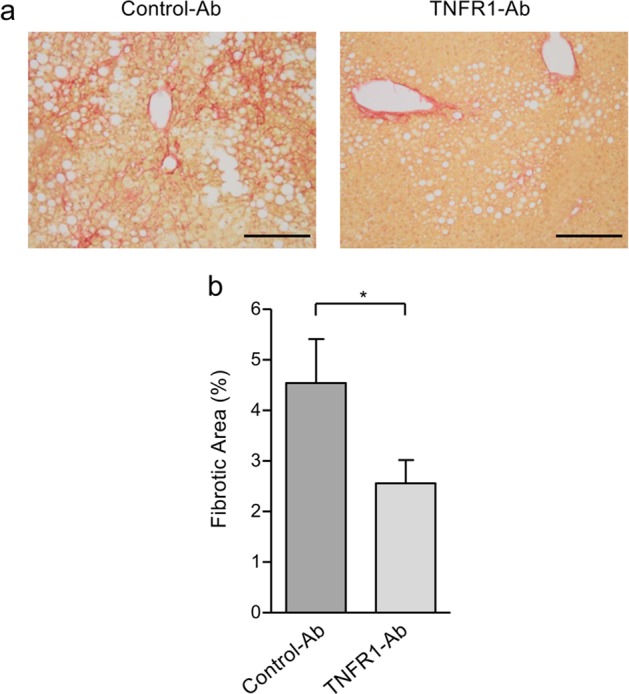
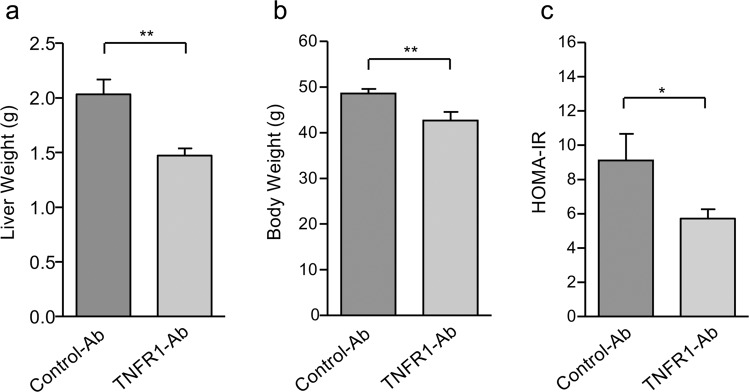
Non-alcoholic fatty liver disease (NAFLD) shows an increasing prevalence and is associated with the development of liver fibrosis and cirrhosis as the major risk factors of liver-related mortality in this disease. The therapeutic possibilities are limited and restricted to life style intervention, since specific drugs for NAFLD are unavailable so far. TNFα has been implicated as a major pathogenic driver of NAFLD. TNFα-mediated liver injury occurs mainly via TNF-receptor-1 (TNFR1) signaling, whereas TNFR2 mediates protective pathways. In this study, we analyzed the therapeutic effects of a novel antibody, which selectively inhibits TNFR1 while retaining protective TNFR2 signaling in a high-fat diet (HFD) mouse model of NAFLD. Mice were fed with HFD for 32 weeks and treated with anti-TNFR1-antibody or control-antibody for the last 8 weeks. We then investigated the mechanisms of TNFR1 inhibition on liver steatosis, inflammatory liver injury, insulin resistance and fibrosis. Compared to control-antibody treatment, TNFR1 inhibition significantly reduced liver steatosis and triglyceride content, which was accompanied by reduced expression and activation of the transcription factor SREBP1 and downstream target genes of lipogenesis. Furthermore, inhibition of TNFR1 resulted in reduced activation of the MAP kinase MKK7 and its downstream target JNK, which was associated with significant improvement of insulin resistance. Apoptotic liver injury, NAFLD activity and alanine aminotransferase (ALT) levels, as well as liver fibrosis significantly decreased by anti-TNFR1 compared to control-antibody treatment. Thus, our results suggest selective TNFR1 inhibition as a promising approach for NAFLD treatment.
非酒精性脂肪性肝病(NAFLD)的发病率不断上升,并且与肝纤维化和肝硬化的发展密切相关,这些是导致该病患者肝相关死亡率的主要危险因素。由于目前尚无针对 NAFLD 的特定药物,治疗方法有限且仅限于生活方式干预。TNFα 被认为是 NAFLD 的主要致病驱动因素。TNFα 介导的肝损伤主要通过 TNF 受体 1(TNFR1)信号发生,而 TNFR2 介导保护途径。在这项研究中,我们分析了一种新型抗体的治疗效果,该抗体选择性抑制 TNFR1 而保留保护性 TNFR2 信号在高脂肪饮食(HFD)NAFLD 小鼠模型中。小鼠用 HFD 喂养 32 周,并用抗 TNFR1 抗体或对照抗体治疗最后 8 周。然后,我们研究了 TNFR1 抑制对肝脂肪变性、炎症性肝损伤、胰岛素抵抗和纤维化的机制。与对照抗体治疗相比,TNFR1 抑制显著减少肝脂肪变性和甘油三酯含量,这伴随着转录因子 SREBP1 的表达和激活以及脂肪生成的下游靶基因减少。此外,TNFR1 的抑制导致 MAP 激酶 MKK7 及其下游靶标 JNK 的激活减少,这与胰岛素抵抗的显著改善有关。与对照抗体治疗相比,抗 TNFR1 治疗可显著减少凋亡性肝损伤、NAFLD 活动和丙氨酸氨基转移酶(ALT)水平以及肝纤维化。因此,我们的研究结果表明,选择性 TNFR1 抑制可能是治疗 NAFLD 的一种有前途的方法。