Berbara Tatiana Martins Benvenuto Louro, Morais Nathalie Silva de, Saraiva Débora Ayres, Corcino Carolina Martins, Schtscherbyna Annie, Moreira Karina Lúcia, Teixeira Patrícia de Fátima Dos Santos, Vaisman Mario
Faculdade de Medicina, Hospital Universitário Clementino Fraga Filho, Universidade Federal do Rio de Janeiro, Rio de Janeiro, RJ, Brasil.
Arch Endocrinol Metab. 2020 Apr;64(2):159-164. doi: 10.20945/2359-3997000000209. Epub 2020 Mar 27.
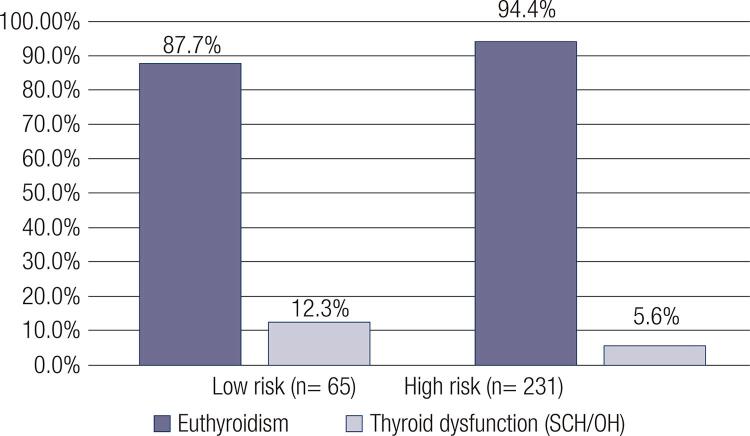
Objective Maternal hypothyroidism during pregnancy may lead to adverse outcomes. Recently published guidelines by the American Thyroid Association (ATA) do not advocate for universal screening but recommend a case-finding approach in high-risk pregnant women. The present study aims to evaluate the accuracy of this approach in identifying women with thyroid dysfunction during early pregnancy. Subjects and methods This is a multiple-center, cross-sectional study. Three hundred and one pregnant women were enrolled. Anamnesis and a physical examination were performed to detect which women fulfilled the criteria to undergo laboratory screening of thyroid dysfunction, according to the ATA's 2017 guidelines. The Zulewski's validated clinical score was applied to assess signs and symptoms of hypothyroidism. Serum levels of thyrotropin (TSH), free thyroxine (FT4), anti-thyroperoxidase (TPO-Ab), and anti-thyroglobulin (Tg-Ab) antibodies were determined. Results Two hundred and thirty one women (78%) were classified as high risk, and 65 (22%) were classified as low risk for thyroid dysfunction. Regarding the clinical score, 75 patients (31.2%) presented mild symptoms that were compatible with SCH, of which 22 (7.4%) had symptoms as the only risk factor for thyroid disease. 17 patients (5.7%) had SCH, of which 10 (58.8%) belonged to the high-risk group, and 7 (41.2%) belonged to the low-risk group. OH was found in 4 patients (1.4%): 3 (75%) in the high-risk group and 1 (25%) in the low-risk group. Conclusions The ATA's proposed screening criteria were not accurate in the diagnosis of thyroid dysfunction in pregnancy. Testing only the high-risk pregnant women would miss approximately 40% of all hypothyroid patients.
目的 孕期母亲甲状腺功能减退可能导致不良后果。美国甲状腺协会(ATA)最近发布的指南不提倡进行普遍筛查,而是建议对高危孕妇采用病例发现方法。本研究旨在评估这种方法在识别孕早期甲状腺功能障碍女性中的准确性。
对象与方法 这是一项多中心横断面研究。招募了301名孕妇。根据ATA 2017年指南,进行病史采集和体格检查,以确定哪些女性符合进行甲状腺功能障碍实验室筛查的标准。应用Zulewski验证的临床评分来评估甲状腺功能减退的体征和症状。测定血清促甲状腺激素(TSH)、游离甲状腺素(FT4)、抗甲状腺过氧化物酶(TPO-Ab)和抗甲状腺球蛋白(Tg-Ab)抗体水平。
结果 231名女性(78%)被归类为甲状腺功能障碍高危,65名(22%)被归类为低危。关于临床评分,75例患者(31.2%)出现与亚临床甲状腺功能减退(SCH)相符的轻度症状,其中22例(7.4%)以症状作为甲状腺疾病的唯一危险因素。17例患者(5.7%)患有SCH,其中10例(58.8%)属于高危组,7例(41.2%)属于低危组。4例患者(1.4%)发现有显性甲减(OH):高危组3例(75%),低危组1例(25%)。
结论 ATA提出的筛查标准在诊断孕期甲状腺功能障碍方面不准确。仅对高危孕妇进行检测会遗漏约40%的所有甲状腺功能减退患者。