First Department of Medicine, University Medical Centre Mannheim (UMM), Faculty of Medicine Mannheim, University of Heidelberg, Theodor-Kutzer-Ufer 1-3, 68167, Mannheim, Germany.
European Center for AngioScience (ECAS), Mannheim, Germany.
Clin Res Cardiol. 2020 Nov;109(11):1333-1341. doi: 10.1007/s00392-020-01627-8. Epub 2020 Mar 31.
Interventional left atrial appendage closure (LAAC) effectively prevents thromboembolic events in atrial fibrillation patients. Impaired left ventricular ejection fraction (LVEF) increases not only the thromboembolic risk but also the complication rates of cardiac interventions. The LAAC procedure's benefit in patients with an impaired LVEF, therefore, has yet to be investigated.
LAARGE is a prospective, non-randomized registry depicting the clinical reality of LAAC in Germany. Procedure was conducted with different standard commercial devices, and follow-up period was one year. In the sense of an as-treated analysis, patients with started procedure and documented LVEF were selected from the whole database.
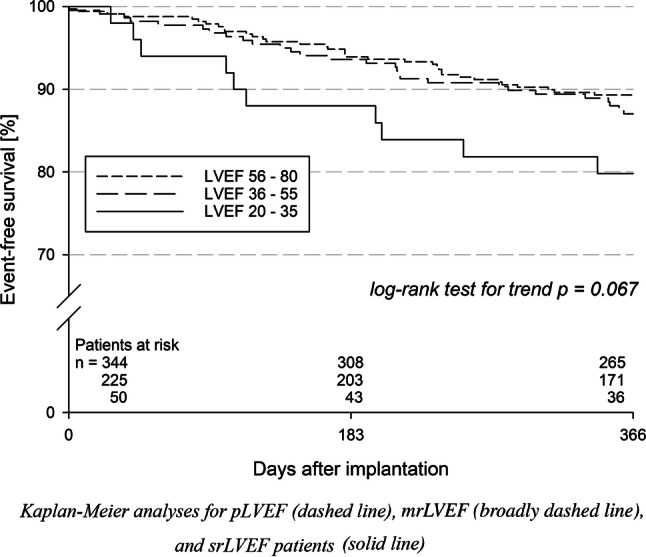
619 patients from 37 centers were categorized into one of three groups: LVEF > 55% (56%), 36-55% (36%), and ≤ 35% (8%). Prevalence of cardiovascular comorbidity increased with LVEF reduction (p < 0.001 for trend). CHADS-VASc score was 4.3, 4.8, and 5.1 (p < 0.001), and HAS-BLED score was 3.7, 4.1, and 4.2 (p < 0.001). Implantation success was consistently high (97.9%), rates of intra-hospital MACCE (0.5%), and other major complications (4.2%) were low (each p = NS). Kaplan-Meier estimation showed a decrease in survival free of stroke with LVEF reduction during one-year follow-up (89.3 vs. 87.0 vs. 79.8%; p = 0.067), a trend which was no longer evident after adjustment for relevant confounding factors. Rates of non-fatal strokes (0.4 vs. 1.1 vs. 0%) and severe bleedings (0.7 vs. 0.0 vs. 3.1%) were consistently low across all groups (each p = NS).
LVEF reduction neither influenced the procedural success nor the effectiveness and safety of stroke prevention by LAAC.
ClinicalTrials.gov Identifier: NCT02230748.
介入性左心耳封堵术(LAAC)可有效预防房颤患者的血栓栓塞事件。左心室射血分数(LVEF)降低不仅增加血栓栓塞风险,还增加心脏介入治疗的并发症发生率。因此,需要研究 LAAC 术在左心室射血分数降低患者中的获益。
LAARGE 是一项描述德国 LAAC 临床实际情况的前瞻性、非随机登记研究。该研究采用不同的标准商业设备进行操作,随访时间为 1 年。根据治疗分析的思路,从整个数据库中选择已开始治疗并记录 LVEF 的患者。
来自 37 个中心的 619 名患者分为三组:LVEF>55%(56%)、36-55%(36%)和≤35%(8%)。心血管合并症的患病率随 LVEF 降低而增加(趋势 p<0.001)。CHADS-VASc 评分分别为 4.3、4.8 和 5.1(p<0.001),HAS-BLED 评分分别为 3.7、4.1 和 4.2(p<0.001)。植入成功率始终很高(97.9%),院内主要不良心脑血管事件(MACCE)发生率(0.5%)和其他主要并发症发生率(4.2%)较低(均 p=NS)。Kaplan-Meier 估计显示,在 1 年随访期间,LVEF 降低与无卒中生存率降低相关(89.3%比 87.0%比 79.8%;p=0.067),但在调整了相关混杂因素后,这种趋势不再明显。非致死性卒中发生率(0.4%比 1.1%比 0%)和严重出血发生率(0.7%比 0.0%比 3.1%)在所有组中均较低(均 p=NS)。
LVEF 降低既不影响 LAAC 的手术成功率,也不影响卒中预防的有效性和安全性。
ClinicalTrials.gov 标识符:NCT02230748。