Department of Chemistry, University of Cambridge, Lensfield Road, CB2 1EW, Cambridge, UK.
Instituto de Medicina Molecular, Faculdade de Medicina, Universidade de Lisboa, Avenida Professor Egas Moniz, 1649-028, Lisboa, Portugal.
Chemistry. 2020 May 12;26(27):5965-5969. doi: 10.1002/chem.202001146. Epub 2020 Apr 28.
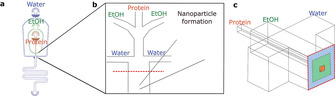
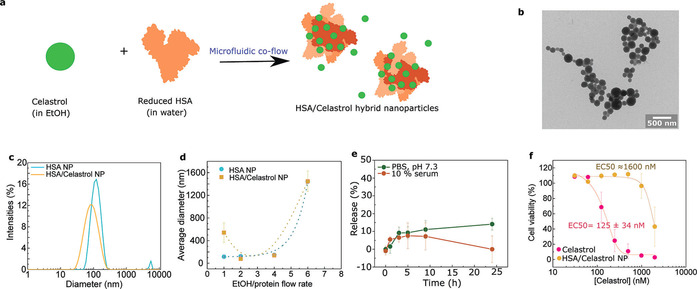
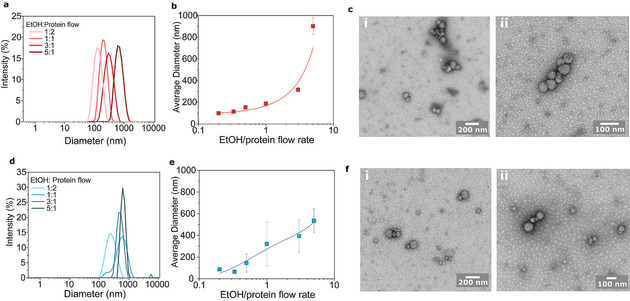
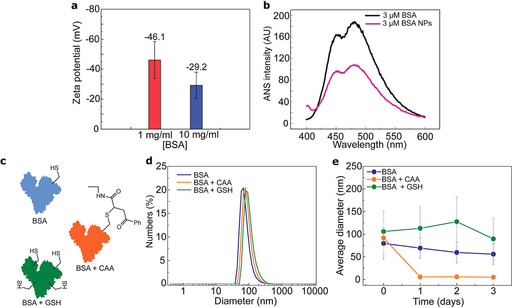
Nanoparticles are widely studied as carrier vehicles in biological systems because their size readily allows access through cellular membranes. Moreover, they have the potential to carry cargo molecules and as such, these factors make them especially attractive for intravenous drug delivery purposes. Interest in protein-based nanoparticles has recently gained attraction due to particle biocompatibility and lack of toxicity. However, the production of homogeneous protein nanoparticles with high encapsulation efficiencies, without the need for additional cross-linking or further engineering of the molecule, remains challenging. Herein, we present a microfluidic 3D co-flow device to generate human serum albumin/celastrol nanoparticles by co-flowing an aqueous protein solution with celastrol in ethanol. This microscale co-flow method resulted in the formation of nanoparticles with a homogeneous size distribution and an average size, which could be tuned from ≈100 nm to 1 μm by modulating the flow rates used. We show that the high stability of the particles stems from the covalent cross-linking of the naturally present cysteine residues within the particles formed during the assembly step. By choosing optimal flow rates during synthesis an encapsulation efficiency of 75±24 % was achieved. Finally, we show that this approach achieves significantly enhanced solubility of celastrol in the aqueous phase and, crucially, reduced cellular toxicity.
纳米粒子因其尺寸易于通过细胞膜而被广泛研究作为生物系统中的载体。此外,它们有潜力携带货物分子,因此,这些因素使它们特别适合用于静脉内药物输送的目的。由于粒子的生物相容性和缺乏毒性,基于蛋白质的纳米粒子的研究最近引起了关注。然而,生产具有高包封效率的均匀蛋白质纳米粒子,而无需额外的交联或进一步对分子进行工程改造,仍然具有挑战性。在此,我们介绍了一种微流控 3D 共流装置,通过在乙醇中使含有人血清白蛋白/雷公藤红素的水溶液共流来生成人血清白蛋白/雷公藤红素纳米粒子。这种微尺度共流方法导致纳米粒子形成具有均匀尺寸分布和平均尺寸的纳米粒子,通过调节使用的流速可以将其调至约 100nm 至 1μm。我们表明,粒子的高稳定性源于在组装过程中形成的粒子内天然存在的半胱氨酸残基的共价交联。通过在合成过程中选择最佳的流速,实现了 75±24%的包封效率。最后,我们表明,这种方法显著提高了雷公藤红素在水相中的溶解度,并显著降低了细胞毒性。