Department of Developmental Biology and Cancer Research, The Institute for Medical Research Israel-Canada, Faculty of Medicine, Hebrew University of Jerusalem, 91120, Jerusalem, Israel.
Fluids Barriers CNS. 2020 Apr 1;17(1):27. doi: 10.1186/s12987-020-00188-2.
Several secreted factors have been identified as drivers of cerebral vasculature development and inducers of blood-brain barrier (BBB) differentiation. Vascular endothelial growth factor A (VEGF-A) is central for driving cerebral angiogenesis and Wnt family factors (Wnt7a, Wnt7b and norrin) are central for induction and maintenance of barrier properties. Expressed by developing neural tissue (neuron and glia progenitors), they influence the formation of central nervous system (CNS) vascular networks. Another type of factors are tissue-specific paracrine factors produced by endothelial cells (ECs), also known as 'angiocrine' factors, that provide instructive signals to regulate homeostatic and regenerative processes. Very little is known about CNS angiocrine factors and their role in BBB development. Angiomodulin (AGM) was reported to be expressed by developing vasculature and by pathological tumor vasculature. Here we investigated AGM in the developing CNS and its function as a potential BBB inducer.
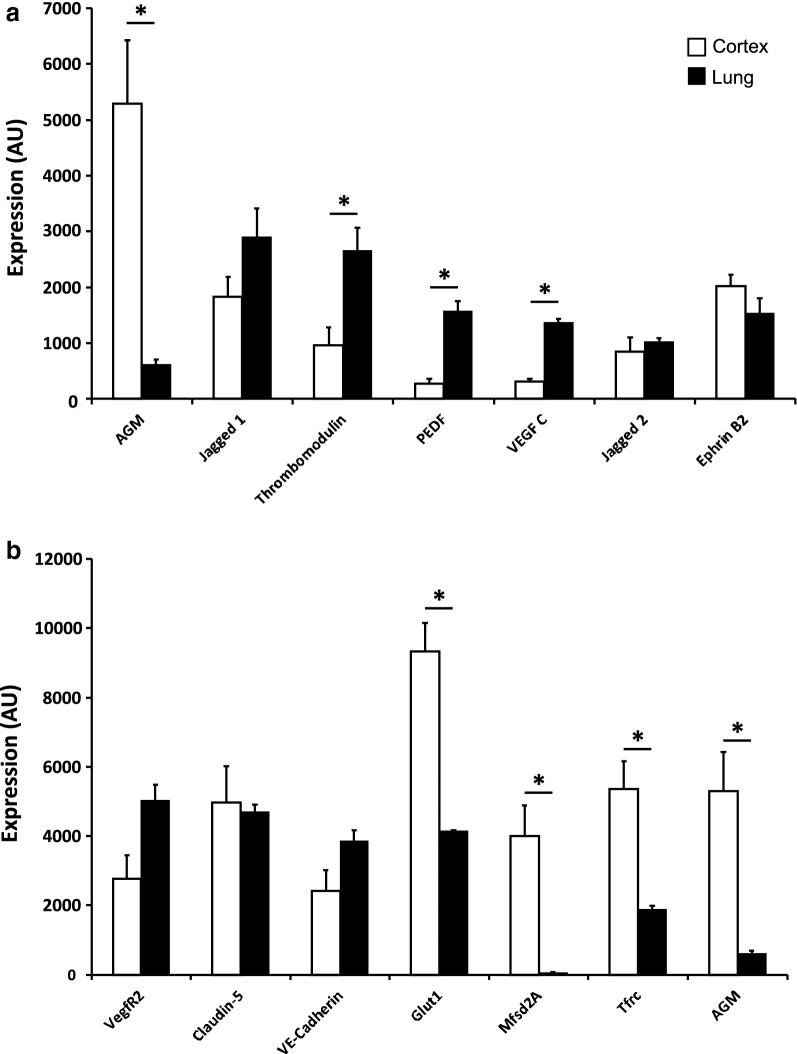
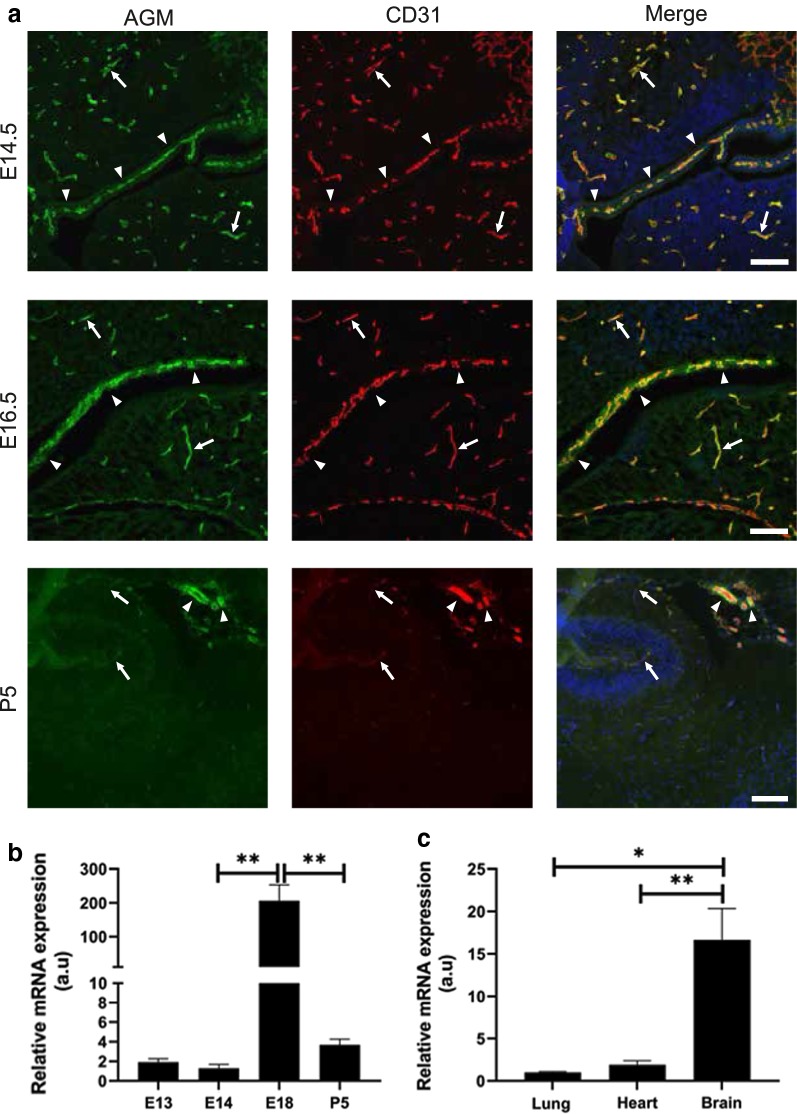
We analyzed microarray data to identify potential angiocrine factors specifically expressed at early stages of barrier formation. We then tested AGM expression with immunofluorescence and real-time PCR in various organs during development, post-natal and in adults. Permeability induction with recombinant proteins (Miles assay) was used to test potential interaction of AGM with VEGF-A.
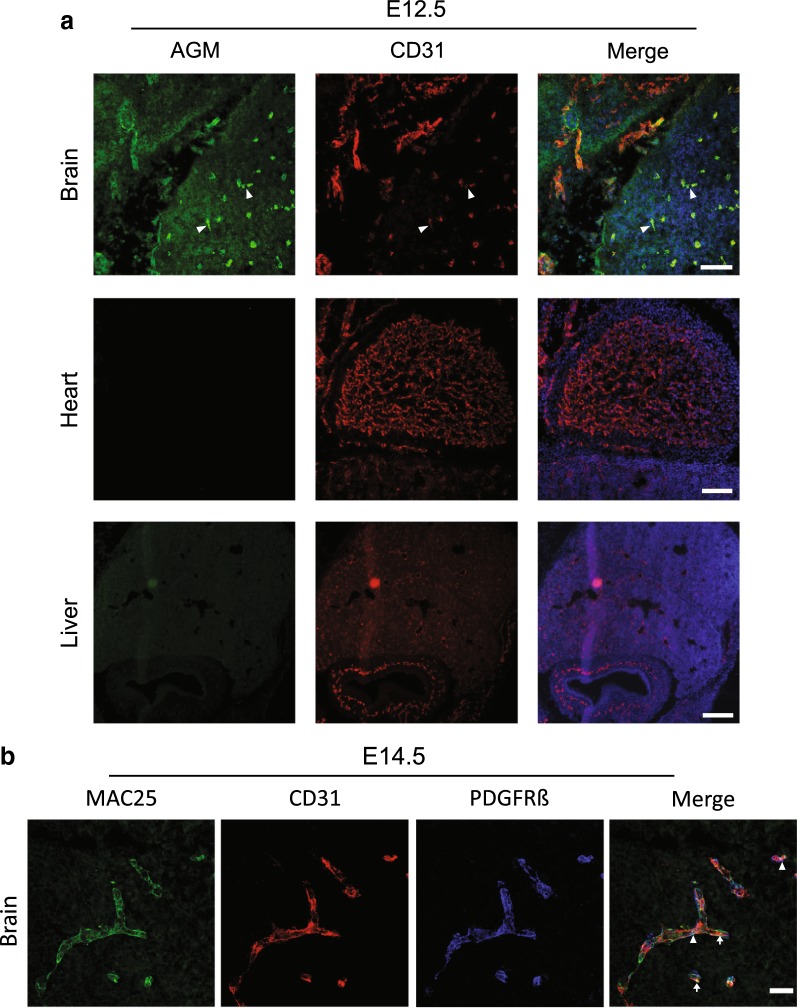
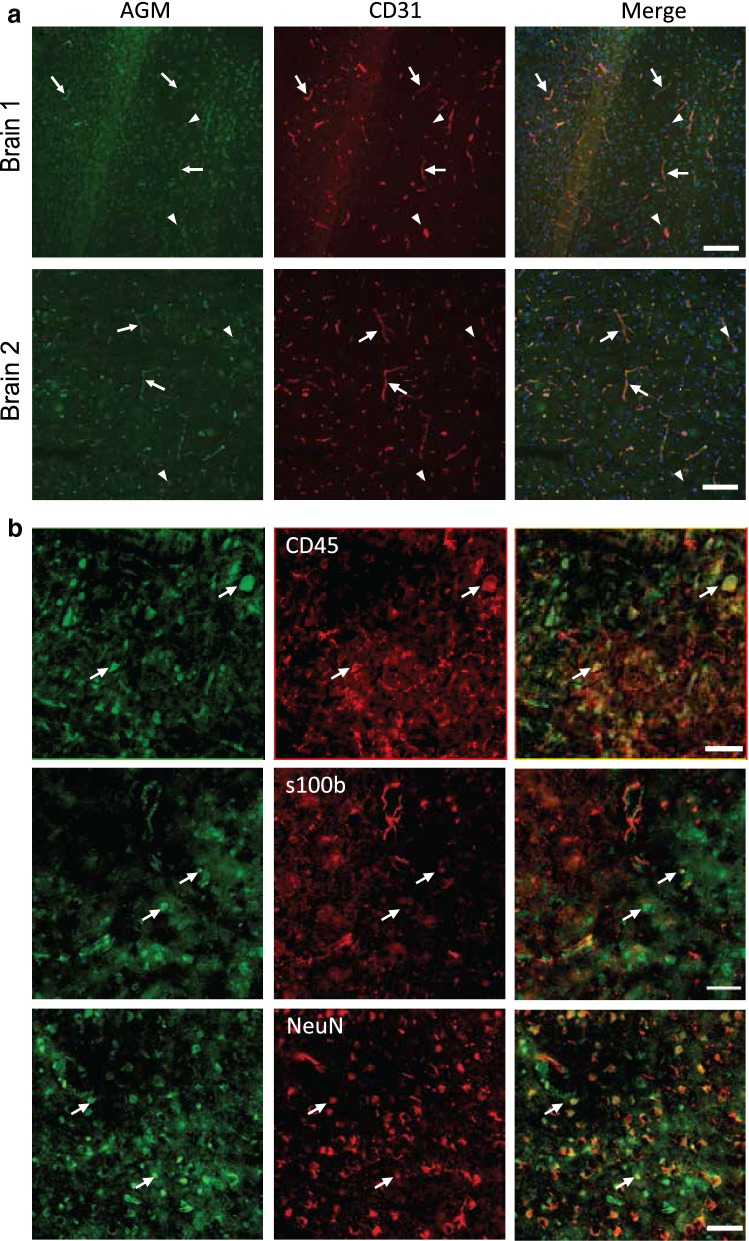
Several angiocrine factors are differentially expressed by CNS ECs and AGM is a prominent CNS-specific angiocrine candidate. Contrary to previous reports, we found that AGM protein expression is specific to developing CNS endothelium and not to highly angiogenic developing vasculature in general. In skin vasculature we found that AGM antagonizes VEGF-A-induced vascular hyperpermeability. Finally, CNS AGM expression is not specific to BBB vasculature and AGM is highly expressed in non-BBB choroid-plexus vasculature.
We propose AGM as a developmental CNS vascular-specific marker. AGM is not a pan-endothelial marker, nor a general marker for developing angiogenic vasculature. Thus, AGM induction in the developing CNS might be distinct from its induction in pathology. While AGM is able to antagonize VEGF-A-induced vascular hyperpermeability in the skin, its high expression levels in non-BBB CNS vasculature does not support its potential role as a BBB inducer. Further investigation including loss-of-function approaches might elucidate AGM function in the developing CNS.
已有多种分泌因子被鉴定为脑血管发育的驱动因子和血脑屏障(BBB)分化的诱导因子。血管内皮生长因子 A(VEGF-A)是驱动脑血管生成的核心因子,Wnt 家族因子(Wnt7a、Wnt7b 和 norrin)是诱导和维持屏障特性的核心因子。它们由发育中的神经组织(神经元和神经胶质前体)表达,影响中枢神经系统(CNS)血管网络的形成。另一类因子是内皮细胞(EC)产生的组织特异性旁分泌因子,也称为“血管分泌因子”,它们提供有指导意义的信号,以调节稳态和再生过程。关于 CNS 血管分泌因子及其在 BBB 发育中的作用,我们知之甚少。血管调节蛋白(AGM)曾被报道在发育中的血管和病理性肿瘤血管中表达。在这里,我们研究了 AGM 在发育中的 CNS 中的表达及其作为潜在 BBB 诱导因子的功能。
我们分析了微阵列数据,以鉴定在屏障形成早期特异性表达的潜在血管分泌因子。然后,我们通过免疫荧光和实时 PCR 检测了 AGM 在发育过程中、出生后和成年期各种器官中的表达。使用重组蛋白(迈尔斯测定法)进行渗透性诱导,以测试 AGM 与 VEGF-A 的潜在相互作用。
几种血管分泌因子在 CNS EC 中差异表达,AGM 是一种突出的 CNS 特异性血管分泌候选因子。与之前的报道相反,我们发现 AGM 蛋白表达特异性存在于发育中的 CNS 内皮细胞中,而不是普遍存在于高度血管生成的发育中的血管中。在皮肤血管中,我们发现 AGM 拮抗 VEGF-A 诱导的血管通透性增加。最后,CNS AGM 表达不是 BBB 血管的特异性,而是在非 BBB 脉络丛血管中高度表达。
我们提出 AGM 作为一种发育中的 CNS 血管特异性标记物。AGM 不是一种普遍的内皮标记物,也不是发育中血管生成性血管的一般标记物。因此,AGM 在发育中的 CNS 中的诱导可能与其在病理学中的诱导不同。虽然 AGM 能够拮抗 VEGF-A 诱导的皮肤血管通透性增加,但它在非 BBB CNS 血管中的高表达水平并不支持其作为 BBB 诱导因子的潜在作用。包括功能丧失方法在内的进一步研究可能会阐明 AGM 在发育中的 CNS 中的功能。