Center for Mind/Brain Sciences, University of Trento, Rovereto, Italy.
Department of Psychology and Cognitive Science, University of Trento, Rovereto, Italy.
Sci Rep. 2020 Apr 1;10(1):5769. doi: 10.1038/s41598-020-62608-5.
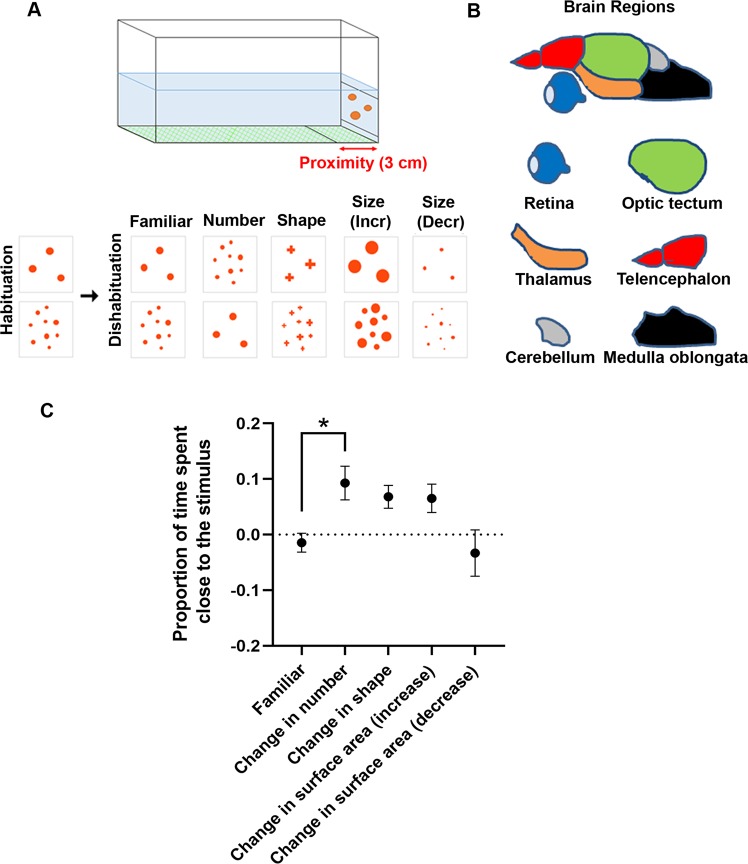
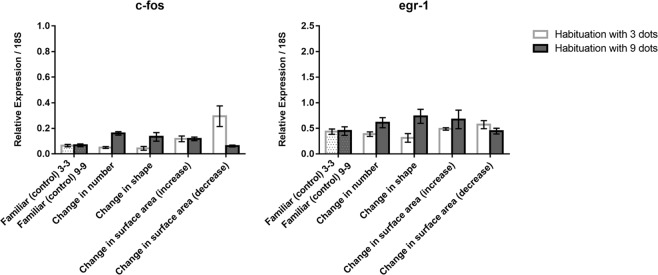
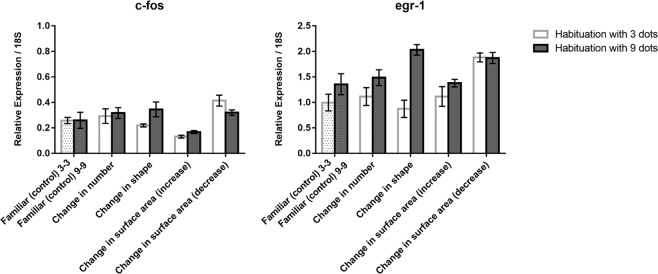
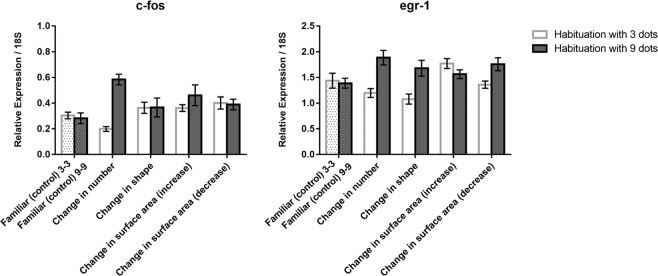
Evidence has shown that a variety of vertebrates, including fish, can discriminate collections of visual items on the basis of their numerousness using an evolutionarily conserved system for approximating numerical magnitude (the so-called Approximate Number System, ANS). Here we combine a habituation/dishabituation behavioural task with molecular biology assays to start investigating the neural bases of the ANS in zebrafish. Separate groups of zebrafish underwent a habituation phase with a set of 3 or 9 small red dots, associated with a food reward. The dots changed in size, position and density from trial to trial but maintained their numerousness, and the overall areas of the stimuli was kept constant. During the subsequent dishabituation test, zebrafish faced a change (i) in number (from 3 to 9 or vice versa with the same overall surface), or (ii) in shape (with the same overall surface and number), or (iii) in size (with the same shape and number). A control group of zebrafish was shown the same stimuli as during the habituation. RT-qPCR revealed that the telencephalon and thalamus were characterized by the most consistent modulation of the expression of the immediate early genes c-fos and egr-1 upon change in numerousness; in contrast, the retina and optic tectum responded mainly to changes in stimulus size.
有证据表明,多种脊椎动物,包括鱼类,可以根据其数量使用一种进化上保守的方法来近似数量大小的系统(即所谓的近似数量系统,ANS)来区分视觉项目的集合。在这里,我们结合习惯化/去习惯化行为任务和分子生物学检测,开始研究斑马鱼中 ANS 的神经基础。 不同的斑马鱼组经历了一组 3 个或 9 个小红点的习惯化阶段,与食物奖励相关。这些点在大小、位置和密度上从一次试验到另一次试验都发生了变化,但保持了它们的数量,并且刺激的总面积保持不变。在随后的去习惯化测试中,斑马鱼面临着数量的变化(从 3 到 9 或反之亦然,总面积相同),或者形状的变化(总面积和数量相同),或者大小的变化(形状和数量相同)。一组对照组的斑马鱼被展示了与习惯化阶段相同的刺激。实时定量 PCR 显示,端脑和丘脑的特征是在数量变化时,即时早期基因 c-fos 和 egr-1 的表达最一致地调节;相比之下,视网膜和视顶盖主要对刺激大小的变化做出反应。