Institute of Modern Physics, Chinese Academy of Sciences, Lanzhou 730000, China.
The First Clinical Medical College of Lanzhou University, Lanzhou 730000, China.
J Radiat Res. 2020 May 22;61(3):399-409. doi: 10.1093/jrr/rraa017.
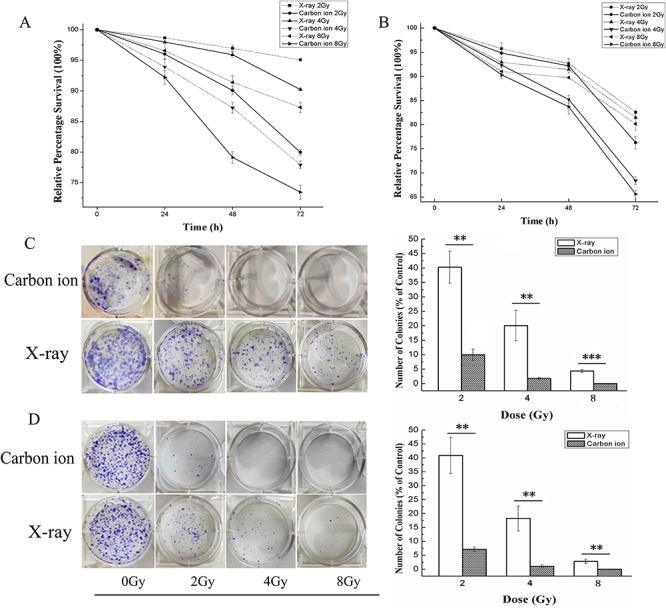
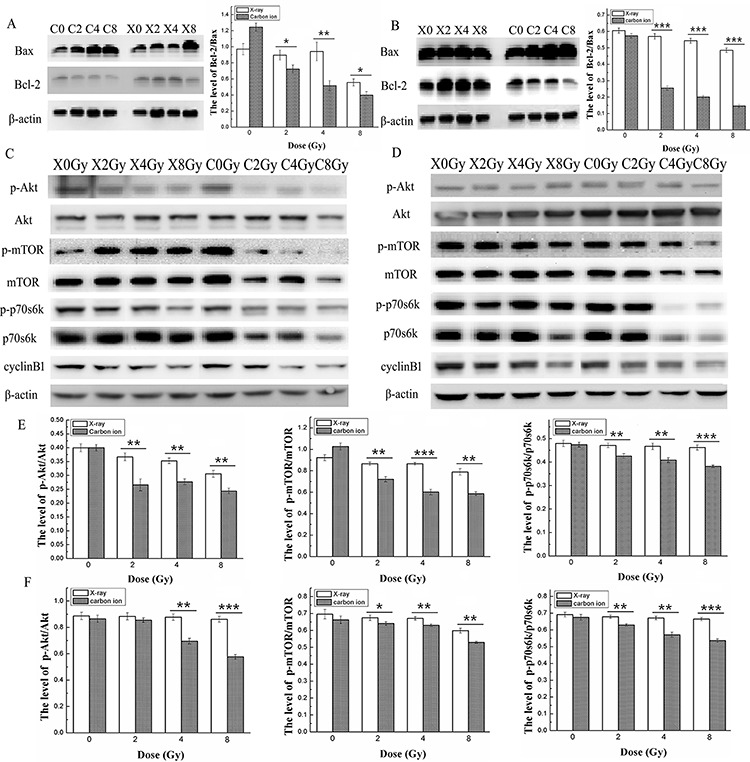
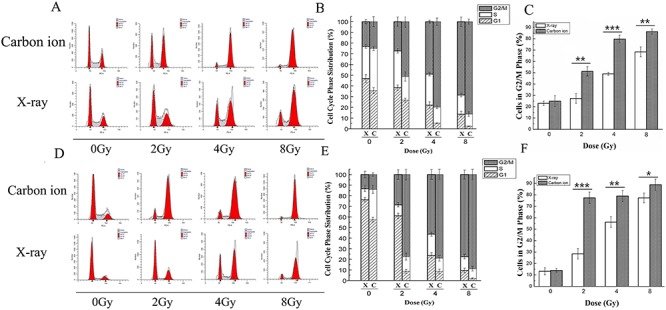
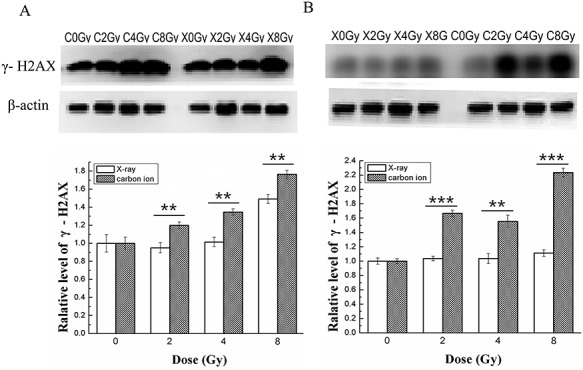
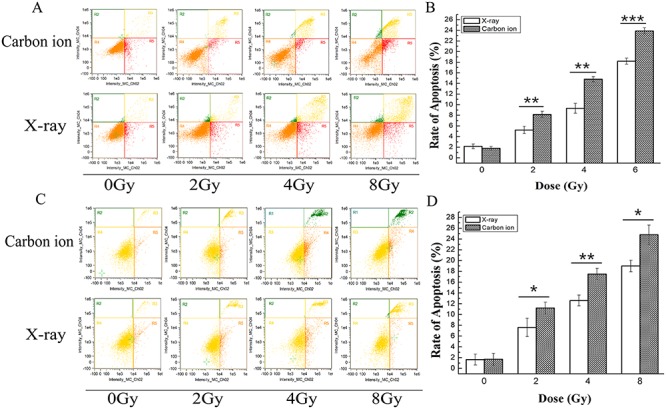
The aim of the study was to investigate the various effects of high linear energy transfer (LET) carbon ion (12C6+) and low LET X-ray radiation on MDA-MB-231 and MCF-7 human breast cancer cells and to explore the underlying mechanisms of radiation sensitivity. Cell proliferation, cell colony formation, cell cycle distribution, cell apoptosis and protein expression levels [double-strand break marker γ-H2AX, cell cycle-related protein cyclin B1, apoptosis-related proteins Bax and Bcl-2, and the Akt/mammalian target of rapamycin (mTOR)/ribosomal protein S6 kinase B1 (p70S6K) pathway] were detected after irradiation with carbon ions or X-rays at doses of 0, 2, 4 and 8 Gy. Our results showed that the inhibition of cell proliferation and cell colony formation and the induction of G2/M phase arrest, DNA lesions and cell apoptosis/necrosis elicited by carbon ion irradiation were more potent than the effects elicited by X-ray radiation at the same dose. Simultaneously, compared with X-ray radiation, carbon ion radiation induced a marked increase in Bax and prominent decreases in cyclin B1 and Bcl-2 in a dose-dependent manner. Furthermore, the Akt/mTOR/p70S6K pathway was significantly inhibited by carbon ion radiation in both breast cancer cell lines. These results indicate that carbon ion radiation kills MDA-MB-231 and MCF-7 breast cancer cells more effectively than X-ray radiation, which might result from the inhibition of the Akt/mTOR/p70S6K pathway.
本研究旨在探讨高线性能量转移(LET)碳离子(12C6+)和低 LET X 射线辐射对 MDA-MB-231 和 MCF-7 人乳腺癌细胞的多种影响,并探讨辐射敏感性的潜在机制。用碳离子或 X 射线(剂量分别为 0、2、4 和 8 Gy)照射后,检测细胞增殖、细胞集落形成、细胞周期分布、细胞凋亡和蛋白表达水平[双链断裂标志物 γ-H2AX、细胞周期相关蛋白细胞周期蛋白 B1、凋亡相关蛋白 Bax 和 Bcl-2 以及 Akt/哺乳动物雷帕霉素靶蛋白(mTOR)/核糖体蛋白 S6 激酶 B1(p70S6K)通路]。结果表明,与 X 射线辐射相比,碳离子照射抑制细胞增殖和集落形成,诱导 G2/M 期阻滞、DNA 损伤和细胞凋亡/坏死的作用更强,其效应与相同剂量的 X 射线辐射相当。同时,与 X 射线辐射相比,碳离子辐射在两种乳腺癌细胞系中均以剂量依赖性方式显著增加 Bax 并显著降低细胞周期蛋白 B1 和 Bcl-2。此外,碳离子辐射还显著抑制了 Akt/mTOR/p70S6K 通路。这些结果表明,碳离子辐射比 X 射线辐射更有效地杀死 MDA-MB-231 和 MCF-7 乳腺癌细胞,这可能是由于 Akt/mTOR/p70S6K 通路的抑制。