Department of Anatomy and Neurobiology, Zhongshan School of Medicine, Sun Yat-sen University, Guangzhou, P.R. China.
Guangdong Province Key Laboratory of Brain Function and Disease, Zhongshan School of Medicine, Sun Yat-sen University, Guangzhou, P.R. China.
PLoS One. 2020 Apr 2;15(4):e0225874. doi: 10.1371/journal.pone.0225874. eCollection 2020.
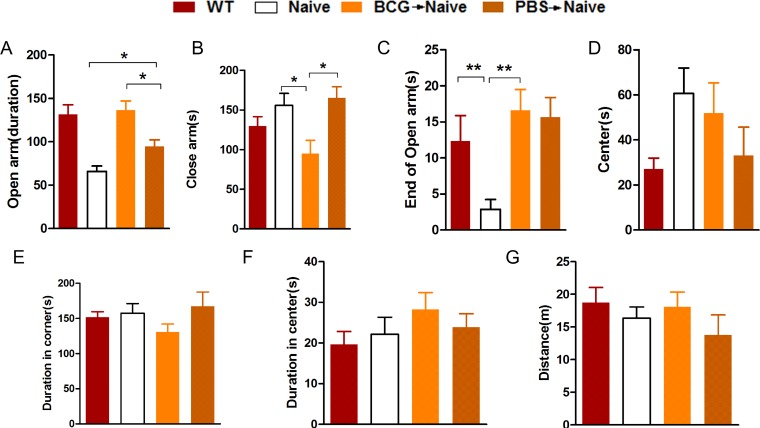
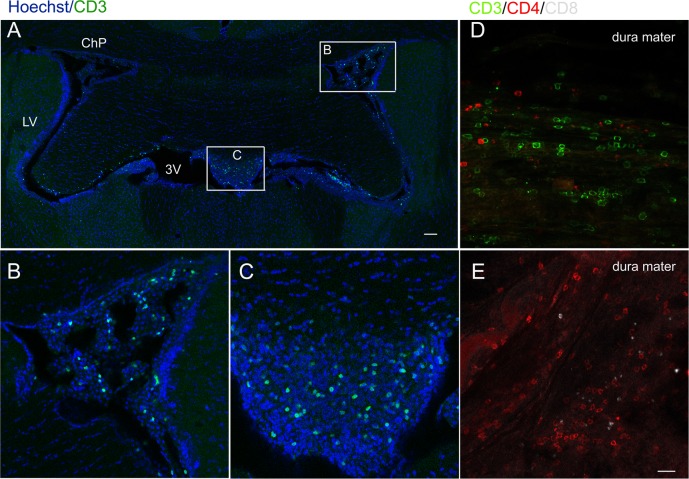
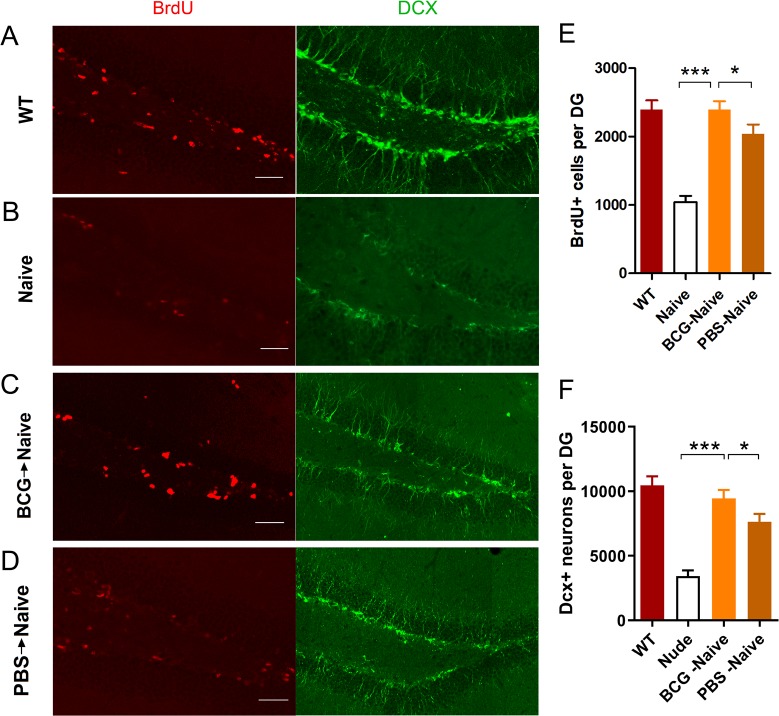
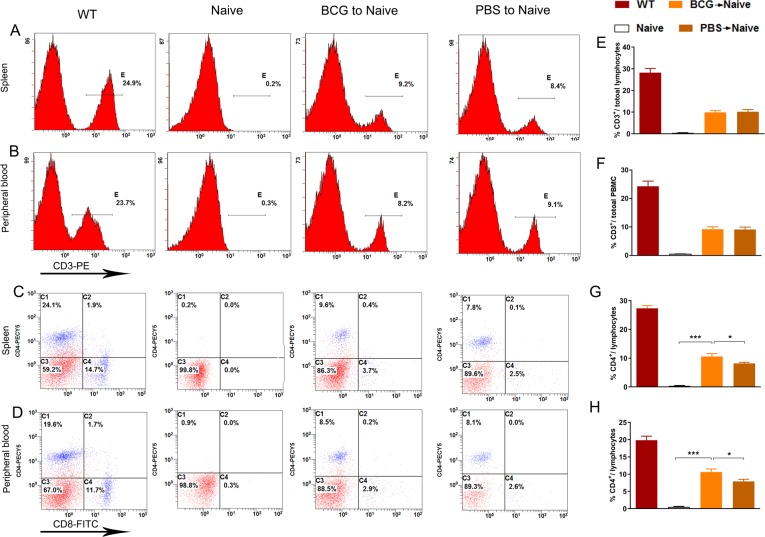
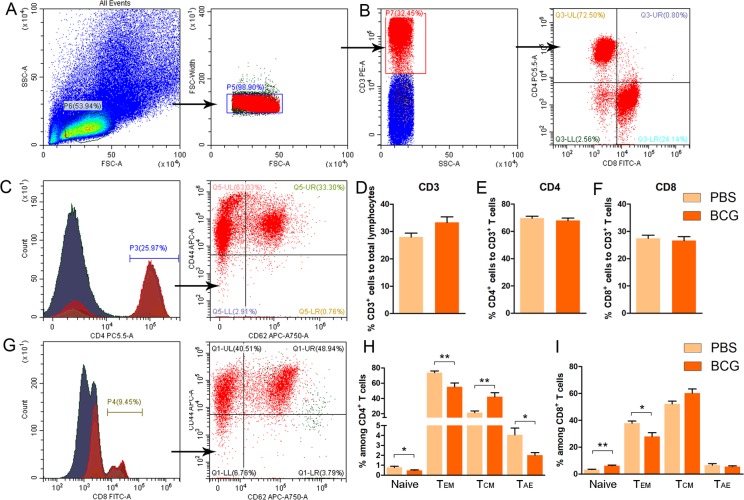
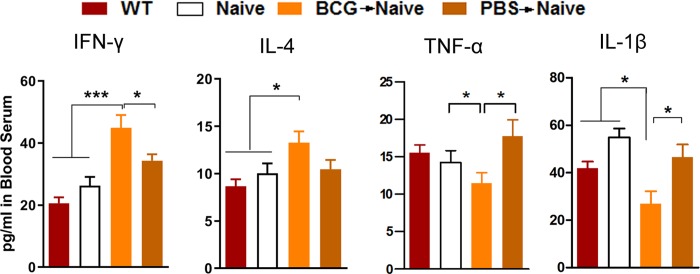
We previously have reported that neonatal Bacillus Calmette-Guerin (BCG) vaccination improves neurogenesis and behavior in early life through affecting the neuroimmune milieu in the brain, but it is uncertain whether activation phenotypes and functional changes in T lymphocytes shape brain development. Here, we studied the effects of BCG vaccination via the adoptive transfer of T lymphocytes from the BALB/c wild-type mice into naive mice. Our results show that mice adoptive BCG-induced lymphocytes (BCG->naive mice) showed anxiolytic and antidepressant-like performance when completing an elevated plus maze (EPM) test. Meanwhile, BCG->naive mice possess more cell proliferation and newborn neurons than PBS->naive and nude mice in the hippocampus. IFN-γ and IL-4 levels in the serum of BCG->naive mice also increased, while TNF-α and IL-1β levels were reduced relative to those of PBS->naive and nude mice. We further found that BCG->naive mice showed different repartition of CD4+ and CD8+ T cell to naive (CD62L+CD44low), effector memory (CD62L-CD44hi), central memory (CD62L+CD44hi) and acute/activated effector (CD62L-CD44low) cells in the spleen. Importantly, the adoptive transfer of BCG-induced T lymphocytes infiltrated into the dura mater and brain parenchyma of the nude mice. Activation phenotypes and functional changes in T lymphocytes are very likely to affect the neuroimmune milieu in the brain, and alterations in ratios of splenic CD4+ and CD8+ memory T cells may affect the expression of correlative cytokines in the serum, accounting for our behavioral results. We conclude thus that the adoptive transfer of BCG-induced T lymphocytes contributes to hippocampal cell proliferation and tempers anxiety-like behavior in immune deficient mice. Our work shows that BCG vaccination improves hippocampal cell proliferation outcomes and behaviors, likely as a result of splenic effector/memory T lymphocytes regulating the neuroimmune niche in the brain.
我们之前曾报道过,新生牛型卡介苗(BCG)接种通过影响大脑中的神经免疫环境,改善生命早期的神经发生和行为,但尚不确定 T 淋巴细胞的激活表型和功能变化是否会影响大脑发育。在这里,我们通过将来自 BALB/c 野生型小鼠的 T 淋巴细胞过继转移到幼稚小鼠中来研究 BCG 接种的影响。我们的结果表明,在完成高架十字迷宫(EPM)测试时,接受 BCG 诱导的淋巴细胞过继转移的小鼠(BCG->naive 小鼠)表现出抗焦虑和抗抑郁样行为。同时,BCG->naive 小鼠的海马体中的细胞增殖和新生神经元数量比 PBS->naive 和裸鼠多。BCG->naive 小鼠血清中的 IFN-γ 和 IL-4 水平也升高,而 TNF-α 和 IL-1β 水平则低于 PBS->naive 和裸鼠。我们进一步发现,与 PBS->naive 和裸鼠相比,BCG->naive 小鼠的脾中 CD4+和 CD8+T 细胞向幼稚(CD62L+CD44low)、效应记忆(CD62L-CD44hi)、中央记忆(CD62L+CD44hi)和急性/激活效应(CD62L-CD44low)细胞的分布不同。重要的是,BCG 诱导的 T 淋巴细胞过继转移可浸润到裸鼠的硬脑膜和脑实质中。T 淋巴细胞的激活表型和功能变化很可能会影响大脑中的神经免疫环境,而脾中 CD4+和 CD8+记忆 T 细胞比例的改变可能会影响血清中相关细胞因子的表达,这解释了我们的行为结果。因此,我们得出结论,BCG 诱导的 T 淋巴细胞的过继转移有助于幼稚小鼠海马体的细胞增殖,并调节其焦虑样行为。我们的工作表明,BCG 接种可改善海马体的细胞增殖结果和行为,这可能是由于脾中的效应/记忆 T 淋巴细胞调节大脑中的神经免疫环境所致。