Qi Fangfang, Zuo Zejie, Yang Junhua, Hu Saisai, Yang Yang, Yuan Qunfang, Zou Juntao, Guo Kaihua, Yao Zhibin
Department of Anatomy and Neurobiology, Zhongshan School of Medicine, Sun Yat-sen University, #74, Zhongshan No.2 Road, 510080, Guangzhou, People's Republic of China.
Guangdong Province Key Laboratory of Brain Function and Disease, Zhongshan School of Medicine, Sun Yat-sen University, #74, Zhongshan No. 2 Road, 510080, Guangzhou, People's Republic of China.
J Neuroinflammation. 2017 Feb 10;14(1):32. doi: 10.1186/s12974-017-0808-7.
The spatial learning abilities of developing mice benefit from extrinsic cues, such as an enriched environment, with concomitant enhancement in cognitive functions. Interestingly, such enhancements can be further increased through intrinsic Bacillus Calmette-Guérin (BCG) vaccination.
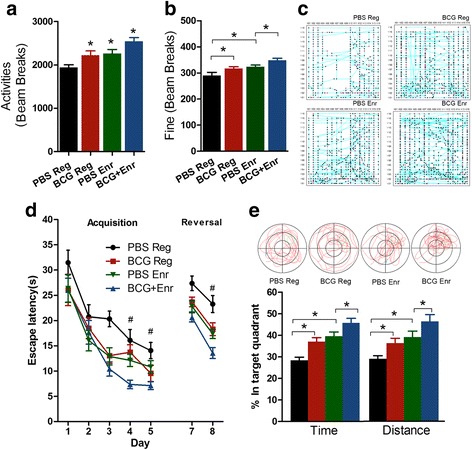
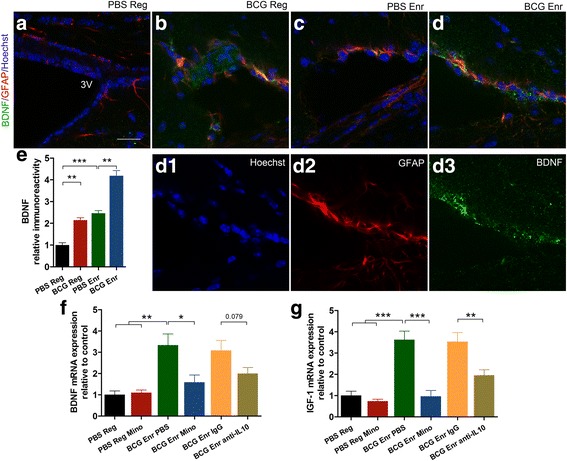
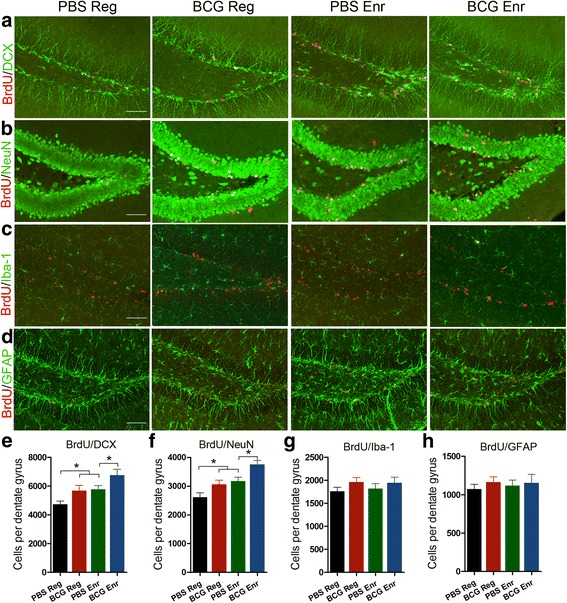
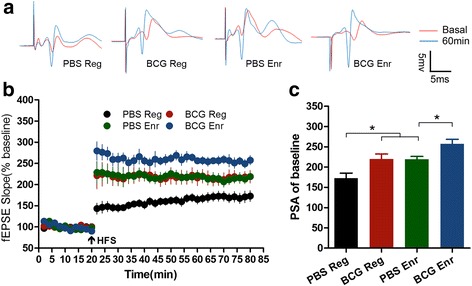
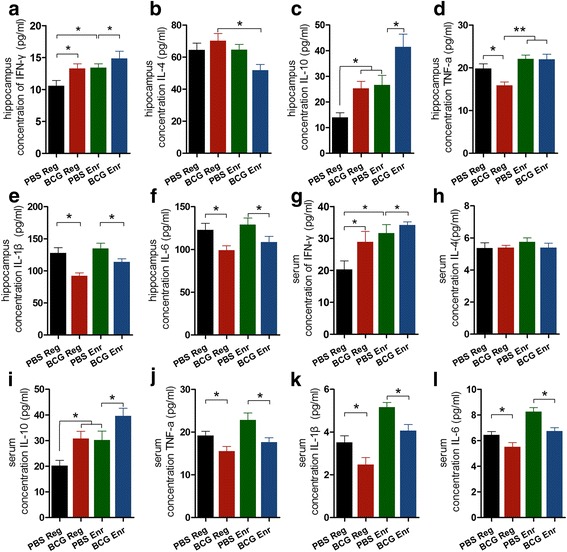
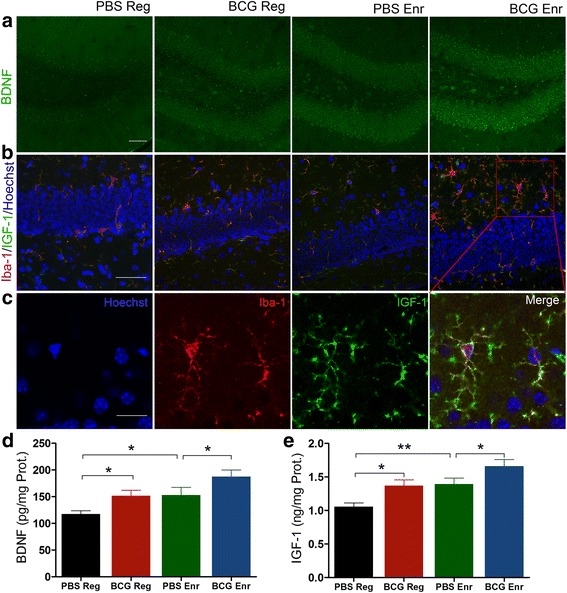
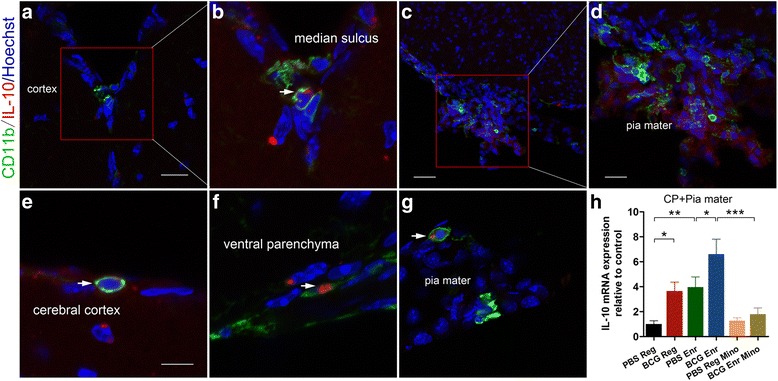
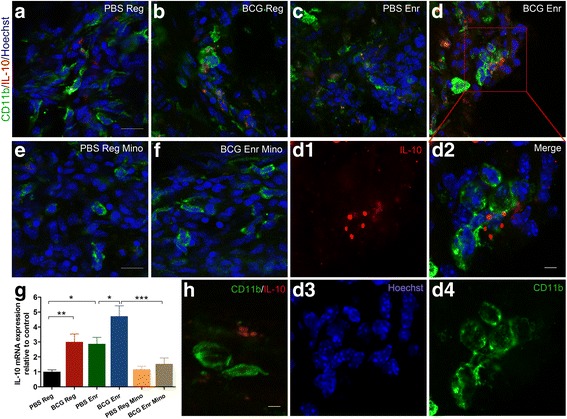
Here, we first report that combined neonatal BCG vaccination and exposure to an enriched environment (Enr) induced combined neurobeneficial effects, including hippocampal long-term potentiation, and increased neurogenesis and spatial learning and memory, in mice exposed to the Enr and vaccinated with BCG relative to those in the Enr that did not receive BCG vaccination. Neonatal BCG vaccination markedly induced anti-inflammatory meningeal macrophage polarization both in regular and Enr breeding mice. The meninges are composed of the pia mater, dura mater, and choroid plexus. Alternatively, this anti-inflammatory activity of the meninges occurred simultaneously with increased expression of the neurotrophic factors BDNF/IGF-1 and the M2 microglial phenotype in the hippocampus. Our results reveal a critical role for BCG vaccination in the regulation of neurogenesis and spatial cognition through meningeal macrophage M2 polarization and neurotrophic factor expression; these effects were completely or partially prevented by minocycline or anti-IL-10 antibody treatment, respectively.
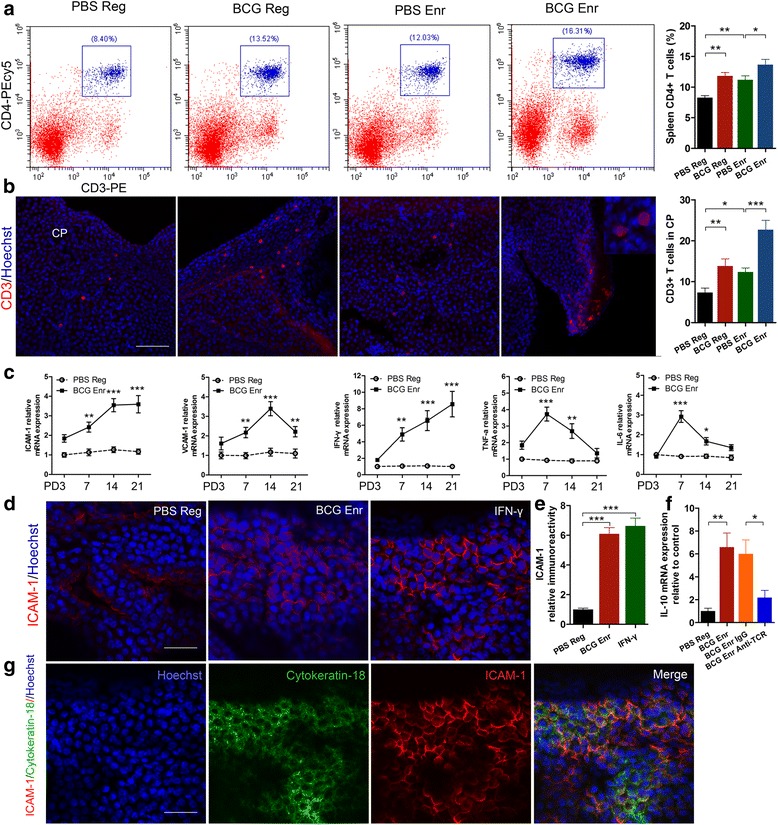
Together, we first claim that immunological factor and environmental factor induce a combined effect on neurogenesis and cognition via a common pathway-meningeal macrophage M2 polarization. We also present a novel functional association between peripheral T lymphocytes and meningeal macrophages after evoking adaptive immune responses in the periphery whereby T lymphocytes are recruited to the meninges in response to systemic IFN-γ signaling. This leads to meningeal macrophage M2 polarization, subsequent to microglial M2 activation and neurotrophic factor expression, and eventually promotes a positive behavior.
发育中小鼠的空间学习能力受益于外部线索,如丰富的环境,同时认知功能也会增强。有趣的是,通过内在的卡介苗(BCG)接种,这种增强作用可以进一步提高。
在此,我们首次报道,与未接种BCG的丰富环境(Enr)小鼠相比,联合新生期BCG接种和暴露于丰富环境(Enr)可诱导联合神经有益效应,包括海马体长期增强、神经发生增加以及空间学习和记忆增强。新生期BCG接种在常规饲养和Enr饲养的小鼠中均显著诱导抗炎性脑膜巨噬细胞极化。脑膜由软脑膜、硬脑膜和脉络丛组成。此外,脑膜的这种抗炎活性与海马体中神经营养因子BDNF/IGF-1的表达增加以及M2小胶质细胞表型同时出现。我们的结果揭示了BCG接种在通过脑膜巨噬细胞M2极化和神经营养因子表达来调节神经发生和空间认知方面的关键作用;这些效应分别被米诺环素或抗IL-10抗体处理完全或部分阻断。
总之,我们首次提出免疫因子和环境因子通过共同途径——脑膜巨噬细胞M2极化,对神经发生和认知产生联合效应。我们还展示了在外周引发适应性免疫反应后,外周T淋巴细胞与脑膜巨噬细胞之间的一种新的功能关联,即T淋巴细胞响应全身IFN-γ信号被招募到脑膜。这导致脑膜巨噬细胞M2极化,继小胶质细胞M2激活和神经营养因子表达之后,最终促进积极行为。