Department of Nephrology, Bagcilar Training and Research Hospital, University of Health Sciences, Istanbul, Turkey.
Department of Nephrology, Cerrahpasa Medical Faculty, Istanbul University-Cerrahpasa, Istanbul, Turkey.
PLoS One. 2020 Apr 2;15(4):e0230980. doi: 10.1371/journal.pone.0230980. eCollection 2020.
Anemia is highly prevalent in chronic kidney disease patients; however, its identification and management have been reported to be suboptimal. In this study we aimed to describe the prevalence, severity, risk factors, and treatment of anemia in different nephrology centers, among chronic kidney disease patients who were not given renal replacement therapy.
We performed a multicenter cross-sectional study in three different nephrology clinics. Adult (>18 years of age) chronic kidney disease patients with an estimated glomerular filtration rate (eGFR) below 60 ml/min, and who were not started dialysis were recruited. Demographic, clinical and laboratory data regarding anemia and its management were collected using a standard data form. Anemia was defined as a hemoglobin level below 12g/dL and severe anemia as a hemoglobin level below 10g/dl.
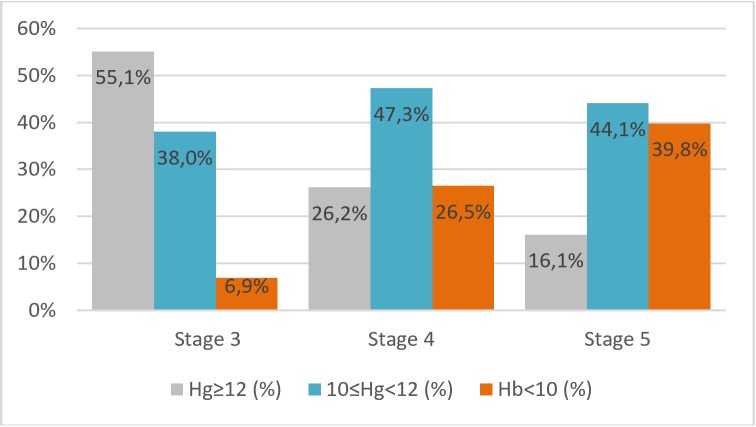
A total of 1066 patients were enrolled in the study. Anemia and severe anemia were present in 55.9% and 14.9% of the patients, respectively. The mean hemoglobin level for the whole cohort was 11.8±1.8 g/dL. Univariate analyses revealed that the mean hemoglobin level was significantly different among the centers. Moreover, the frequency of the presence of anemia stratified by severity was also significantly different among the centers. According to binary logistic regression analysis, gender, levels of eGFR and iron, ferritin ≥ 100 ng/mL, and the nephrology center were independent determinants of severe anemia.
We found a high prevalence of anemia among chronic kidney disease patients who were not on renal replacement therapy. Each center should determine the treatment strategy according to the patient's characteristics. According to our results, the center-specific management of anemia seems to be important.
贫血在慢性肾脏病患者中很常见,但对其的识别和管理被报道并不完善。本研究旨在描述未接受肾脏替代治疗的慢性肾脏病患者中不同肾病中心贫血的患病率、严重程度、危险因素和治疗情况。
我们在三个不同的肾病诊所进行了一项多中心横断面研究。纳入年龄>18 岁、估算肾小球滤过率(eGFR)<60ml/min 且未开始透析的慢性肾脏病患者。使用标准数据表收集有关贫血及其管理的人口统计学、临床和实验室数据。贫血定义为血红蛋白水平<12g/dL,严重贫血定义为血红蛋白水平<10g/dL。
共纳入 1066 例患者。贫血和严重贫血分别占患者的 55.9%和 14.9%。整个队列的平均血红蛋白水平为 11.8±1.8g/dL。单因素分析显示,各中心间平均血红蛋白水平差异有统计学意义。此外,各中心间严重贫血的存在频率也存在显著差异。根据二项逻辑回归分析,性别、eGFR 和铁水平、铁蛋白≥100ng/mL 以及肾病中心是严重贫血的独立决定因素。
我们发现未接受肾脏替代治疗的慢性肾脏病患者中贫血的患病率很高。每个中心都应根据患者的特点确定治疗策略。根据我们的结果,针对每个中心的贫血管理似乎很重要。