Adaptation Physiology Group, Wageningen University and Research, Wageningen, The Netherlands.
Wageningen Livestock Research, Wageningen University and Research, Wageningen, The Netherlands.
Poult Sci. 2020 Apr;99(4):2162-2175. doi: 10.1016/j.psj.2019.11.041. Epub 2020 Feb 8.
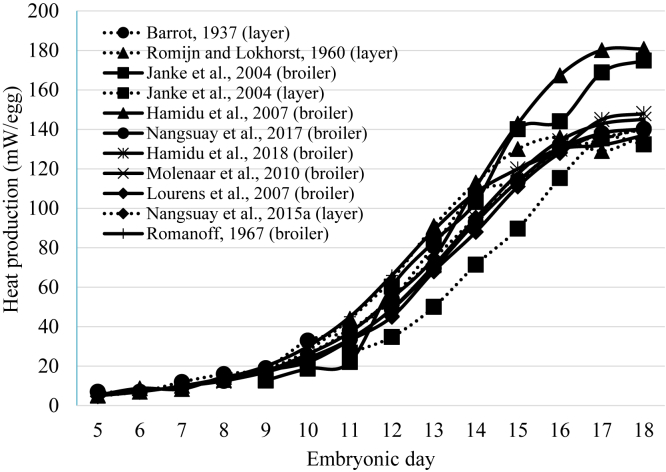
During incubation, embryonic growth and development are dependent on nutrients deposited in the egg. The content of the yolk can be transferred to the embryo in 2 ways: directly into the intestine via the yolk stalk or through the highly vascularized yolk sac membrane. It has been suggested that, as a result of genetic selection and improved management, the increase in posthatch growth rate and concurrently the increase in metabolic rate of broiler chickens during the last 50 yr has also increased embryonic metabolism. A higher metabolic rate during incubation would imply a lower residual yolk weight and possibly lower energy reserve for the hatchling. This might affect posthatch development and performance. This review examined scientific publications published between 1930 and 2018 to compare residual yolk weight at hatch, metabolic heat production, and yolk utilization throughout incubation. This review aimed to investigate 1) whether or not residual yolk weight and composition has been changed during the 88-yr period considered and 2) which abiotic and biotic factors affect yolk utilization in poultry during incubation and the early posthatch period. It can be concluded that 1) residual yolk weight and the total solid amount of the residual yolk at hatch seem to be decreased in the recent decades. It cannot be concluded whether the (lack of) differences between old and modern strains are due to genetic selection, changed management and incubation conditions, or moment of sampling (immediately after hatch or at pulling). It is remarkable that with the genetic progress and improved management and incubation conditions over the last 88 yr, effects on yolk utilization efficiency and embryonic metabolic heat production are limited; 2) factors specially affecting residual yolk weight at hatch include egg size and incubation temperature, whereas breeder age has more influence on nutrient composition of the residual yolk.
在孵化期间,胚胎的生长和发育依赖于储存在蛋中的营养物质。蛋黄的内容物可以通过 2 种方式转移到胚胎中:通过蛋黄柄直接进入肠道,或通过高度血管化的蛋黄囊膜。有人认为,由于遗传选择和管理的改善,在过去的 50 年中,肉鸡的孵化后生长速度和代谢率同时提高,也增加了胚胎的新陈代谢。孵化期间较高的代谢率意味着剩余蛋黄重量较低,可能为雏鸡提供的能量储备较低。这可能会影响孵化后发育和性能。本综述检查了 1930 年至 2018 年期间发表的科学出版物,以比较孵化时的剩余蛋黄重量、代谢产热和整个孵化期间的蛋黄利用情况。本综述旨在探讨:1)在考虑的 88 年期间,剩余蛋黄重量和组成是否发生了变化;2)哪些非生物和生物因素影响孵化期间和孵化后早期家禽的蛋黄利用。可以得出结论:1)在最近几十年,孵化时的剩余蛋黄重量和剩余蛋黄的总固体量似乎减少了。无法确定现代品系与旧品系之间的差异是由于遗传选择、管理和孵化条件的改变,还是由于采样时间(刚孵化后或拉拔时)的不同。值得注意的是,在过去的 88 年中,随着遗传进展和管理以及孵化条件的改善,对蛋黄利用效率和胚胎代谢产热的影响是有限的;2)专门影响孵化时剩余蛋黄重量的因素包括蛋的大小和孵化温度,而种鸡年龄对剩余蛋黄的营养成分影响更大。