Division of Cardiology, Department of Medicine, Stanford University School of Medicine, Stanford, California.
Meta-Research Innovation Center at Stanford (METRICS), Stanford University, Stanford, California.
JAMA Netw Open. 2020 Apr 1;3(4):e202064. doi: 10.1001/jamanetworkopen.2020.2064.
Atrial fibrillation (AF) affects more than 6 million people in the United States; however, much AF remains undiagnosed. Given that more than 265 million people in the United States own smartphones (>80% of the population), smartphone applications have been proposed for detecting AF, but the accuracy of these applications remains unclear.
To determine the accuracy of smartphone camera applications that diagnose AF.
MEDLINE and Embase were searched until January 2019 for studies that assessed the accuracy of any smartphone applications that use the smartphone's camera to measure the amplitude and frequency of the user's fingertip pulse to diagnose AF.
Bivariate random-effects meta-analyses were constructed to synthesize data. The study followed the Preferred Reporting Items for Systematic Reviews and Meta-analyses (PRISMA) of Diagnostic Test Accuracy Studies reporting guideline.
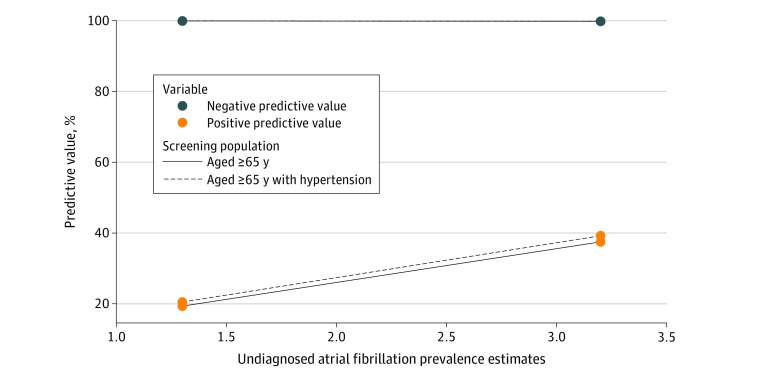
Sensitivity and specificity were measured with bivariate random-effects meta-analysis. To simulate the use of these applications as a screening tool, the positive predictive value (PPV) and negative predictive value (NPV) for different population groups (ie, age ≥65 years and age ≥65 years with hypertension) were modeled. Lastly, the association of methodological limitations with outcomes were analyzed with sensitivity analyses and metaregressions.
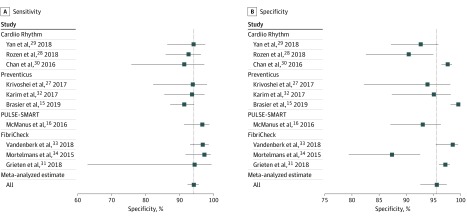
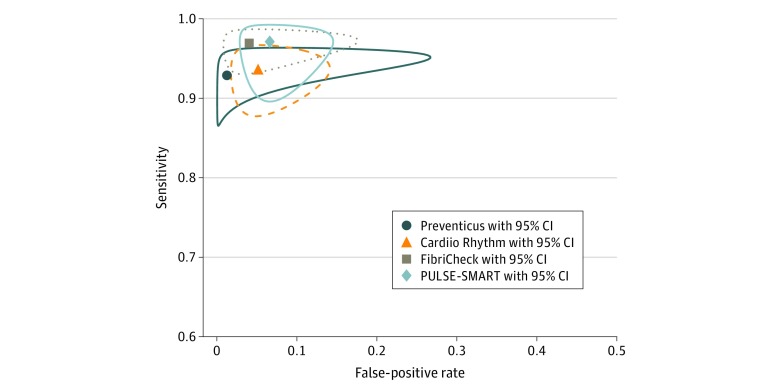
A total of 10 primary diagnostic accuracy studies, with 3852 participants and 4 applications, were included. The oldest studies were published in 2016 (2 studies [20.0%]), while most studies (4 [40.0%]) were published in 2018. The applications analyzed the pulsewave signal for a mean (range) of 2 (1-5) minutes. The meta-analyzed sensitivity and specificity for all applications combined were 94.2% (95% CI, 92.2%-95.7%) and 95.8% (95% CI, 92.4%-97.7%), respectively. The PPV for smartphone camera applications detecting AF in an asymptomatic population aged 65 years and older was between 19.3% (95% CI, 19.2%-19.4%) and 37.5% (95% CI, 37.4%-37.6%), and the NPV was between 99.8% (95% CI, 99.83%-99.84%) and 99.9% (95% CI, 99.94%-99.95%). The PPV and NPV increased for individuals aged 65 years and older with hypertension (PPV, 20.5% [95% CI, 20.4%-20.6%] to 39.2% [95% CI, 39.1%-39.3%]; NPV, 99.8% [95% CI, 99.8%-99.8%] to 99.9% [95% CI, 99.9%-99.9%]). There were methodological limitations in a number of studies that did not appear to be associated with diagnostic performance, but this could not be definitively excluded given the sparsity of the data.
In this study, all smartphone camera applications had relatively high sensitivity and specificity. The modeled NPV was high for all analyses, but the PPV was modest, suggesting that using these applications in an asymptomatic population may generate a higher number of false-positive than true-positive results. Future research should address the accuracy of these applications when screening other high-risk population groups, their ability to help monitor chronic AF, and, ultimately, their associations with patient-important outcomes.
重要性:在美国,有超过 600 万人患有房颤(AF);然而,仍有许多房颤未被诊断出来。鉴于美国有超过 2.65 亿人拥有智能手机(超过总人口的 80%),人们已经提出了利用智能手机应用程序来检测房颤的方案,但这些应用程序的准确性仍不清楚。
目的:确定用于诊断 AF 的智能手机摄像头应用程序的准确性。
数据来源和研究选择:截至 2019 年 1 月,我们通过 MEDLINE 和 Embase 搜索了评估使用智能手机摄像头测量用户指尖脉搏幅度和频率来诊断 AF 的任何智能手机应用程序准确性的研究。
数据提取和综合:使用双变量随机效应荟萃分析来综合数据。本研究遵循系统评价和荟萃分析的首选报告项目(PRISMA)诊断测试准确性研究报告指南。
主要结果和措施:通过双变量随机效应荟萃分析测量了敏感性和特异性。为了模拟这些应用程序作为筛查工具的使用,针对不同人群(即年龄≥65 岁和年龄≥65 岁且患有高血压),对阳性预测值(PPV)和阴性预测值(NPV)进行了建模。最后,通过敏感性分析和元回归分析了方法学局限性与结果之间的关联。
结果:共纳入 10 项初级诊断准确性研究,涉及 3852 名参与者和 4 种应用程序。最古老的研究发表于 2016 年(2 项研究[20.0%]),而大多数研究(4 项研究[40.0%])发表于 2018 年。这些应用程序分析脉搏波信号的平均(范围)为 2(1-5)分钟。所有应用程序的合并敏感性和特异性分别为 94.2%(95%CI,92.2%-95.7%)和 95.8%(95%CI,92.4%-97.7%)。在无症状、年龄≥65 岁的人群中,智能手机摄像头应用程序检测 AF 的 PPV 介于 19.3%(95%CI,19.2%-19.4%)和 37.5%(95%CI,37.4%-37.6%)之间,NPV 介于 99.8%(95%CI,99.83%-99.84%)和 99.9%(95%CI,99.94%-99.95%)之间。对于年龄≥65 岁且患有高血压的个体,PPV 和 NPV 增加(PPV,20.5%[95%CI,20.4%-20.6%]至 39.2%[95%CI,39.1%-39.3%];NPV,99.8%[95%CI,99.8%-99.8%]至 99.9%[95%CI,99.9%-99.9%])。许多研究存在方法学局限性,但这似乎与诊断性能无关,不过由于数据的稀疏性,不能明确排除这种关联。
结论和相关性:在这项研究中,所有智能手机摄像头应用程序都具有相对较高的敏感性和特异性。所有分析的 NPV 都很高,但 PPV 适中,这表明在无症状人群中使用这些应用程序可能会产生比真实阳性结果更多的假阳性结果。未来的研究应该解决这些应用程序在筛查其他高危人群时的准确性、它们帮助监测慢性房颤的能力,以及最终它们与患者重要结果的关联。