Department of Pneumology, Hospital General Universitario JM Morales Meseguer, Murcia, Spain.
Research Group Fisioterapia y Discapacidad, Instituto Murciano de Investigación Biosanitaria-Virgen de La Arrixaca (IMIB), Murcia, Spain.
PLoS One. 2020 Apr 3;15(4):e0230116. doi: 10.1371/journal.pone.0230116. eCollection 2020.
Although frailty is a frequent occurrence in chronic obstructive pulmonary disease (COPD) patients, evidence on the frequency of frailty transition is scarce.
The present study aimed to describe the frailty status transition rates over a 2-year period and their associated clinical outcomes in stable COPD patients, and to determine predictors of improvement in frailty status.
We prospectively included 119 patients with stable COPD (mean age ± SD, 66.9 ± 7.9 years) over a follow-up period of 2 years. Frailty was assessed using the Fried criteria (unintentional weight loss, weakness, exhaustion, low activity level, and slow walking speed). Several demographic, clinical, and health-related variables were measured. We calculated the rates for each of the frailty transitions (no change, improvement, or worsening) between baseline and 2 years. Outcomes were compared using one-way analysis of variance and predictors of improvement were identified in multivariate logistic regression.
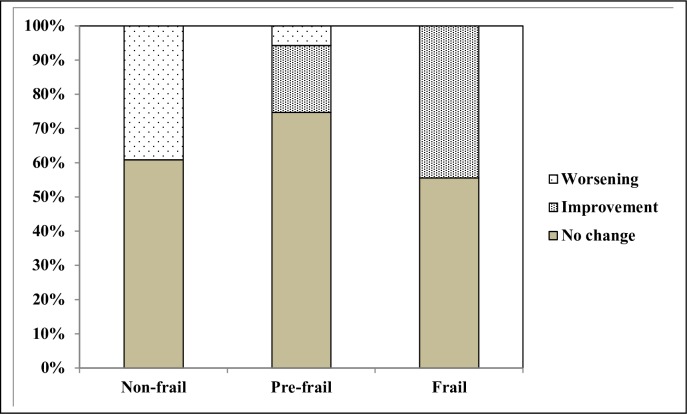
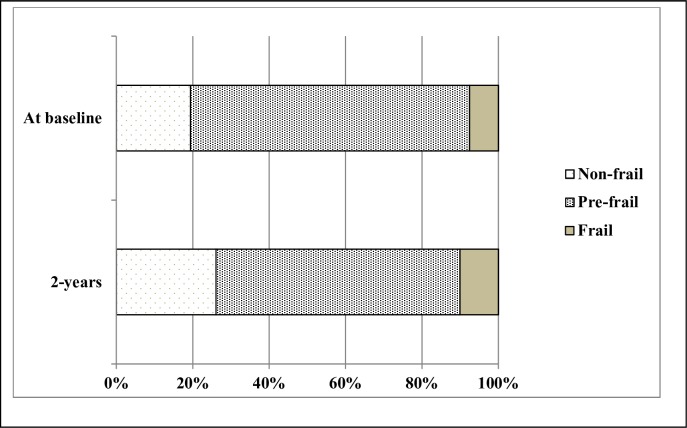
After 2 years of follow-up, 21 (17.6%) patients had an improved frailty status, 14 (11.7%) had worsened, and 84 (70.5%) had maintained the same frailty status. The worsening group (vs no change group) had greater dyspnea (p = 0.013) and disability (p = 0.036) and lower handgrip strength (p = 0.001). In contrast, the improved group (vs no change group) had greater handgrip (p<0.001) and quadriceps strength (p = 0.032). Furthermore, the improved group had greater handgrip strength (p<0.001), quadriceps strength (p = 0.003), physical activity (p = 0.008), and lower disability (p = 0.019) than the worsening group. Additionally, we determined that the 5STS test (≤ 13.6s) and exacerbations (≥ 2) were independent predictors for improvement in frailty status [adjusted OR 9.46, p = 0.058 and adjusted OR 0.12, p = 0.026, respectively].
Frailty is a dynamic process for approximately one-third of patients with stable COPD and transitions in frailty status are associated with significant changes in clinical outcomes. The 5STS and exacerbations were independent predictors of improvement in frailty status.
衰弱是慢性阻塞性肺疾病(COPD)患者的常见现象,但关于衰弱转变频率的证据很少。
本研究旨在描述稳定期 COPD 患者两年内衰弱状态的转变率及其相关临床结局,并确定衰弱状态改善的预测因素。
我们前瞻性纳入了 119 例稳定期 COPD 患者(平均年龄±标准差,66.9±7.9 岁),随访时间为 2 年。使用 Fried 标准(非故意体重减轻、虚弱、疲劳、低活动水平和缓慢行走速度)评估衰弱状态。测量了几个人口统计学、临床和健康相关变量。我们计算了基线和 2 年内每个衰弱转变(无变化、改善或恶化)的发生率。使用单因素方差分析比较结局,并用多元逻辑回归识别改善的预测因素。
随访 2 年后,21 例(17.6%)患者的衰弱状态得到改善,14 例(11.7%)恶化,84 例(70.5%)保持不变。恶化组(与无变化组相比)呼吸困难更严重(p=0.013),残疾程度更高(p=0.036),握力更弱(p=0.001)。相反,改善组(与无变化组相比)握力更大(p<0.001),股四头肌力量更强(p=0.032)。此外,改善组握力(p<0.001)、股四头肌力量(p=0.003)、体力活动(p=0.008)更高,残疾程度更低(p=0.019)。此外,我们发现 5 步上楼梯测试(≤13.6s)和加重(≥2 次)是衰弱状态改善的独立预测因素[调整后的比值比 9.46,p=0.058 和调整后的比值比 0.12,p=0.026]。
衰弱是稳定期 COPD 患者的一个动态过程,约三分之一的患者衰弱状态发生转变,与临床结局的显著变化相关。5 步上楼梯测试和加重是衰弱状态改善的独立预测因素。