Mallorquí-Bagué Nuria, Lozano-Madrid María, Testa Giulia, Vintró-Alcaraz Cristina, Sánchez Isabel, Riesco Nadine, César Perales José, Francisco Navas Juan, Martínez-Zalacaín Ignacio, Megías Alberto, Granero Roser, Veciana De Las Heras Misericordia, Chami Rayane, Jiménez-Murcia Susana, Fernández-Formoso José Antonio, Treasure Janet, Fernández-Aranda Fernando
Department of Psychiatry, University Hospital of Bellvitge-IDIBELL, 08907 Barcelona, Spain.
CIBER Fisiopatologia Obesidad y Nutrición (CIBERobn), Instituto de Salud Carlos III, 28029 Madrid, Spain.
J Clin Med. 2020 Mar 31;9(4):960. doi: 10.3390/jcm9040960.
Difficulties in emotion regulation and craving regulation have been linked to eating symptomatology in patients with anorexia nervosa (AN), contributing to the maintenance of their eating disorder.
To investigate clinical and electrophysiological correlates of these processes, 20 patients with AN and 20 healthy controls (HC) completed a computerized task during EEG recording, where they were instructed to down-regulate negative emotions or food craving. Participants also completed self-report measures of emotional regulation and food addiction. The P300 and Late Positive Potential (LPP) ERPs were analysed.
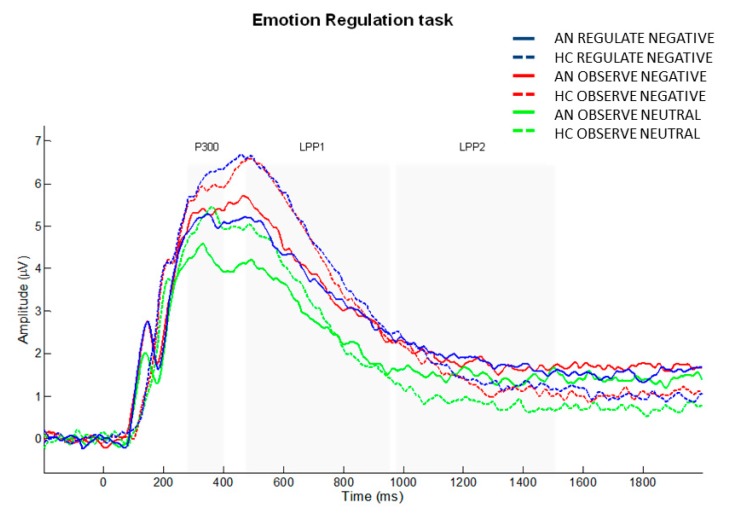
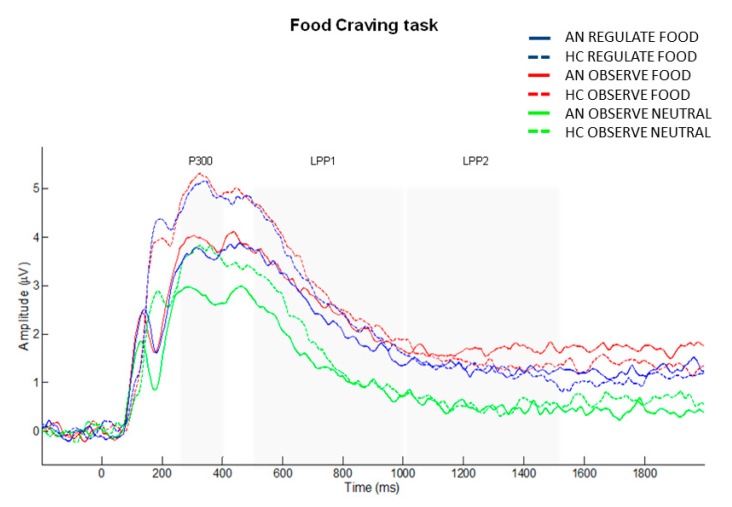
LPP amplitudes were significantly smaller during down-regulation of food craving among both groups. Independent of task condition, individuals with AN showed smaller P300 amplitudes compared to HC. Among HC, the self-reported use of re-appraisal strategies positively correlated with LPP amplitudes during emotional regulation task, while suppressive strategies negatively correlated with LPP amplitudes. The AN group, in comparison to the HC group, exhibited greater food addiction, greater use of maladaptive strategies, and emotional dysregulation.
Despite the enhanced self-reported psychopathology among AN, both groups indicated neurophysiological evidence of food craving regulation as evidenced by blunted LPP amplitudes in the relevant task condition. Further research is required to delineate the mechanisms associated with reduced overall P300 amplitudes among individuals with AN.
情绪调节和渴望调节困难与神经性厌食症(AN)患者的饮食症状有关,这有助于维持他们的饮食失调。
为了研究这些过程的临床和电生理相关性,20名AN患者和20名健康对照者(HC)在脑电图记录期间完成了一项计算机任务,在该任务中,他们被要求下调负面情绪或食物渴望。参与者还完成了情绪调节和食物成瘾的自我报告测量。对P300和晚期正电位(LPP)事件相关电位进行了分析。
两组在下调食物渴望期间,LPP波幅均显著较小。与任务条件无关,AN患者与HC相比,P300波幅较小。在HC中,自我报告的重新评估策略的使用与情绪调节任务期间的LPP波幅呈正相关,而抑制策略与LPP波幅呈负相关。与HC组相比,AN组表现出更大的食物成瘾、更多地使用适应不良策略和情绪失调。
尽管AN患者自我报告的精神病理学有所增强,但两组在相关任务条件下LPP波幅减弱,均表明有食物渴望调节的神经生理学证据。需要进一步研究来阐明与AN患者总体P300波幅降低相关的机制。