Barić Lidija, Drenjančević Ines, Mihalj Martina, Matić Anita, Stupin Marko, Kolar Luka, Mihaljević Zrinka, Mrakovčić-Šutić Ines, Šerić Vatroslav, Stupin Ana
Department of Physiology and Immunology, Faculty of Medicine Josip Juraj Strossmayer University of Osijek, J. Huttlera 4, Hr-31000 Osijek, Croatia.
Scientific Center of Excellence for Personalized Health Care, Josip Juraj Strossmayer University of Osijek, Trg Svetog Trojstva 3, Hr-31000 Osijek, Croatia.
J Clin Med. 2020 Mar 20;9(3):843. doi: 10.3390/jcm9030843.
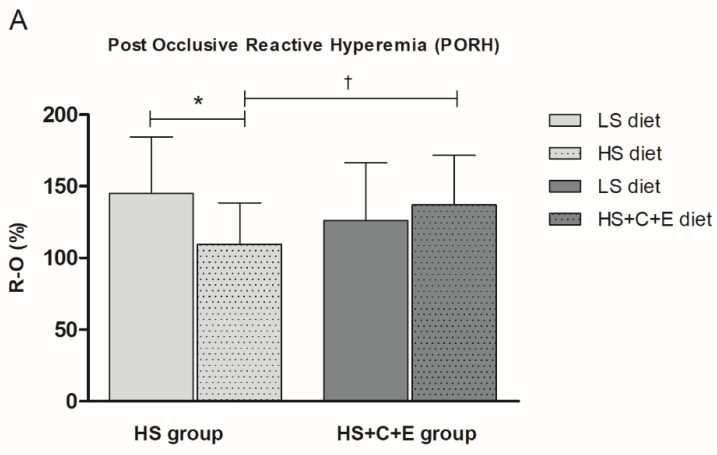
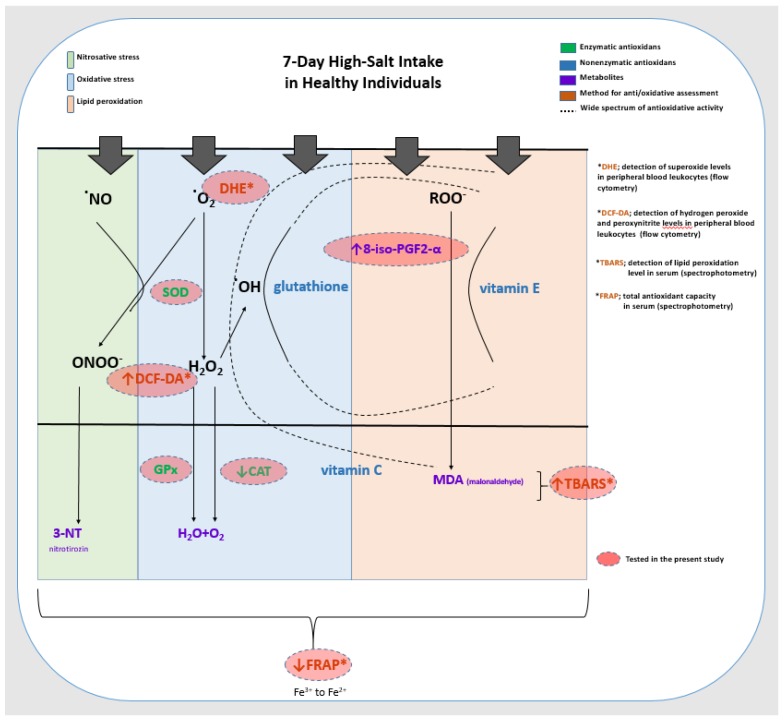
This study aimed to examine whether the oral supplementation of vitamins C and E during a seven-day high salt diet (HS; ~14 g salt/day) prevents microvascular endothelial function impairment and changes oxidative status caused by HS diet in 51 (26 women and 25 men) young healthy individuals. Laser Doppler flowmetry measurements demonstrated that skin post-occlusive reactive hyperemia (PORH), and acetylcholine-induced dilation (AChID) were significantly impaired in the HS group, but not in HS+C+E group, while sodium nitroprusside-induced dilation remained unaffected by treatments. Serum oxidative stress markers: Thiobarbituric acid reactive substances (TBARS), 8-iso prostaglandin-F2α, and leukocytes' intracellular hydrogen peroxide (HO) production were significantly increased, while ferric-reducing ability of plasma (FRAP) and catalase concentrations were decreased in the HS group. All these parameters remained unaffected by vitamins supplementation. Matrix metalloproteinase 9, antioxidant enzymes Cu/Zn SOD and glutathione peroxidase 1, and leukocytes' intracellular superoxide production remained unchanged after the protocols in both HS and HS+C+E groups. Importantly, multiple regression analysis revealed that FRAP was the most powerful predictor of AChID, while PORH was strongly predicted by both FRAP and renin-angiotensin system activity. Hereby, we demonstrated that oxidative dis-balance has the pivotal role in HS diet-induced impairment of endothelial and microvascular function in healthy individuals which could be prevented by antioxidative vitamins consumption.
本研究旨在检测,在51名(26名女性和25名男性)年轻健康个体中,为期七天的高盐饮食(HS;约14克盐/天)期间口服补充维生素C和E是否能预防微血管内皮功能损害以及高盐饮食引起的氧化状态变化。激光多普勒血流仪测量结果显示,高盐组皮肤闭塞后反应性充血(PORH)和乙酰胆碱诱导的扩张(AChID)显著受损,但高盐+维生素C+维生素E组未受损,而硝普钠诱导的扩张不受治疗影响。血清氧化应激标志物:硫代巴比妥酸反应性物质(TBARS)、8-异前列腺素-F2α和白细胞细胞内过氧化氢(HO)生成显著增加,而高盐组血浆铁还原能力(FRAP)和过氧化氢酶浓度降低。所有这些参数均不受维生素补充的影响。高盐组和高盐+维生素C+维生素E组在实验方案后基质金属蛋白酶9、抗氧化酶铜/锌超氧化物歧化酶和谷胱甘肽过氧化物酶1以及白细胞细胞内超氧化物生成均保持不变。重要的是,多元回归分析显示,FRAP是AChID的最强有力预测指标,而PORH则由FRAP和肾素-血管紧张素系统活性共同强烈预测。据此,我们证明氧化失衡在高盐饮食诱导的健康个体内皮和微血管功能损害中起关键作用,而抗氧化维生素的摄入可以预防这种损害。