National Institute for Health and Care Excellence, 10 Spring Gardens, London, SW1A 2BU, UK.
Harvard Global Health Institute, Harvard University, 42 Church St, Cambridge, MA, 02138, USA.
BMC Health Serv Res. 2020 Apr 3;20(1):279. doi: 10.1186/s12913-020-5058-1.
Oral anticoagulants are prescribed for stroke prophylaxis in patients with atrial fibrillation, which is the most common heart arrhythmia worldwide. The vitamin K antagonist (VKA) warfarin is a long-established anticoagulant. However, newer direct oral anticoagulants (DOACs) have been recently introduced as an alternative. Given the prevalence of atrial fibrillation, anticoagulant choice has substantial clinical and financial implications for healthcare systems. In this study, we explore trends and geographic variation in anticoagulant prescribing in English primary care. Because national guidelines in England do not specify a first-line anticoagulant, we investigate the association between local policies and prescribing data.
Primary care prescribing data of anticoagulants for all NHS practices from 2014 to 2019 in England was obtained from the ePACT2 database. Public formularies were accessed online to obtain local anticoagulation prescribing policies for 89.5% of clinical commissioning groups (CCGs). These were categorized according to their recommendations: no local policies, warfarin as first-line, or identification of a preferred DOAC (but not a preferred anticoagulant). Local policies were cross-tabulated with pooled prescribing data to measure the strength of association with Cramér's V.
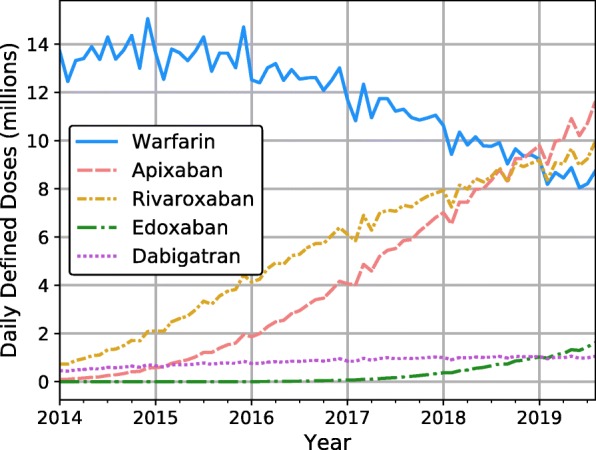
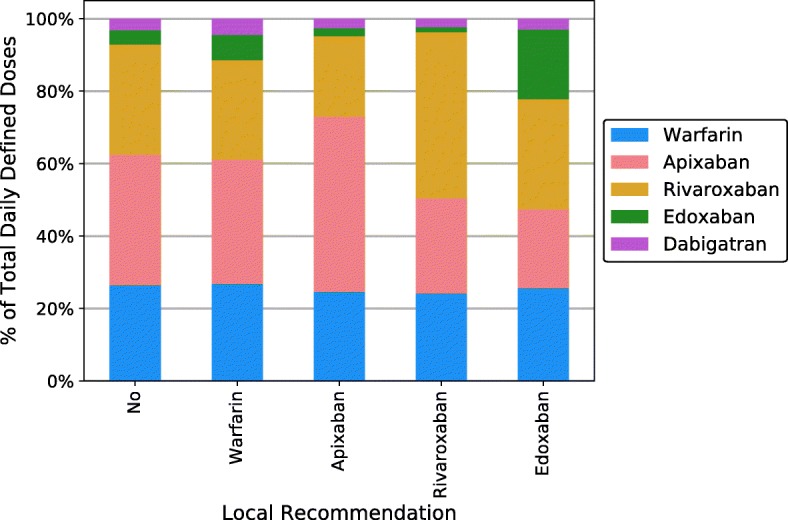
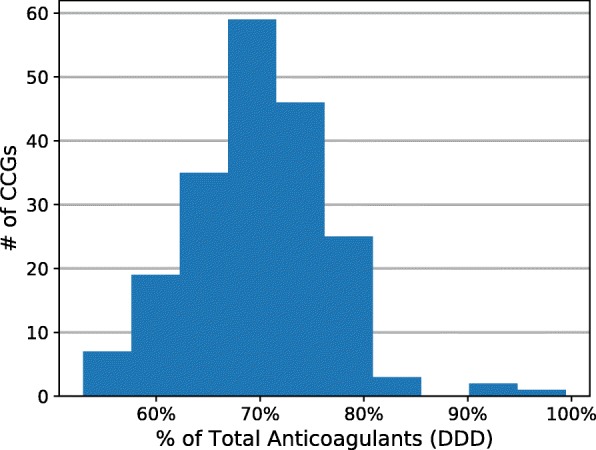
Nationally, prescribing of DOACs increased from 9% of all anticoagulants in 2014 to 74% in 2019, while that of warfarin declined accordingly. Still, there was significant local variation. Across geographical regions, DOACs ranged from 53 to 99% of all anticoagulants. Most CCGs (73%) did not specify a first-line choice, and 16% recommended warfarin first line. Only 11% designated a preferred DOAC. Policies with a preferred DOAC indeed correlated with increased prescribing of that DOAC (Cramér's V = 0.25, 0.27, 0.38 for rivaroxaban, apixaban, edoxaban respectively). However, local policies showed a negligible relationship with the classes of anticoagulants prescribed-DOAC or VKA (Cramér's V = 0.01).
Nationally, the use of DOACs to treat atrial fibrillation has increased rapidly. Despite this, significant geographical variation in uptake remains. This study provides insights on how local policies relate to this variation. Our findings suggest that, in the absence of a nationally recommended first-line anticoagulant, local prescribing policies may aid in deciding between individual DOACs, but not in adjudicating between DOACs and vitamin K antagonists (i.e. warfarin) as general classes.
在全球范围内,心房颤动是最常见的心律失常,华法林等口服抗凝剂被用于预防中风。然而,最近出现了一些新型的直接口服抗凝剂(DOAC)作为替代品。鉴于心房颤动的普遍性,抗凝剂的选择对医疗保健系统具有重要的临床和经济意义。本研究旨在探讨英国初级保健中抗凝剂处方的趋势和地域差异。由于英国国家指南并未指定一线抗凝剂,因此我们调查了当地政策与处方数据之间的关系。
从 2014 年至 2019 年,我们从 ePACT2 数据库中获取了英格兰所有国民保健服务(NHS)实践的抗凝剂处方数据。我们在线访问公共处方集,以获取 89.5%的临床委托组(CCG)的当地抗凝剂处方政策。根据其建议对这些政策进行分类:无当地政策、华法林作为一线药物,或确定首选 DOAC(但不是首选抗凝剂)。将当地政策与汇总的处方数据进行交叉制表,以衡量与 Cramér V 的关联强度。
在全国范围内,DOAC 的处方量从 2014 年的所有抗凝剂的 9%增加到 2019 年的 74%,而华法林的处方量相应减少。尽管如此,仍然存在显著的地域差异。在地理区域范围内,DOAC 占所有抗凝剂的比例从 53%到 99%不等。大多数 CCG(73%)未指定一线药物选择,16%推荐华法林作为一线药物。只有 11%指定了首选的 DOAC。确实,有首选 DOAC 的政策与该 DOAC 的处方量增加相关(利伐沙班、阿哌沙班、依度沙班的 Cramér V 分别为 0.25、0.27、0.38)。然而,当地政策与所开抗凝剂类别(DOAC 或维生素 K 拮抗剂,即华法林)之间的关系可以忽略不计(Cramér V 分别为 0.01)。
全国范围内,使用 DOAC 治疗心房颤动的情况迅速增加。尽管如此,在使用率方面仍存在显著的地域差异。本研究提供了有关当地政策如何影响这种差异的见解。我们的研究结果表明,在缺乏国家推荐的一线抗凝剂的情况下,当地的处方政策可能有助于在个别 DOAC 之间做出决策,但不能在 DOAC 和维生素 K 拮抗剂(即华法林)之间做出一般类别决策。