Singh Sukhmani, Kidane Joseph, Wentworth Kelly L, Motamedi Daria, Morshed Saam, Schober Andrew E, Hsiao Edward C
Division of Endocrinology and Metabolism, Department of Medicine, the Institute for Human Genetics; and the Program in Craniofacial Biology - University of California, San Francisco, 513 Parnassus Ave., HSE901, San Francisco, CA, 94143-0794, USA.
Department of Medicine, University of California, San Francisco, 533 Parnassus Ave, San Francisco, CA, 94143, USA.
BMC Musculoskelet Disord. 2020 Apr 3;21(1):204. doi: 10.1186/s12891-020-03240-2.
Fibrodysplasia ossificans progressiva (FOP) is an ultra-rare disorder marked by painful, recurrent flare-ups and heterotopic ossification (HO) in soft and connective tissues, which can be idiopathic or provoked by trauma, illness, inflammation, or surgery. There are currently no effective treatments for FOP, or for patients with FOP who must undergo surgery. Palovarotene, an investigational retinoic acid receptor-γ agonist, offers a potential avenue to prevent HO formation.
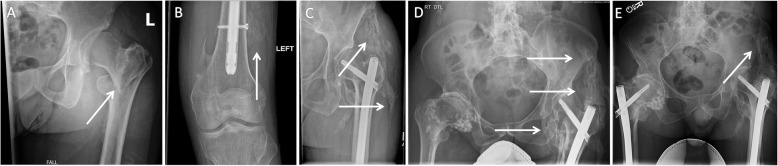
The patient is a 32 year-old male, who at age 29 enrolled in a study evaluating palovarotene to prevent HO formation in FOP. One year after starting palovarotene, he fell resulting in a left intertrochanteric fracture. He underwent intramedullary nailing of the femur shaft with screw placement at the distal femur. After surgery, he received palovarotene at 20 mg/day for 4 weeks, then 10 mg/day for 8 weeks. Imaging 12 weeks after surgery showed new bridging HO at the site of intramedullary rod insertion and distal screw. Nine months after the left hip fracture, the patient had a second fall resulting in a subdural hematoma, left parietal bone fracture, and right intertrochanteric fracture. He underwent intramedullary nailing of the right hip, in a modified procedure which did not require distal screw placement. Palovarotene 20 mg/day was started at fracture occurrence and continued for 4 weeks, then reduced to 10 mg/day for 8 weeks. HO also formed near the insertion site of the intramedullary rod. No HO developed at the right distal intramedullary rod. After each fracture, the patient had prolonged recurrent flare-ups around the hips.
Surgery is only rarely considered in FOP due to the high risks of procedural complications and potential for inducing HO. This case emphasizes the risks of increased flare activity and HO formation from injury and surgery in patients with FOP. The efficacy of HO prevention by palovarotene could not be assessed; however, our observation that palovarotene can be administered in an individual with FOP following surgery with no negative impact on clinical fracture healing, osteointegration, or skin healing will help facilitate future trials testing the role of palovarotene as a therapy for HO.
进行性骨化性纤维发育不良(FOP)是一种极为罕见的疾病,其特征为软组织和结缔组织中出现疼痛性反复发作及异位骨化(HO),病因可能是特发性的,也可能由创伤、疾病、炎症或手术引发。目前,对于FOP或必须接受手术的FOP患者,尚无有效的治疗方法。帕罗维罗汀是一种正在研究的视黄酸受体γ激动剂,为预防HO形成提供了一条潜在途径。
患者为一名32岁男性,29岁时参加了一项评估帕罗维罗汀预防FOP患者HO形成的研究。开始使用帕罗维罗汀一年后,他摔倒导致左股骨转子间骨折。他接受了股骨干髓内钉固定术,并在股骨远端置入螺钉。术后,他接受了4周每天20毫克的帕罗维罗汀治疗,然后8周每天10毫克。术后12周的影像学检查显示,髓内棒插入部位和远端螺钉处出现了新的桥接性HO。左髋部骨折9个月后,患者再次摔倒,导致硬膜下血肿、左顶骨骨折和右股骨转子间骨折。他接受了右髋部髓内钉固定术,采用了一种改良手术,无需在远端置入螺钉。骨折发生时开始每天服用20毫克帕罗维罗汀,并持续4周,然后减至每天10毫克,持续8周。髓内棒插入部位附近也形成了HO。右远端髓内棒处未出现HO。每次骨折后,患者髋部周围都出现了长时间的反复发作。
由于手术并发症风险高且有诱发HO的可能性,FOP患者很少考虑手术治疗。该病例强调了FOP患者因受伤和手术导致发作活动增加及HO形成的风险。无法评估帕罗维罗汀预防HO的疗效;然而,我们观察到帕罗维罗汀可在FOP患者术后使用,且对临床骨折愈合、骨整合或皮肤愈合无负面影响,这将有助于推动未来测试帕罗维罗汀作为HO治疗方法作用的试验。