Department of Medicine, Mayo Clinic, Rochester, MN, US.
Departments of Orthopedic Surgery & Medicine, The Center for Research in FOP and Related Disorders, Perelman School of Medicine, University of Pennsylvania, Philadelphia, PA, US.
BMC Med Res Methodol. 2023 Nov 13;23(1):269. doi: 10.1186/s12874-023-02080-7.
The design of clinical trials in rare diseases is often complicated by a lack of real-world translational knowledge. Fibrodysplasia ossificans progressiva (FOP) is an ultra-rare genetic disorder characterized by skeletal malformations and progressive heterotopic ossification (HO). Palovarotene is a selective retinoic acid receptor gamma agonist. Here, we describe the methodology of three studies in the palovarotene clinical development program in FOP and discuss insights that could inform future research, including endpoint suitability and the impact of trial design.
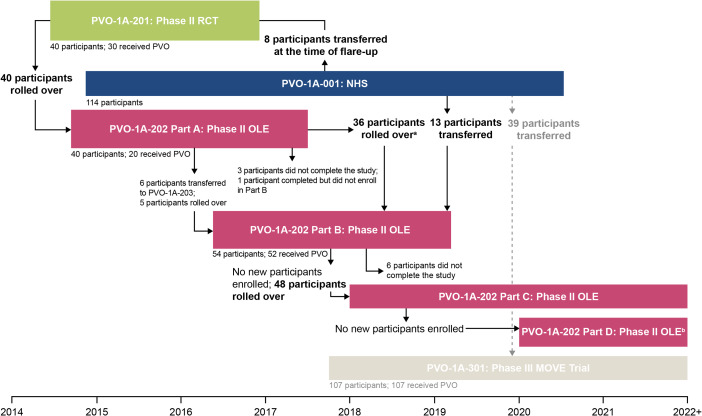
PVO-1A-001 (NCT02322255) was a prospective, protocol-specified, longitudinal FOP natural history study (NHS). PVO-1A-201 (NCT02190747) was a randomized, double-blind, placebo-controlled phase II trial; PVO-1A-202 (NCT02279095) was its open-label extension. Trial designs, including treatment regimens and imaging assessments, were refined between PVO-1A-201 and PVO-1A-202, and within PVO-1A-202, based on emerging data as the studies progressed. Palovarotene doses were administered using a flare-up treatment regimen (higher dose for 2/4 weeks, followed by lower dose for 4/≥8 weeks; from flare-up onset), with or without accompanying chronic (daily) treatment. Flare-up and disease progression outcomes were assessed, including incidence and volume of new HO during flare-ups and/or annually, as well as other clinical, patient-reported, and exploratory outcomes. Safety was monitored throughout all studies.
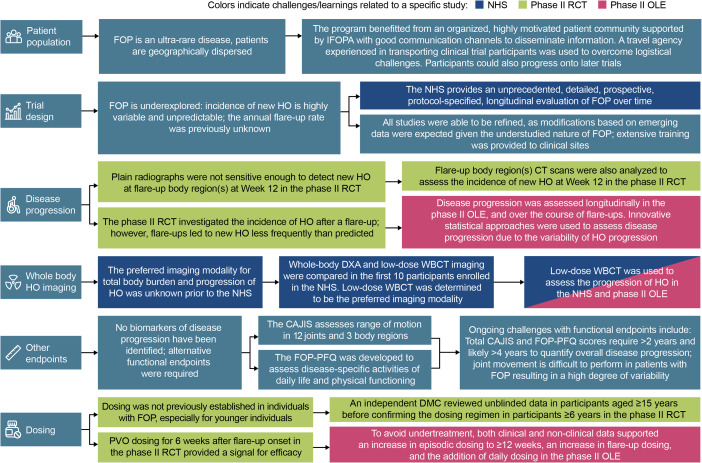
Overall, 114 and 58 individuals with FOP were enrolled in the NHS and phase II trials, respectively. Results of the NHS and PVO-1A-201 were published in 2022; complete results of PVO-1A-202 will be publicly available in due course. Together the studies yielded important information on endpoint suitability, including that low-dose whole-body computed tomography was the optimum imaging modality for assessing HO progression annually and that long study durations are needed to detect substantial changes in functional and patient-reported outcomes.
A flexible clinical development program is necessary for underexplored rare diseases to overcome the many challenges faced. Here, the NHS provided a longitudinal evaluation of FOP progression and interventional trials were based on emerging data. The studies described informed the design and endpoints implemented in the phase III MOVE trial (NCT03312634) and provide a foundation for future clinical trial development.
NCT02322255 (registered 23/12/2014); NCT02190747 (registered 15/07/2014); NCT02279095 (registered 30/10/2014).
罕见病临床试验的设计常常因缺乏真实世界的转化知识而变得复杂。成骨不全症进展性(FOP)是一种罕见的遗传性疾病,其特征是骨骼畸形和进行性异位骨化(HO)。帕拉罗特醇是一种选择性维甲酸受体γ激动剂。在这里,我们描述了 FOP 中帕拉罗特醇临床开发项目中的三项研究的方法,并讨论了可能为未来研究提供信息的见解,包括终点适用性和试验设计的影响。
PVO-1A-001(NCT02322255)是一项前瞻性、协议规定的、纵向 FOP 自然史研究(NHS)。PVO-1A-201(NCT02190747)是一项随机、双盲、安慰剂对照的 II 期试验;PVO-1A-202(NCT02279095)是其开放标签扩展。基于研究进展中出现的数据,在 PVO-1A-201 和 PVO-1A-202 之间以及 PVO-1A-202 内,试验设计(包括治疗方案和影像学评估)得到了改进。帕拉罗特醇剂量采用爆发性治疗方案(高剂量 2/4 周,随后低剂量 4/≥8 周;从爆发性发作开始),伴或不伴伴随慢性(每日)治疗。评估了爆发和疾病进展的结果,包括爆发期间和/或每年新 HO 的发生率和体积,以及其他临床、患者报告和探索性结果。在所有研究中均监测安全性。
共有 114 名和 58 名 FOP 患者分别入组 NHS 和 II 期试验。NHS 和 PVO-1A-201 的结果于 2022 年发表;PVO-1A-202 的完整结果将在适当的时候公开。这些研究共同提供了关于终点适用性的重要信息,包括低剂量全身计算机断层扫描是每年评估 HO 进展的最佳影像学方法,以及需要较长的研究时间才能检测到功能和患者报告结果的显著变化。
对于探索不足的罕见病,需要灵活的临床开发计划来克服面临的许多挑战。在这里,NHS 提供了 FOP 进展的纵向评估,而干预性试验则基于新兴数据。所描述的研究为 III 期 MOVE 试验(NCT03312634)的设计和终点实施提供了信息,并为未来的临床试验发展奠定了基础。
NCT02322255(2014 年 12 月 23 日注册);NCT02190747(2014 年 7 月 15 日注册);NCT02279095(2014 年 10 月 30 日注册)。