Istituto Superiore di Sanità, National Centre for pre-clinical and clinical drug research and evaluation, Pharmacological research and experimental therapy Unit, 00166, Rome, Italy.
University Hospital CHUV, Dept. of Dermatology, 1011, Lausanne, Switzerland.
Sci Rep. 2020 Apr 3;10(1):5851. doi: 10.1038/s41598-020-62480-3.
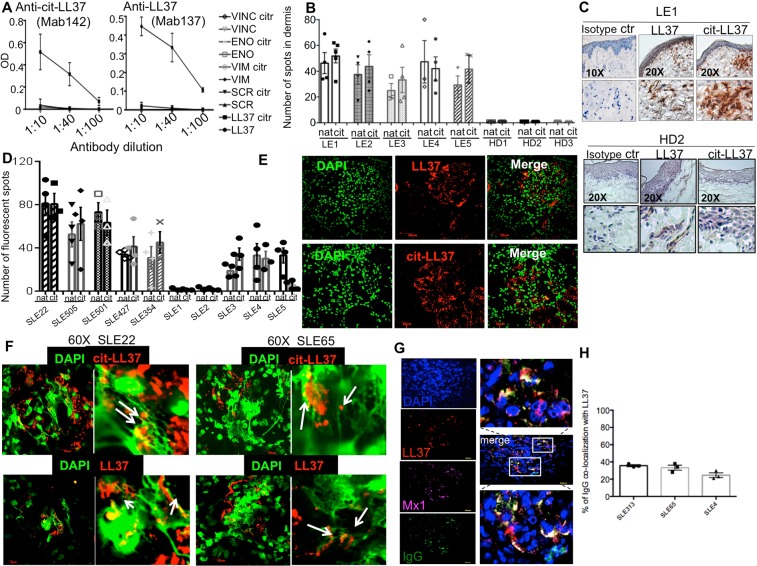
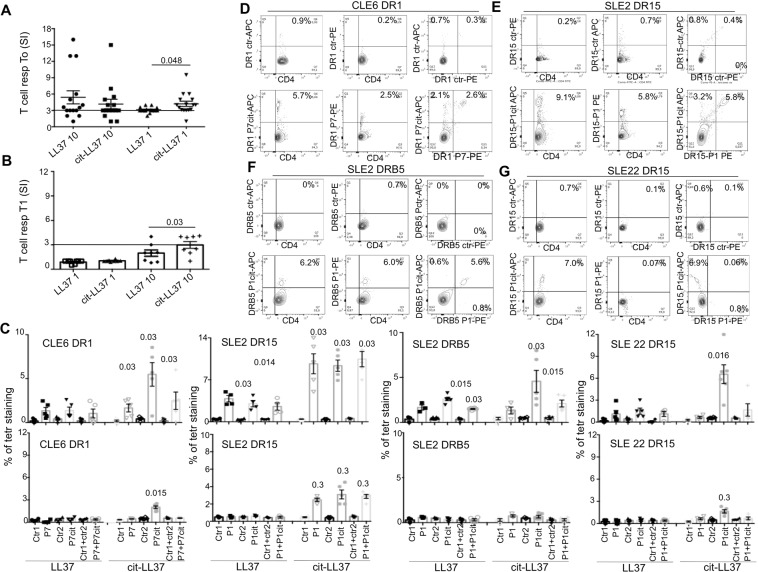
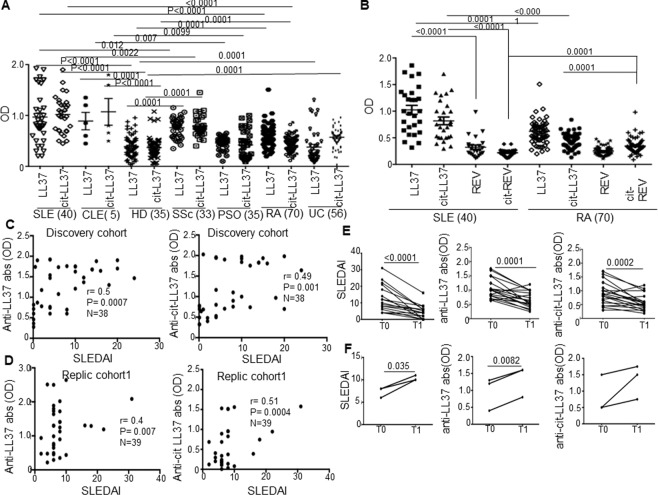
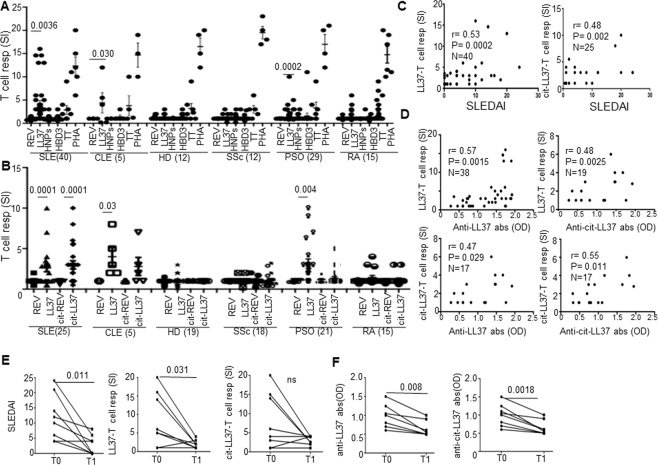
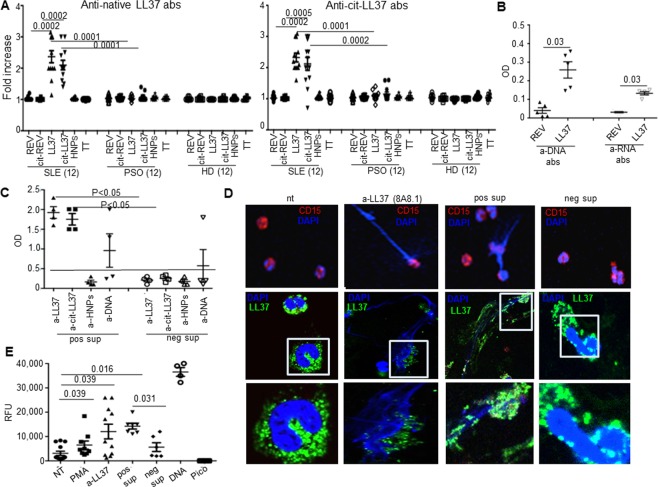
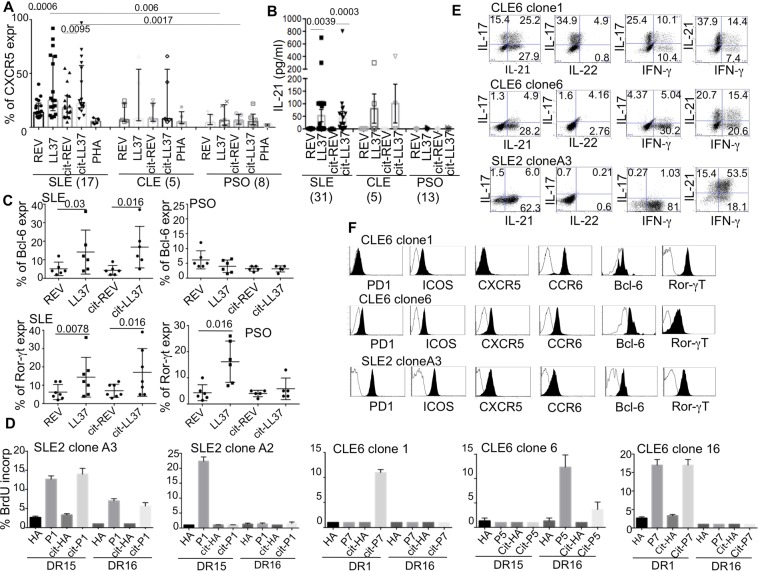
LL37 exerts a dual pathogenic role in psoriasis. Bound to self-DNA/RNA, LL37 licenses autoreactivity by stimulating plasmacytoid dendritic cells-(pDCs)-Type I interferon (IFN-I) and acts as autoantigen for pathogenic Th17-cells. In systemic lupus erythematosus (SLE), LL37 also triggers IFN-I in pDCs and is target of pathogenic autoantibodies. However, whether LL37 activates T-cells in SLE and how the latter differ from psoriasis LL37-specific T-cells is unknown. Here we found that 45% SLE patients had circulating T-cells strongly responding to LL37, which correlate with anti-LL37 antibodies/disease activity. In contrast to psoriatic Th17-cells, these LL37-specific SLE T-cells displayed a T-follicular helper-(T)-like phenotype, with CXCR5/Bcl-6 and IL-21 expression, implicating a role in stimulation of pathogenic autoantibodies. Accordingly, SLE LL37-specific T-cells promoted B-cell secretion of pathogenic anti-LL37 antibodies in vitro. Importantly, we identified abundant citrullinated LL37 (cit-LL37) in SLE tissues (skin and kidney) and observed very pronounced reactivity of LL37-specific SLE T-cells to cit-LL37, compared to native-LL37, which was much more occasional in psoriasis. Thus, in SLE, we identified LL37-specific T-cells with a distinct functional specialization and antigenic specificity. This suggests that autoantigenic specificity is independent from the nature of the autoantigen, but rather relies on the disease-specific milieu driving T-cell subset polarization and autoantigen modifications.
LL37 在银屑病中具有双重致病作用。与自身 DNA/RNA 结合后,LL37 通过刺激浆细胞样树突状细胞(pDC)-I 型干扰素(IFN-I)来激发自身反应,并作为致病性 Th17 细胞的自身抗原。在系统性红斑狼疮(SLE)中,LL37 也会在 pDC 中引发 IFN-I,并成为致病性自身抗体的靶标。然而,LL37 是否会在 SLE 中激活 T 细胞,以及后者与银屑病特异性 LL37-T 细胞有何不同尚不清楚。在这里,我们发现 45%的 SLE 患者存在对 LL37 强烈反应的循环 T 细胞,这些细胞与抗 LL37 抗体/疾病活动度相关。与银屑病 Th17 细胞不同,这些 LL37 特异性 SLE T 细胞表现出滤泡辅助性 T 细胞(Tfh)样表型,表达 CXCR5/Bcl-6 和 IL-21,暗示其在刺激致病性自身抗体中的作用。因此,SLE 中的 LL37 特异性 T 细胞可在体外促进 B 细胞分泌致病性抗 LL37 抗体。重要的是,我们在 SLE 组织(皮肤和肾脏)中发现了大量瓜氨酸化的 LL37(cit-LL37),并观察到与银屑病相比,LL37 特异性 SLE T 细胞对 cit-LL37 的反应更为明显,而对 native-LL37 的反应则更为偶然。因此,在 SLE 中,我们鉴定了具有独特功能特化和抗原特异性的 LL37 特异性 T 细胞。这表明自身抗原特异性不依赖于自身抗原的性质,而是依赖于驱动 T 细胞亚群极化和自身抗原修饰的疾病特异性微环境。