Division of Asthma, Allergy, and Rheumatology, Department of Pediatrics, Chang Gung Children's Hospital, College of Medicine, Chang Gung University, Taoyuan, Taiwan.
Department of Microbiology and Immunology, Graduate Institute of Biomedical Sciences, College of Medicine, Chang Gung University, Tao-Yuan, Taiwan.
Sci Rep. 2020 Apr 3;10(1):5858. doi: 10.1038/s41598-020-62654-z.
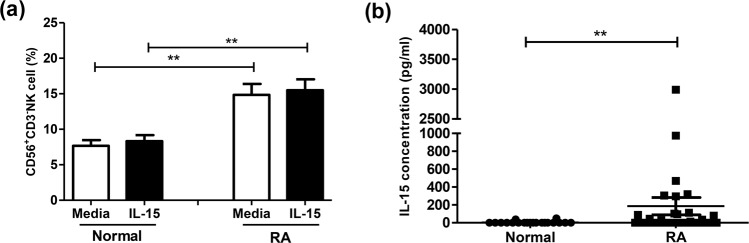
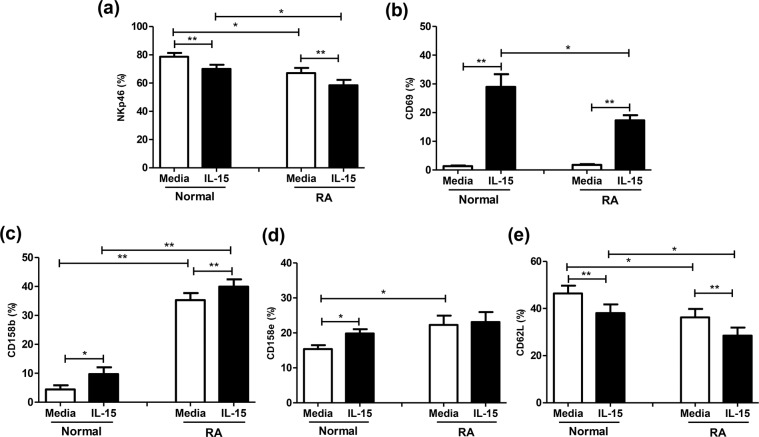
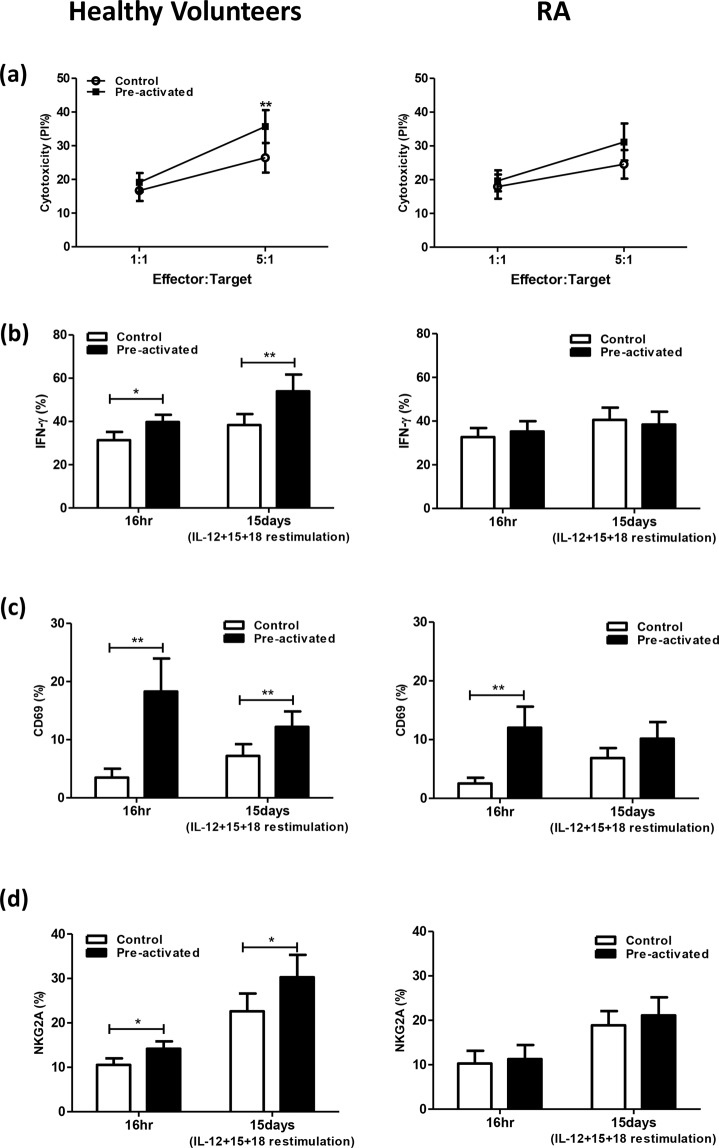
Rheumatoid arthritis (RA) is an autoimmune disease characterized by synovial inflammation and joint destruction. Previous studies have shown that natural killer (NK) cells may play an important role in the pathogenesis of RA. Interleukin (IL)-15, a pro-inflammatory cytokine which induces proliferation and differentiation of NK cells, is overexpressed in RA. In this present study, we examine various NKRs and adhesion molecule expression on NK cells from RA patients and their response to IL-15 stimulation. We also sought to study cytokine-induced memory-like (CIML) NK cells in RA patients. We established that 1. RA patients had higher NK cell percentages in peripheral blood and their serum IL-15 levels were higher compared to healthy volunteers; 2. NK cells from RA patients showed lower NKp46 expression and an impaired CD69 response to IL-15; 3. NK cells from RA patients showed higher CD158b and CD158e expression but lower CD62L expression; 4. exogenous IL-15 up-regulated CD69, CD158b, CD158e but down-regulated NKp46 and CD62L expression in RA; 5. As to CIML NK cells, restimulation - induced NK cytotoxicity and IFN-γ production was impaired in RA patients, 6. Reduced NKp46, perforin, and granzyme B expression on NK cells was found in RA patients with bone deformity and erosion, 7. RA disease activity (DAS28) showed inverse correlation with the percentages of CD56CD3 NK cells, and NKp46 and perforin expression on NK cells, respectively. Taken together, our study demonstrated differential expression of various NK receptors in RA patients. NKp46, CD158e, and perforin expression on NK cells may serve as markers of RA severity.
类风湿关节炎(RA)是一种以滑膜炎症和关节破坏为特征的自身免疫性疾病。先前的研究表明,自然杀伤(NK)细胞可能在 RA 的发病机制中起重要作用。白细胞介素(IL)-15 是一种促炎细胞因子,可诱导 NK 细胞的增殖和分化,在 RA 中过度表达。在本研究中,我们检查了 RA 患者 NK 细胞上的各种 NK 受体和粘附分子的表达及其对 IL-15 刺激的反应。我们还试图研究 RA 患者中的细胞因子诱导的记忆样(CIML)NK 细胞。我们确定:1. RA 患者外周血中 NK 细胞百分比较高,其血清 IL-15 水平高于健康志愿者;2. RA 患者 NK 细胞上的 NKp46 表达降低,对 IL-15 的 CD69 反应受损;3. RA 患者的 NK 细胞表达更高的 CD158b 和 CD158e,但表达更低的 CD62L;4. 外源性 IL-15 上调 RA 中 NK 细胞的 CD69、CD158b 和 CD158e,但下调 NKp46 和 CD62L 的表达;5. 至于 CIML NK 细胞,RA 患者的再刺激诱导 NK 细胞毒性和 IFN-γ 产生受损;6. 在患有骨畸形和侵蚀的 RA 患者中,发现 NK 细胞上的 NKp46、穿孔素和颗粒酶 B 表达减少;7. RA 疾病活动度(DAS28)与 CD56CD3 NK 细胞、NK 细胞上的 NKp46 和穿孔素的表达百分比呈负相关。总之,我们的研究表明 RA 患者中存在各种 NK 受体的差异表达。NK 细胞上的 NKp46、CD158e 和穿孔素表达可作为 RA 严重程度的标志物。