Utrecht University School of Economics, Utrecht University, Utrecht, The Netherlands.
Sci Rep. 2020 Apr 3;10(1):5863. doi: 10.1038/s41598-020-62626-3.
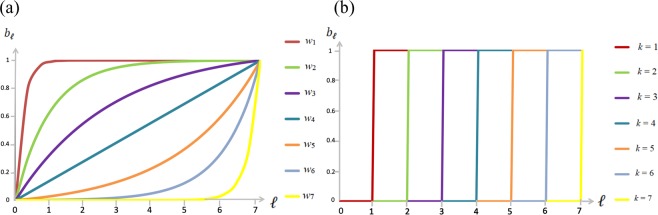
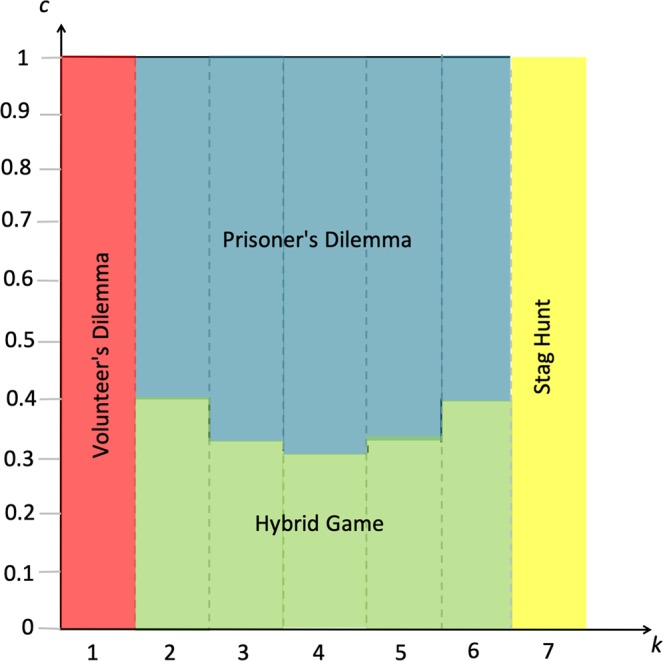
For a well-mixed population, we consider a threshold public good game where group members only obtain benefits from a public good if a sufficiently large number of them cooperates. We investigate the effect of an increase in the threshold on the level of cooperation that evolves. It is shown that for sufficiently large participation costs, the level of cooperation is higher for low and for high thresholds, than it is for intermediate thresholds - where in the latter case cooperation may not evolve at all. The counterintuitive effect where an increase in the threshold from an intermediate to a high one decreases the probability of cooperation, is related to the so-called common-enemy hypothesis of the evolution of cooperation. We further apply our analysis to assess the relative weight of different game types across the parameter space, and show that game types where either a small, or a large fraction of the population evolves as cooperators, receive more weight compared to game types where an intermediate fraction of cooperators evolves.
对于一个混合良好的群体,我们考虑了一个阈值公共物品博弈,其中只有当足够多的群体成员合作时,他们才能从公共物品中获得收益。我们研究了阈值增加对合作水平演变的影响。结果表明,对于足够大的参与成本,低阈值和高阈值的合作水平高于中间阈值的合作水平——在后一种情况下,合作可能根本不会出现。从中间阈值增加到高阈值会降低合作概率的这种违反直觉的效应,与合作进化的所谓共同敌人假说有关。我们进一步应用我们的分析来评估不同博弈类型在参数空间中的相对权重,并表明与合作者处于中间比例的博弈类型相比,群体中要么一小部分,要么很大一部分进化为合作者的博弈类型受到更多重视。