• 文献检索
  • 文档翻译
  • 深度研究
  • 学术资讯
  • Suppr Zotero 插件Zotero 插件
  • 邀请有礼
  • 套餐&价格
  • 历史记录
应用&插件
Suppr Zotero 插件Zotero 插件浏览器插件Mac 客户端Windows 客户端微信小程序
定价
高级版会员购买积分包购买API积分包
服务
文献检索文档翻译深度研究API 文档MCP 服务
关于我们
关于 Suppr公司介绍联系我们用户协议隐私条款
关注我们

Suppr 超能文献

核心技术专利:CN118964589B侵权必究
粤ICP备2023148730 号-1Suppr @ 2026

文献检索

告别复杂PubMed语法,用中文像聊天一样搜索,搜遍4000万医学文献。AI智能推荐,让科研检索更轻松。

立即免费搜索

文件翻译

保留排版,准确专业,支持PDF/Word/PPT等文件格式,支持 12+语言互译。

免费翻译文档

深度研究

AI帮你快速写综述,25分钟生成高质量综述,智能提取关键信息,辅助科研写作。

立即免费体验

预防在日本的中国女性产后抑郁症状的护理干预措施。

Nursing intervention for preventing postpartum depressive symptoms among Chinese women in Japan.

作者信息

Jin Qiongai, Mori Emi, Sakajo Akiko

机构信息

School of Health Sciences, Fujita Health University, Toyoake, Japan.

Graduate School of Nursing, Chiba University, Chiba, Japan.

出版信息

Jpn J Nurs Sci. 2020 Oct;17(4):e12336. doi: 10.1111/jjns.12336. Epub 2020 Apr 6.

DOI:10.1111/jjns.12336
PMID:32250045
原文链接:https://pmc.ncbi.nlm.nih.gov/articles/PMC7586781/
Abstract

AIM

We evaluated the effectiveness of a nursing intervention program for Chinese women who are giving birth in Japan to reduce cross-cultural stressors during the postpartum period and prevent postpartum depressive symptoms.

METHODS

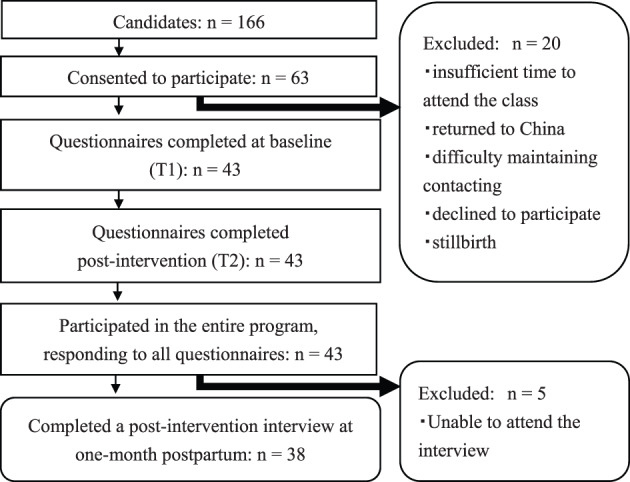
A prospective, before-and-after study incorporating a longitudinal mixed-method design was conducted. Thirty-eight participants underwent this program from August 2016 to July 2017. The program comprised a maternity class, conversation cards, and a social-network group. Data collection was initially performed using questionnaires administered in the third trimester (T1)-before the intervention-to obtain participants' basic information, stress levels, depressive symptoms, and cognitive appraisals. Then, stress levels, depressive symptoms, and social support were measured during hospitalization after having given birth (T2) and during the first month postpartum (T3). Finally, through semi-structured interviews, cognitive appraisal, coping, stress, social support, participants' evaluations of the intervention were determined.

RESULTS

Post-intervention, all participants showed positive cognitive appraisals, although eight also showed some negative appraisals. At T3, 36 participants did not report experiencing stress owing to cross-cultural stressors. Furthermore, post-intervention, participants who returned scores that were suggestive of depression remained identical to that at pre-intervention (21.1%). Among the eight participants who showed postpartum depressive symptoms during T3, seven did not report experiencing cross-cultural stressors, but did report encountering maternity stressors.

CONCLUSION

The nursing intervention program may be effective for preventing postpartum depressive symptoms in Chinese women who give birth in Japan. Since this was a pre-post study in which one group was measured pre-intervention and again post-intervention, we did not register in a publicly assessible database.

摘要

目的

我们评估了一项针对在日本分娩的中国女性的护理干预项目的有效性,该项目旨在减轻产后跨文化压力源并预防产后抑郁症状。

方法

进行了一项采用纵向混合方法设计的前瞻性前后对照研究。2016年8月至2017年7月,38名参与者接受了该项目。该项目包括产前课程、交流卡片和社交网络小组。最初在孕晚期(T1,干预前)通过问卷调查收集数据,以获取参与者的基本信息、压力水平、抑郁症状和认知评估。然后,在产后住院期间(T2)和产后第一个月(T3)测量压力水平、抑郁症状和社会支持。最后,通过半结构化访谈确定认知评估、应对方式、压力、社会支持以及参与者对干预的评价。

结果

干预后,所有参与者都表现出积极的认知评估,尽管有8人也表现出一些消极评估。在T3时,36名参与者未报告因跨文化压力源而感到压力。此外,干预后,抑郁评分呈阳性的参与者人数与干预前相同(21.1%)。在T3期间出现产后抑郁症状的8名参与者中,有7人未报告经历跨文化压力源,但报告遇到了孕产压力源。

结论

该护理干预项目可能对预防在日本分娩的中国女性产后抑郁症状有效。由于这是一项前后对照研究,其中一组在干预前和干预后进行测量,我们未在可公开访问的数据库中注册。
https://cdn.ncbi.nlm.nih.gov/pmc/blobs/ba89/7586781/090aa1a049c1/JJNS-17-na-g001.jpg

相似文献

1
Nursing intervention for preventing postpartum depressive symptoms among Chinese women in Japan.预防在日本的中国女性产后抑郁症状的护理干预措施。
Jpn J Nurs Sci. 2020 Oct;17(4):e12336. doi: 10.1111/jjns.12336. Epub 2020 Apr 6.
2
Risk factors, cross-cultural stressors and postpartum depression among immigrant Chinese women in Japan.日本华裔移民女性的风险因素、跨文化压力源与产后抑郁
Int J Nurs Pract. 2016 Apr;22 Suppl 1:38-47. doi: 10.1111/ijn.12438.
3
Anxiety and depressive symptoms, and stress biomarkers in pregnant women after in vitro fertilization: a prospective cohort study.体外受精后孕妇的焦虑和抑郁症状及应激生物标志物:一项前瞻性队列研究。
Hum Reprod. 2018 Jul 1;33(7):1237-1246. doi: 10.1093/humrep/dey109.
4
Longitudinal study of perinatal maternal stress, depressive symptoms and anxiety.围产期孕产妇压力、抑郁症状和焦虑的纵向研究。
Midwifery. 2014 Jun;30(6):795-801. doi: 10.1016/j.midw.2013.11.007. Epub 2013 Nov 27.
5
Performance of a Culturally Tailored Cognitive-Behavioral Intervention Integrated in a Public Health Setting to Reduce Risk of Antepartum Depression: A Randomized Controlled Trial.在公共卫生环境中实施的文化适应性认知行为干预对降低产前抑郁风险的效果:一项随机对照试验。
J Midwifery Womens Health. 2015 Sep-Oct;60(5):578-92. doi: 10.1111/jmwh.12308. Epub 2015 Aug 10.
6
Effect of Community-Initiated Kangaroo Mother Care on Postpartum Depressive Symptoms and Stress Among Mothers of Low-Birth-Weight Infants: A Randomized Clinical Trial.社区发起的袋鼠式护理对低出生体重儿母亲产后抑郁症状和压力的影响:一项随机临床试验。
JAMA Netw Open. 2021 Apr 1;4(4):e216040. doi: 10.1001/jamanetworkopen.2021.6040.
7
Early intervention in pregnant women with elevated anxiety and depressive symptoms: efficacy of a cognitive-behavioral group program.对焦虑和抑郁症状加重的孕妇进行早期干预:一项认知行为团体项目的疗效
J Perinat Neonatal Nurs. 2014 Jul-Sep;28(3):185-95. doi: 10.1097/JPN.0000000000000027.
8
Preventing postpartum depressive symptoms using an educational video on infant crying: A cluster randomized controlled trial.使用婴儿啼哭教育视频预防产后抑郁症状:一项群组随机对照试验。
Depress Anxiety. 2020 May;37(5):449-457. doi: 10.1002/da.23002. Epub 2020 Feb 14.
9
A comparative study of domestic decision-making power and social support as predictors of postpartum depressive and physical symptoms between immigrant and native-born women.移民和本地出生女性产后抑郁和身体症状的家庭决策权和社会支持预测因素的比较研究。
PLoS One. 2020 Apr 8;15(4):e0231340. doi: 10.1371/journal.pone.0231340. eCollection 2020.
10
Milk intake during pregnancy is inversely associated with the risk of postpartum depressive symptoms in Japan: the Kyushu Okinawa Maternal and Child Health Study.在日本,孕期牛奶摄入量与产后抑郁症状风险呈负相关:九州冲绳母婴健康研究。
Nutr Res. 2016 Sep;36(9):907-913. doi: 10.1016/j.nutres.2016.06.001. Epub 2016 Jun 3.

引用本文的文献

1
Interventions that prevent or reduce perinatal loneliness and its proximal determinants: a restricted scoping review.预防或减少围产期孤独感及其近端决定因素的干预措施:一项限定范围综述
BMC Public Health. 2025 Feb 6;25(1):495. doi: 10.1186/s12889-024-20788-z.
2
Public health, policy, and clinical interventions to improve perinatal care for migrant women and infants in high-income countries: a systematic review.改善高收入国家移民妇女和婴儿围产期护理的公共卫生、政策及临床干预措施:一项系统综述
EClinicalMedicine. 2024 Nov 19;78:102938. doi: 10.1016/j.eclinm.2024.102938. eCollection 2024 Dec.
3
Effect of an Internet-based mental health promotion intervention among immigrant Chinese women: A quasi-experimental study.

本文引用的文献

1
Risk factors, cross-cultural stressors and postpartum depression among immigrant Chinese women in Japan.日本华裔移民女性的风险因素、跨文化压力源与产后抑郁
Int J Nurs Pract. 2016 Apr;22 Suppl 1:38-47. doi: 10.1111/ijn.12438.
2
Prevalence of postpartum depression among immigrant women: A systematic review and meta-analysis.移民妇女产后抑郁症的患病率:一项系统评价与荟萃分析。
J Psychiatr Res. 2015 Nov;70:67-82. doi: 10.1016/j.jpsychires.2015.08.010. Epub 2015 Aug 13.
3
Performance of a Culturally Tailored Cognitive-Behavioral Intervention Integrated in a Public Health Setting to Reduce Risk of Antepartum Depression: A Randomized Controlled Trial.
基于互联网的心理健康促进干预对华裔移民女性的影响:一项准实验研究。
SSM Popul Health. 2024 Jun 1;26:101686. doi: 10.1016/j.ssmph.2024.101686. eCollection 2024 Jun.
4
Promotion of Parenting and Mental Health Needs among Chinese Women Living in Japan: A Qualitative Study.促进在日中国女性的育儿和心理健康需求:一项定性研究。
Int J Environ Res Public Health. 2022 Oct 19;19(20):13538. doi: 10.3390/ijerph192013538.
5
Relationships of Social Support, Stress, and Health among Immigrant Chinese Women in Japan: A Cross-Sectional Study Using Structural Equation Modeling.日本华裔移民女性的社会支持、压力与健康之间的关系:一项使用结构方程模型的横断面研究
Healthcare (Basel). 2021 Mar 1;9(3):258. doi: 10.3390/healthcare9030258.
在公共卫生环境中实施的文化适应性认知行为干预对降低产前抑郁风险的效果:一项随机对照试验。
J Midwifery Womens Health. 2015 Sep-Oct;60(5):578-92. doi: 10.1111/jmwh.12308. Epub 2015 Aug 10.
4
Biological and psychosocial predictors of postpartum depression: systematic review and call for integration.产后抑郁症的生物学和社会心理预测因素:系统评价与整合呼吁
Annu Rev Clin Psychol. 2015;11:99-137. doi: 10.1146/annurev-clinpsy-101414-020426.
5
Effects of an interpersonal-psychotherapy-oriented postnatal programme for Chinese first-time mothers: a randomized controlled trial.一项针对中国初产妇的人际心理治疗导向产后项目的效果:一项随机对照试验。
Int J Nurs Stud. 2015 Jan;52(1):22-9. doi: 10.1016/j.ijnurstu.2014.06.006. Epub 2014 Jun 19.
6
[Prenatal anxiety and its influence on delivery outcome].[产前焦虑及其对分娩结局的影响]
Zhong Nan Da Xue Xue Bao Yi Xue Ban. 2011 Aug;36(8):803-8. doi: 10.3969/j.issn.1672-7347.2011.08.020.
7
Randomized controlled trial of a preventive intervention for perinatal depression in high-risk Latinas.一项针对高危拉丁裔人群围产期抑郁的预防干预的随机对照试验。
J Consult Clin Psychol. 2011 Apr;79(2):135-41. doi: 10.1037/a0022492.
8
Cultural factors and social support related to breastfeeding among immigrant mothers in Taipei City, Taiwan.台湾台北市移民母亲母乳喂养的文化因素和社会支持。
J Hum Lact. 2011 Feb;27(1):41-8. doi: 10.1177/0890334410376519. Epub 2010 Sep 21.
9
Experiences of postpartum depression among first-time mothers in mainland China.中国大陆初产妇产后抑郁体验。
J Adv Nurs. 2010 Feb;66(2):303-12. doi: 10.1111/j.1365-2648.2009.05169.x.
10
Fetal sex, social support, and postpartum depression.胎儿性别、社会支持与产后抑郁。
Can J Psychiatry. 2009 Nov;54(11):750-6. doi: 10.1177/070674370905401105.