Faculty of Medicine, The University of Queensland, Brisbane, QLD, Australia.
Translational Research Institute, Brisbane, QLD, Australia.
Am J Gastroenterol. 2020 Jun;115(6):814-822. doi: 10.14309/ajg.0000000000000604.
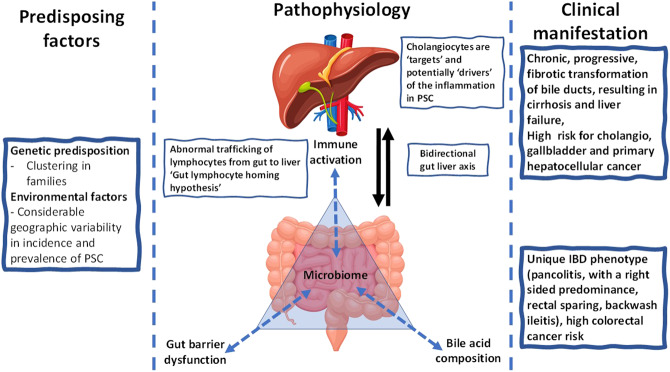
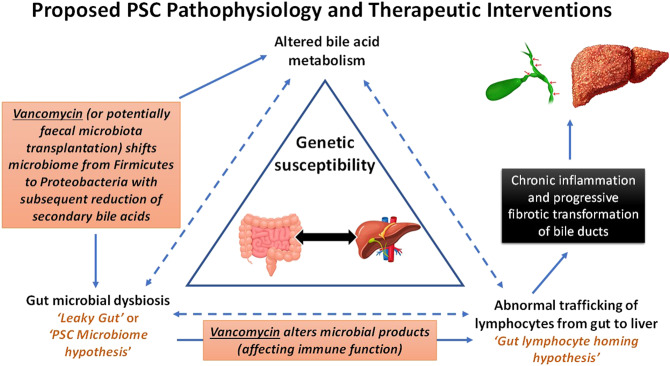
Primary sclerosing cholangitis (PSC) is a rare, immune-mediated, chronic cholestatic liver disease associated with a unique phenotype of inflammatory bowel disease that frequently manifests as pancolitis with right-sided predominance. Available data suggest a bidirectional interplay of the gut-liver axis with critical roles for the gastrointestinal microbiome and circulating bile acids (BAs) in the pathophysiology of PSC. BAs shape the gut microbiome, whereas gut microbes have the potential to alter BAs, and there are emerging data that alterations of BAs and the microbiome are not simply a consequence but the cause of PSC. Clustering of PSC in families may suggest that PSC occurs in genetically susceptible individuals. After exposure to an environmental trigger (e.g., microbial byproducts or BAs), an aberrant or exaggerated cholangiocyte-induced immune cascade occurs, ultimately leading to bile duct damage and progressive fibrosis. The pathophysiology can be conceptualized as a triad of (1) gut dysbiosis, (2) altered BA metabolism, and (3) immune-mediated biliary injury. Immune activation seems to be central to the disease process, but immunosuppression does not improve clinical outcomes or alter the natural history of PSC. Currently, orthoptic liver transplantation is the only established life-saving treatment, whereas antimicrobial therapy or fecal transplantation is an emerging therapeutic option for PSC. The beneficial effects of these microbiome-based therapies are likely mediated by a shift of the gut microbiome with favorable effects on BA metabolism. In the future, personalized approaches will allow to better target the interdependence between microbiome, immune function, and BA metabolism and potentially cure patients with PSC.
原发性硬化性胆管炎(PSC)是一种罕见的、免疫介导的慢性胆汁淤积性肝病,与炎症性肠病的独特表型相关,炎症性肠病常表现为右半结肠炎为主的全结肠炎。现有数据表明,肠道-肝脏轴具有双向相互作用,胃肠道微生物组和循环胆汁酸(BAs)在 PSC 的病理生理学中起着关键作用。BAs 影响肠道微生物组,而肠道微生物组具有改变 BAs 的潜力,并且有新的数据表明,BAs 和微生物组的改变不仅仅是 PSC 的后果,而是其病因。PSC 在家族中的聚集可能表明 PSC 发生在遗传易感个体中。在暴露于环境触发因素(例如,微生物副产物或 BAs)后,会发生异常或过度的胆管细胞诱导的免疫级联反应,最终导致胆管损伤和进行性纤维化。病理生理学可以被概念化为(1)肠道菌群失调,(2)改变的 BA 代谢和(3)免疫介导的胆管损伤的三联征。免疫激活似乎是疾病过程的核心,但免疫抑制并不能改善临床结果或改变 PSC 的自然病程。目前,原位肝移植是唯一公认的救命治疗方法,而抗菌治疗或粪便移植是 PSC 的新兴治疗选择。这些基于微生物组的治疗方法的有益效果可能是通过肠道微生物组的转变介导的,这种转变对 BA 代谢有有利的影响。在未来,个性化方法将允许更好地针对微生物组、免疫功能和 BA 代谢之间的相互依存关系,并有可能治愈 PSC 患者。