Kiel, Germany.
Hamburg, Germany.
Aliment Pharmacol Ther. 2019 Sep;50(5):580-589. doi: 10.1111/apt.15375. Epub 2019 Jun 28.
Single-centre studies reported alterations of faecal microbiota in patients with primary sclerosing cholangitis (PSC). As regional factors may affect microbial communities, it is unclear if a microbial signature of PSC exists across different geographical regions.
To identify a robust microbial signature of PSC independent of geography and environmental influences.
We included 388 individuals (median age, 47 years; range, 15-78) from Germany and Norway in the study, 137 patients with PSC (n = 75 with colitis), 118 with ulcerative colitis (UC) and 133 healthy controls. Faecal microbiomes were analysed by 16S rRNA gene sequencing (V1-V2). Differences in relative abundances of single taxa were subjected to a meta-analysis.
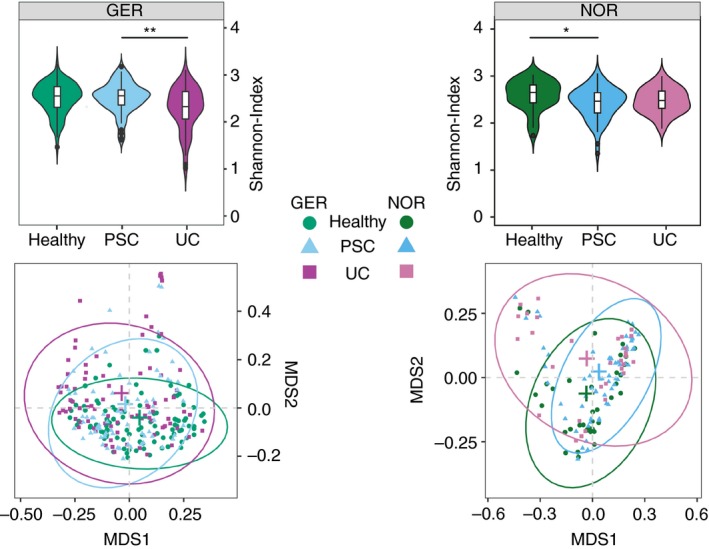
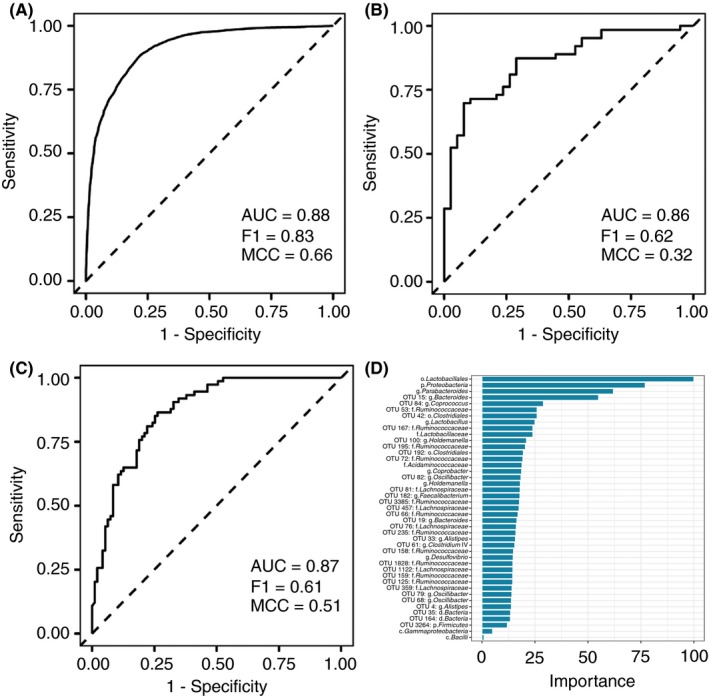
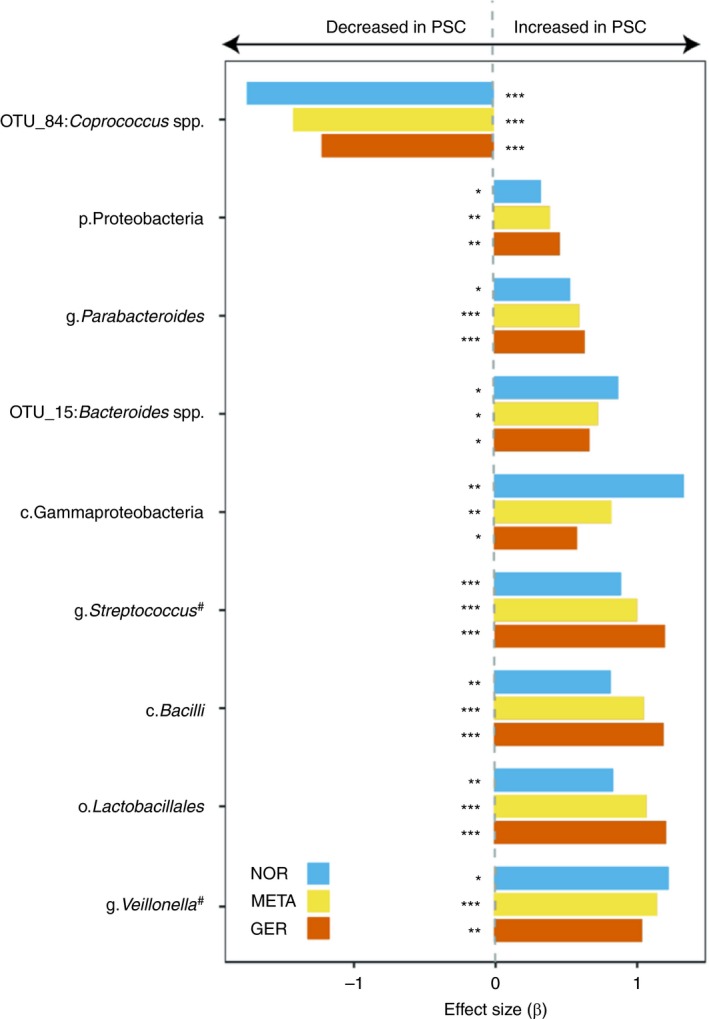
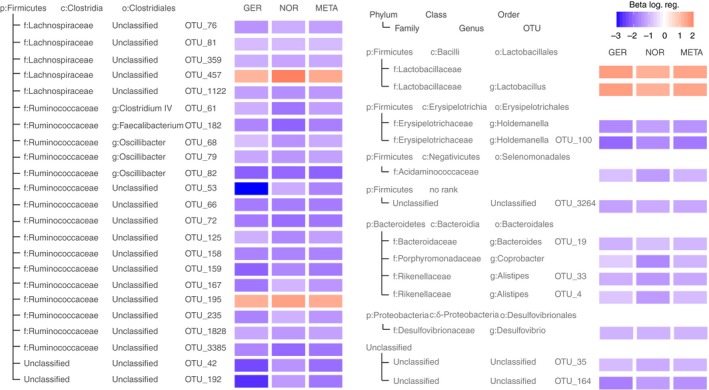
In both cohorts, microbiota composition (beta-diversity) differed between PSC patients and controls (P < 0.001). Random forests classification discriminated PSC patients from controls in both geographical cohorts with an average area under the curve of 0.88. Compared to healthy controls, many new cohort-spanning alterations were identified in PSC, such as an increase of Proteobacteria and the bile-tolerant genus Parabacteroides, which were detected independent from geographical region. Associated colitis only had minor effects on microbiota composition, suggesting that PSC itself drives the faecal microbiota changes observed.
Compared to healthy controls, numerous microbiota alterations are reproducible in PSC patients across geographical regions, clearly pointing towards a microbiota composition that is shaped by the disease itself and not by environmental factors. These reproducibly altered microbial populations might provide future insights into the pathophysiology of PSC.
单中心研究报道原发性硬化性胆管炎(PSC)患者粪便微生物群发生改变。由于区域因素可能会影响微生物群落,因此尚不清楚 PSC 是否存在跨越不同地理区域的微生物特征。
确定 PSC 的微生物特征,不受地理和环境影响。
我们纳入了来自德国和挪威的 388 名个体(中位年龄,47 岁;范围,15-78 岁),包括 137 名 PSC 患者(75 名结肠炎患者)、118 名溃疡性结肠炎患者和 133 名健康对照者。通过 16S rRNA 基因测序(V1-V2)分析粪便微生物组。对单一种类的相对丰度差异进行荟萃分析。
在两个队列中,PSC 患者与对照组的微生物群落组成(β多样性)存在差异(P < 0.001)。随机森林分类可在两个地理队列中区分 PSC 患者与对照组,平均曲线下面积为 0.88。与健康对照组相比,在 PSC 中鉴定出许多新的跨队列改变,例如厚壁菌门和耐胆菌属 Parabacteroides 的增加,这些改变独立于地理区域。相关结肠炎仅对微生物群落组成产生较小影响,表明观察到的粪便微生物变化是由 PSC 本身驱动的。
与健康对照组相比,在 PSC 患者中,跨越地理区域的微生物群改变数量众多,这清楚地表明了由疾病本身而不是环境因素塑造的微生物组成。这些可重复改变的微生物群可能为 PSC 的病理生理学提供新的见解。